TUTORIAL 1:
THE BRIDGE STRATEGY
For the first time in human history, death from aging is becoming optional. But there's a catch: you have to survive long enough—and stay functional enough—to reach the technologies that will make it possible.
This is the Bridge Strategy. And the clock is already running.
THE FUNDAMENTAL PROBLEM
Consider the math: You are aging at a fixed biological rate. Meanwhile, medical science is advancing at an exponential rate. The question is simple but brutal: Will science reach you before you reach terminal decline?
If you are 45 today and the breakthrough therapies arrive in 2035, you will be 55. Can your body make it to 55 in good enough condition to benefit? If you are 60, can you reach 70 without crossing into irreversible pathology?
The Death Gap
The Death Gap is the distance between where you are now and where you need to be when the technology arrives. It is measured in functional capacity, not calendar years.
A 50-year-old with excellent metabolic health, low inflammation, and preserved organ function can bridge a 20-year gap. A 40-year-old with metabolic syndrome, chronic stress, and poor sleep might fail to bridge 10 years.
WHY NOW? WHY THIS DECADE?
Three convergent forces make 2026-2035 the most critical decade in human history:
1. AI-Accelerated Drug Discovery
AlphaFold has solved protein folding. AI models are now designing molecules in days that would have taken decades. Clinical trial timelines are compressing. What took 15 years in 2010 might take 5 years in 2030.
2. Institutional Capital Entering Longevity
Longevity research is no longer fringe. Billions in venture capital are flowing into senolytics, epigenetic reprogramming, and cellular rejuvenation. Altos Labs ($3B), Calico (Google), and dozens of well-funded biotech firms are racing toward the same goal.
3. The First Wave is Already Here
Rapamycin analogs, senolytics, GLP-1 agonists, and NAD+ precursors are available now. They are imperfect, but they buy time. And time is the asset that matters most.
THE 2026-2035 WINDOW
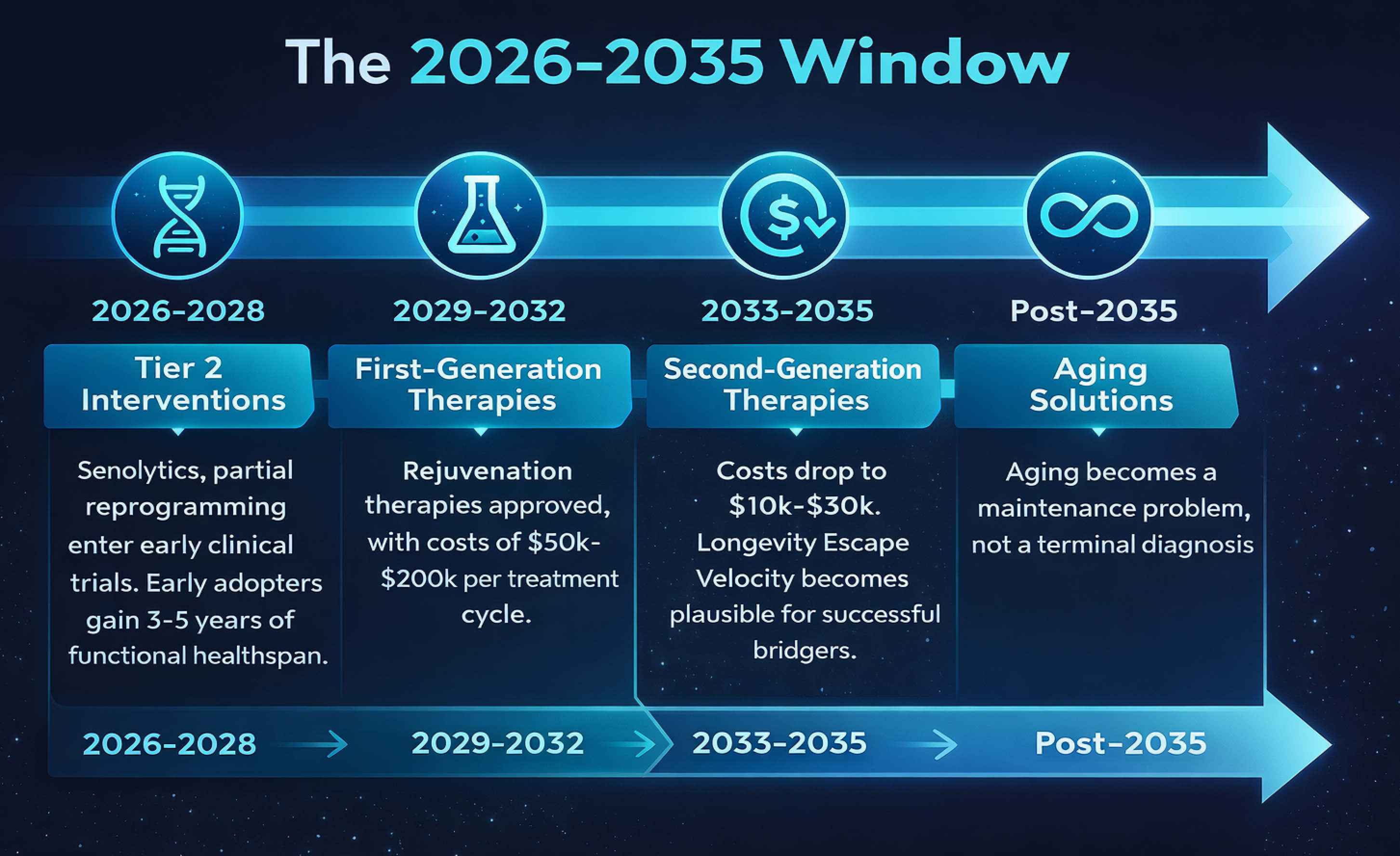
This timeline represents the most probable path to Longevity Escape Velocity. Each phase builds on the previous:
- 2026-2028: Tier 2 interventions like senolytics and partial reprogramming enter early clinical trials. Early adopters who access these therapies gain 3-5 years of functional healthspan extension.
- 2029-2032: First-generation rejuvenation therapies receive regulatory approval. Cost remains prohibitive ($50k-200k per treatment cycle), limiting access to those who planned financially.
- 2033-2035: Second-generation therapies reach scale. Costs drop dramatically to $10k-30k. Longevity Escape Velocity becomes plausible for those who successfully bridged the gap.
- Post-2035: The paradigm shifts. Aging transforms from a terminal diagnosis into a maintenance problem solvable through continuous intervention.
THE THREE-TIER BRIDGE FRAMEWORK
The Bridge Strategy focuses on extending your runway: adding enough high-quality years for you to reach the first wave of true rejuvenation therapies. It does this through staged interventions that progressively increase in sophistication and impact.
Instead of chasing miracle fixes or one-off hacks, the framework organizes your choices into a sequence you can actually execute. You start with what is already proven, then selectively layer more advanced options as evidence and access improve.
Tier 1: Foundation
Widely accessible | Low risk | High leverage
- Sleep optimization, metabolic health, and cardiovascular capacity building
- Core biomarkers that reveal where silent damage is accumulating
- Lifestyle habits that slow the progression toward diabetes, heart disease, and dementia
The report details specific targets, thresholds, and 30-day implementation steps for Tier 1 so you can move from vague "healthy living" to a measurable baseline.
Tier 2: Early Leverage
Available now | Evidence-building | Requires judgment
- Pharmaceutical and supplement strategies that appear to slow or repair aging damage
- Structured protocols combining multiple levers instead of isolated experiments
- Monitoring frameworks to avoid turning "promising" into "reckless"
Inside the 2026 report, Tier 2 is mapped out in depth: which mechanisms are compelling, which are overhyped, and how to think about dosage, timing, and risk.
Tier 3: Frontier Bets
Emerging therapies | High variability | Asymmetric upside
- Gene and cell-based approaches currently moving through clinical trials
- Rejuvenation strategies projected to arrive within the 2026–2035 window
- Capital and access requirements that most people underestimate
The report does not sell fantasies here. It sketches realistic timelines, adoption curves, and the conditions you must meet today to be biologically eligible when Tier 3 finally becomes routine.
The Role of the Report
This page gives you the outline. The 2026 Longevity Horizon Report fills in the working details: exact biomarkers, example protocols, and decision rules for moving between tiers at the right time in your own lifespan.
If you want a structured way to translate this framework into a personal operating plan for the next decade, the report is where the full playbook lives.
THE FINANCIAL DIMENSION
Longevity is both a biological problem and a financial planning variable. If you live to 100 in good health, you need capital that lasts 100 years.
Traditional retirement models (save until 65, spend until 85) will lead to insolvency. The Bridge Strategy must account for:
- Extended earning years: If you are healthy at 70, you can work. Plan for multiple career phases across your extended lifespan.
- Healthcare cost inversion: Preventive maintenance is cheaper than crisis management. Invest in prevention now to avoid catastrophic costs later.
- Longevity-specific investments: Allocate capital to biotech, longevity ETFs, or direct investments in breakthrough companies developing these therapies.
- Insolvency risk hedging: Model financial scenarios where you live 20+ years longer than traditional actuarial tables predict.
WHO SUCCEEDS AND WHO FAILS
The Bridge Strategy rewards those who:
- Act early (biological compounding works like financial compounding—small advantages multiply over time)
- Think probabilistically (maximize expected value across uncertain outcomes, not certainty)
- Have capital (Tier 2 interventions cost $3k-10k annually; Tier 3 can exceed $100k per treatment cycle)
- Stay informed (the longevity landscape changes monthly as new research emerges)
- Avoid fatal errors (one major health catastrophe can erase decades of preparation)
The harsh reality: Most people will fail to bridge successfully. They will optimize for the wrong variables (aesthetics over function), wait for certainty (which arrives too late), or simply run out of time before the technology matures.
But for those who execute the strategy with discipline and urgency, the payoff is open-ended life.
NEXT STEPS
Understanding the Bridge Strategy is step one. You need to know where you stand right now.
Assess Your Position
Take the Longevity Horizon Quiz to identify gaps in your baseline assumptions and understand your current trajectory. Then use the LifeMeter tools to quantify your risk profile.
Take The Quiz Check Your LEV PreparednessWant The Full Operational Manual?
The 2026 Longevity Horizon Report provides mechanistic breakdowns, specific biomarker targets, and 30-day implementation steps for Tier 1 and Tier 2 interventions.
Get The 2026 Report