Biological Age Clocks as Decision Tools: What Is Real, What Is Overstated, and How to Use Them Without Self-Deception
Biological age clocks are moving from papers to dashboards. The promise sounds simple: test, intervene, retest, and watch your age drop. The evidence says the useful reality is more disciplined.
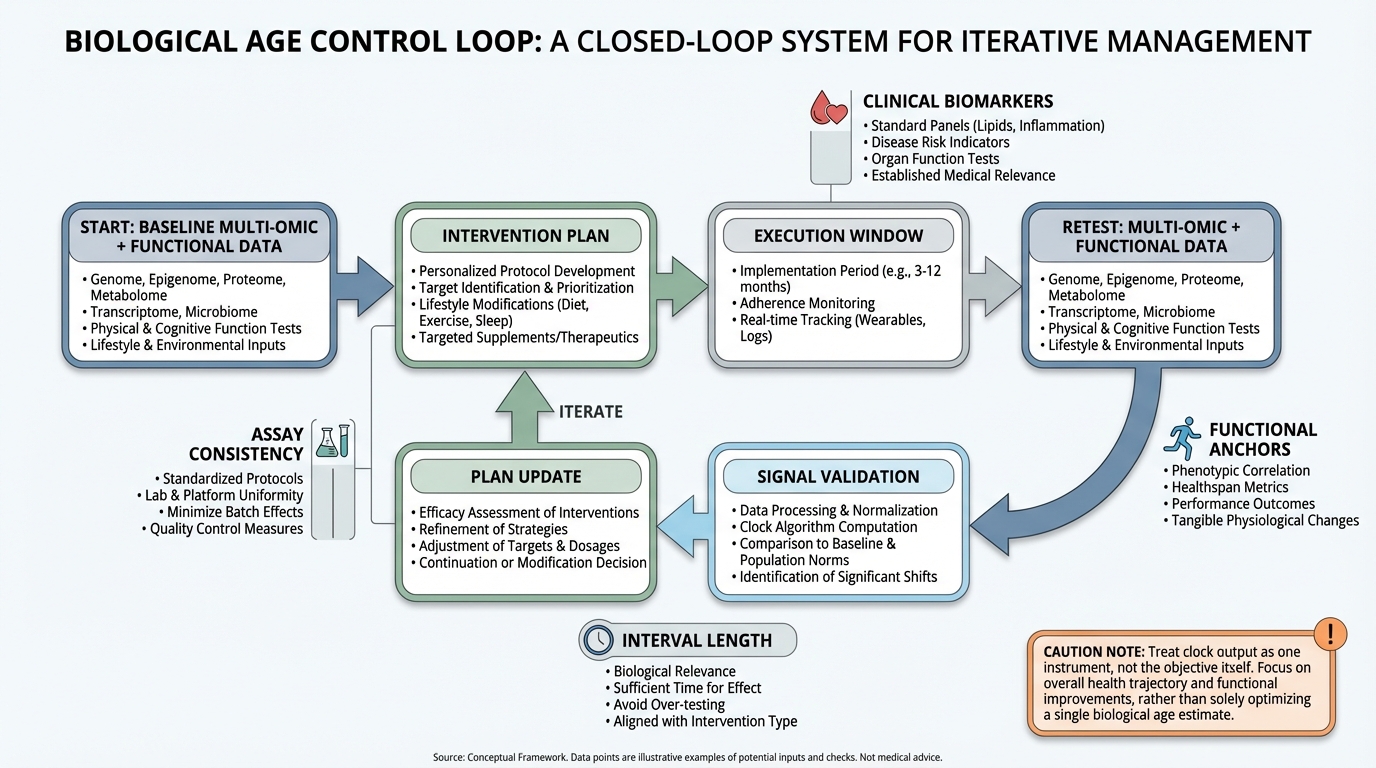
Some methylation measures behave like an aging-speed instrument at the population level. A few respond to interventions in randomized settings. But single-person interpretation still runs into technical noise, shifting pipelines, and weak links between short-term clock movement and durable clinical outcomes. If we treat clocks as instruments in a control system rather than final scores, they become much more useful and much less misleading.
What Is Real Right Now
1) Pace-of-aging measures can be modifiable in humans. In the CALERIE randomized trial, long-term calorie restriction slowed DunedinPACE. The same trial did not show equivalent significant changes across some more static biological-age clocks, which is exactly why clock selection matters.
2) Lifestyle associations are directionally consistent but confounded. Physical activity, diet quality, blood pressure, glycemic control, and smoking status repeatedly correlate with slower biological aging signals in cohort analyses. When analyses adjust for correlated behaviors and baseline differences, effect sizes can shrink.
3) Reliability is a first-class limitation. Technical noise in methylation assays and analysis pipelines is large enough to distort short-interval personal tracking. Reliability-focused computational methods exist because this is not a minor issue.
4) Functional anchors still matter more than a clock score. Strength, cardiorespiratory fitness, blood pressure control, glycemic markers, and lean-mass preservation remain more directly tied to outcomes than one composite age number.
What Is Overstated
Claim: “This gives my true biological age.” Clocks are risk-relevant indicators, not direct ground truth for one person.
Claim: “My score dropped in 8 weeks, so I reversed aging.” Short-term changes can reflect noise, immune shifts, assay differences, or acute physiology.
Claim: “Wearable VO₂max is clinical-grade.” Consumer estimates can be directionally useful, but error versus gold-standard testing can be substantial.
Why Hype Outruns Clarity
The “single-number” narrative is frictionless for social media and product design. Biology is not. Aging is multi-system decline, and measurement pipelines drift. If the sample protocol, platform, preprocessing, or algorithm version changes, your comparison may stop meaning what you think it means.
The other problem is attribution. People who train consistently often also sleep better, eat differently, and engage healthcare differently. Observational associations are valuable, but they are not automatic causal proof.
What Comes Next
1) Multi-signal dashboards will beat single-score dashboards. The practical future is clocks plus function plus clinical risk markers, not clocks alone.
2) Trials will prioritize clock movement plus function. Clock shifts that do not align with functional or risk improvements will face growing skepticism.
3) Standardization pressure will increase. If clocks are used for personal decisions, providers will need stable preprocessing, version control, and explicit error bounds.
A Practical Framework You Can Actually Use
Step 1: Define outcomes first. Pick outcomes you can directly improve and re-measure: strength protocol, aerobic capacity, blood pressure profile, glucose control, and lean-mass trend.
Step 2: Freeze your measurement pipeline. Keep the same test provider, sample conditions, and analysis version whenever possible.
Step 3: Use longer intervals. Retest over months, not weeks, and interpret repeated directionality, not one-off changes.
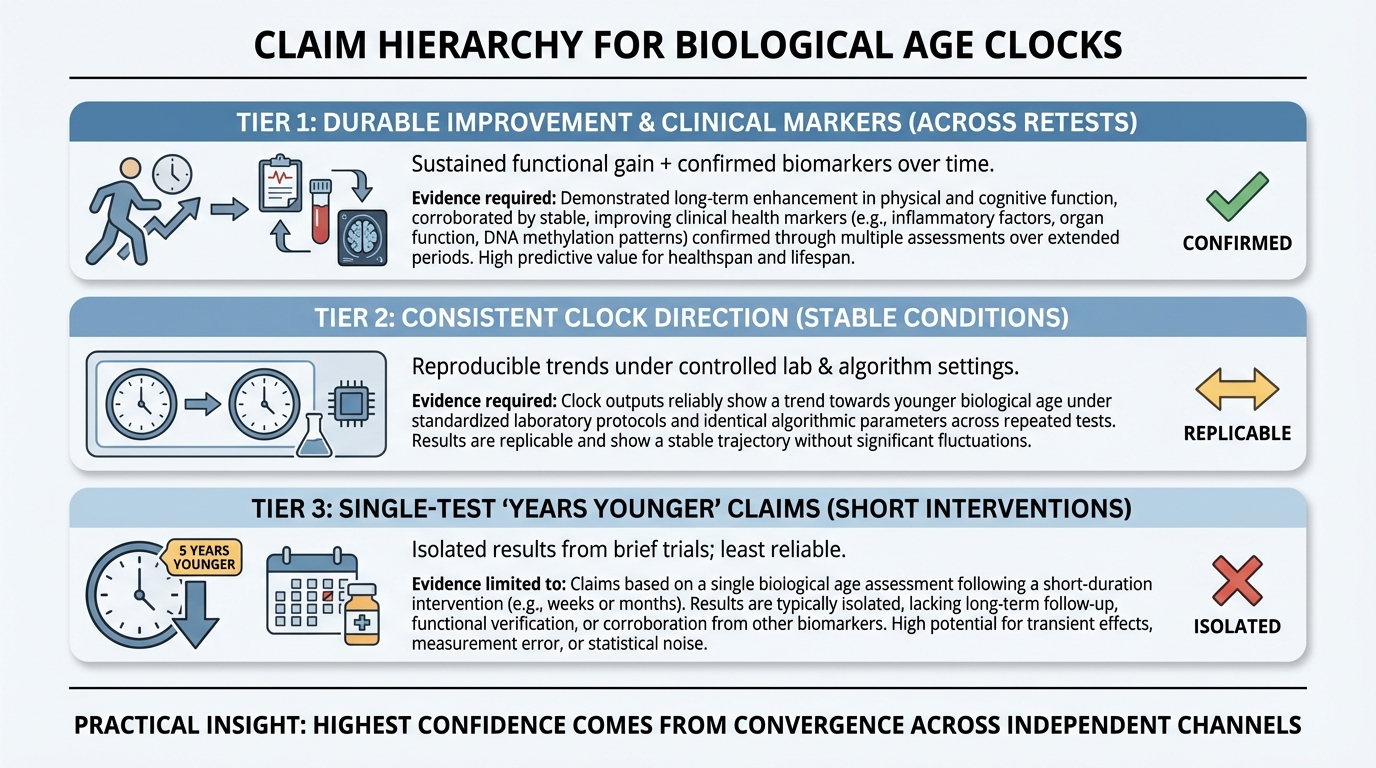
Step 4: Use claim hierarchy discipline. Highest confidence comes from persistent functional and clinical improvements; lowest confidence comes from isolated clock changes after short interventions.
Key Takeaways
Biological age clocks can be useful, especially pace-of-aging measures, but they are not personal truth machines.
The strongest near-term use case is trend detection inside a stable measurement contract.
Use clocks as adjuncts to functional outcomes and validated clinical risk markers, not replacements.
If your intervention improves function and risk markers and your clock trend matches across repeated tests, confidence rises. If only the clock moves once, confidence stays low.
Source List
Waziry, R., et al. (2023). Effect of long-term caloric restriction on DNA methylation measures of biological aging in healthy adults from the CALERIE trial (Nature Aging).
Higgins-Chen, A. T., et al. (2022). A computational solution for bolstering reliability of epigenetic clocks (Nature Aging).
Kankaanpää, A., et al. (2025). Long-term physical activity and later biological ageing with all-cause mortality in a prospective twin study (European Journal of Epidemiology).
Kou, M., et al. (2025). Epigenetic age acceleration and cardiometabolic biomarkers in response to weight-loss interventions: MACRO trial analysis (PubMed Central).
Apsley, A. T., et al. (2025). From population science to clinic: limits of epigenetic clocks as personal biomarkers (PubMed Central).
Lambe, R., et al. (2025). Validation of Apple Watch VO₂ max estimates against laboratory testing (PubMed Central).
Topol, E. (2026). The flawed VO₂ max craze (Ground Truths).