Did AI Reverse Aging? What Is Real, What Is Overstated, and What Comes Next
Claims that AI has already reversed aging spread fast because they compress a complicated scientific story into one dramatic sentence. The real story is more interesting than the headline.
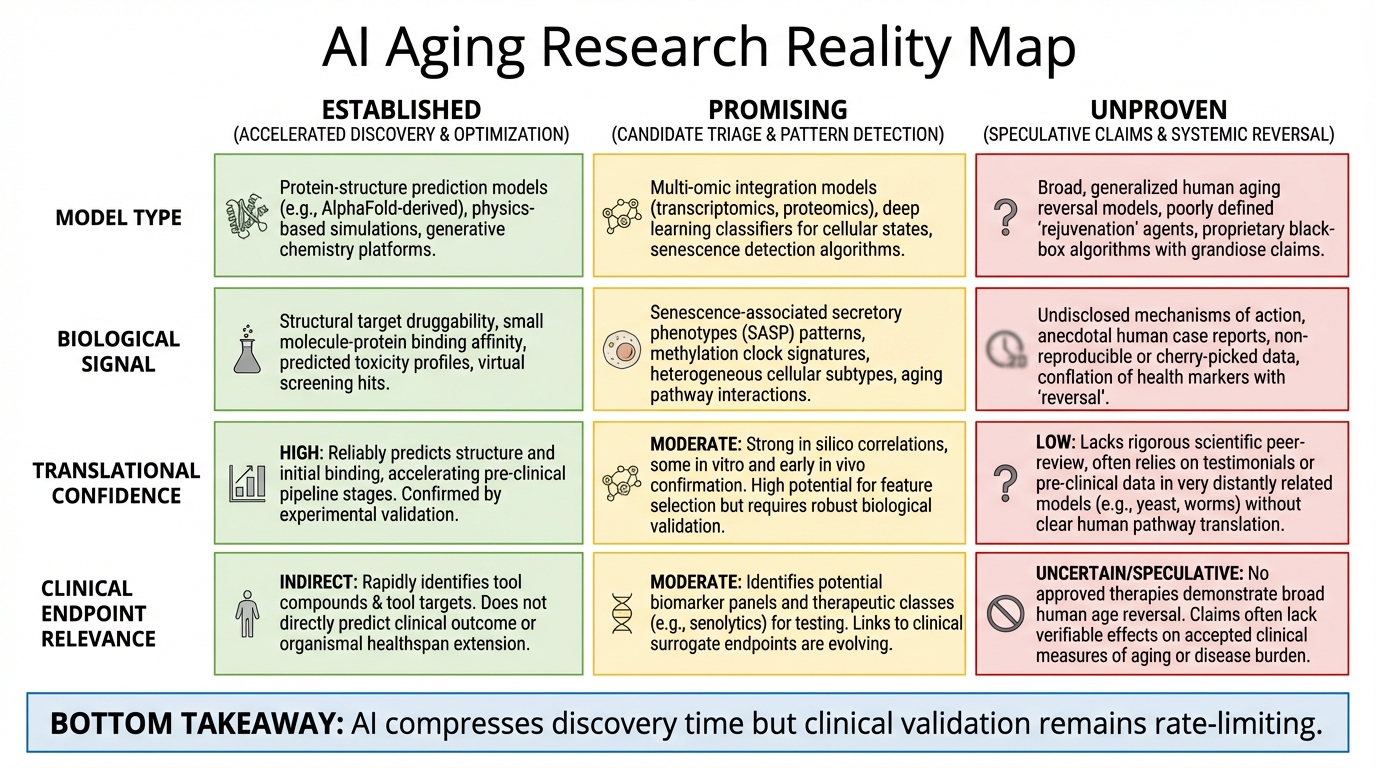
AI is now speeding up parts of rejuvenation research, especially protein design and experiment planning. At the same time, there is still no approved therapy that can safely reverse human aging across organs in clinical practice. Both parts are true. If we separate what has been shown in cells and animals from what has been proven in humans, the field becomes easier to understand and much more useful for readers trying to track real progress.
The current wave of optimism usually points back to cellular reprogramming. In 2012, Shinya Yamanaka and John Gurdon received the Nobel Prize for discoveries showing that mature cells can be reprogrammed toward a pluripotent state. That discovery changed biology. It did not by itself create a safe anti-aging treatment for people.
What Is Real Right Now
1) Partial reprogramming has shown meaningful effects in animal models. A widely cited study in Cell reported that cyclic expression of Yamanaka factors improved multiple aging features in mice and extended lifespan in a progeria model (Ocampo et al., 2016). Another influential study in Nature showed restoration of vision in mice after induced damage using epigenetic reprogramming approaches (Lu et al., 2020).
2) Epigenetic age appears more reversible than previously assumed. Work on methylation patterns and biological age clocks helped establish that aging markers are dynamic, not fixed. Horvath's epigenetic clock framework remains foundational for measuring these shifts.
3) AI is accelerating the discovery layer. AI systems are improving target selection, protein design, and model-to-experiment cycles. OpenAI's announced collaboration with Retro Biosciences explicitly frames model support around life-science acceleration, including workflows linked to reprogramming and age-related disease mechanisms.
What Is Overstated
Claim: "AI reversed aging in humans." Evidence does not support that statement today.
Claim: "Cells were reset to age 20, so organ aging is solved." Cellular age markers can move in a younger direction without proving durable whole-person rejuvenation.
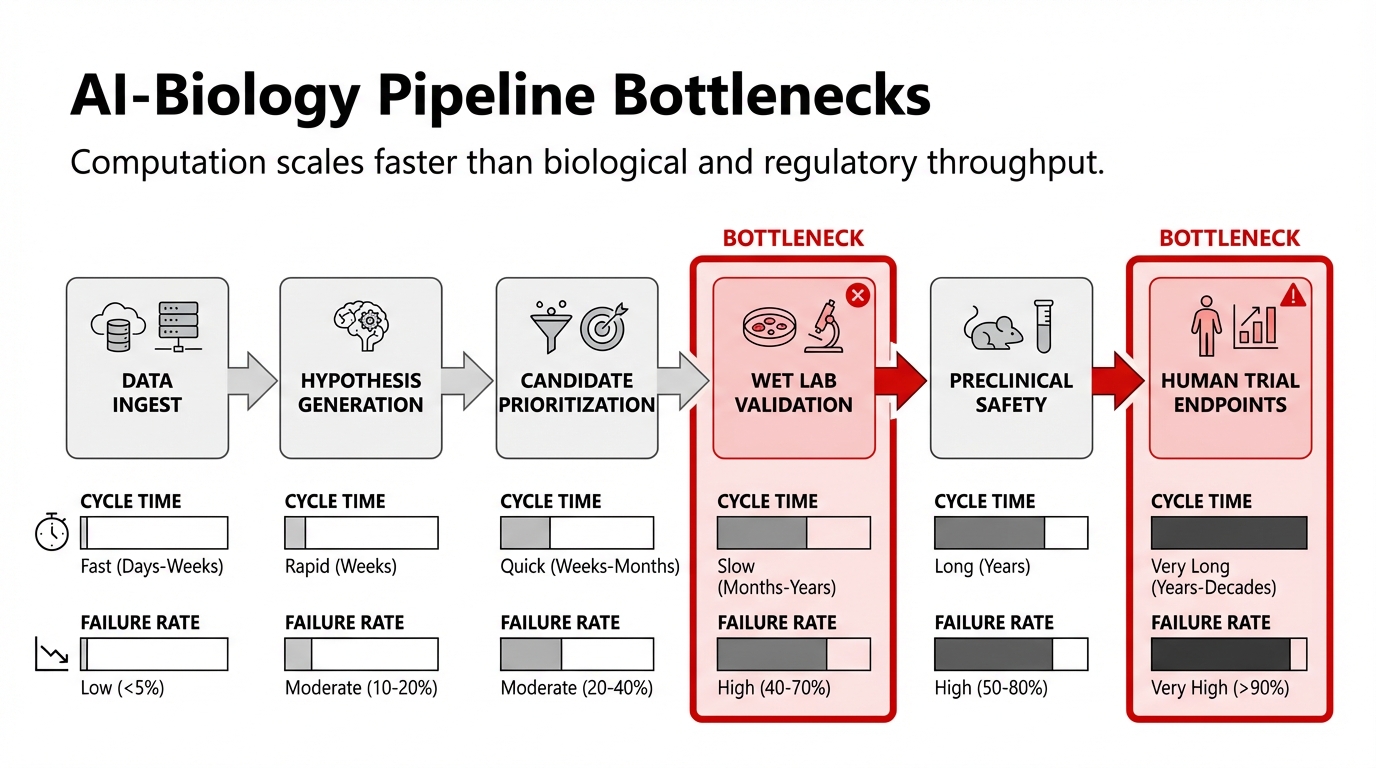
Claim: "Because AI improved the process, timelines collapse immediately." AI can compress discovery time, but clinical trials, safety, and regulation still govern patient outcomes.
Why Hype Appears Faster Than Clarity
The social media format rewards simple causal stories. Reprogramming biology is not simple. AI also adds a second layer of complexity because readers often assume model capability equals clinical readiness. A better mental model is a pipeline with bottlenecks: AI can widen upstream throughput, while downstream bottlenecks remain in delivery, tissue targeting, immunogenicity, oncogenic risk, trial design, and long-term monitoring.
What Comes Next
Near term, expect narrower wins first. The first credible breakthroughs are more likely in defined indications with measurable endpoints, not broad whole-body rejuvenation claims.
Expect AI to improve design quality before it delivers final cures. AI will likely show its biggest impact in target ranking, molecular design, candidate filtering, and protocol simulation.
Expect sharper measurement standards. A shift in one biomarker is not the same as durable functional restoration. The most credible programs combine molecular readouts with clinically meaningful outcomes and long-term safety data.
Speculation, clearly labeled: If model-assisted biology workflows continue improving and partial reprogramming safety control keeps advancing, a plausible 5 to 10 year scenario is a growing portfolio of targeted age-modifying therapies, validated in narrower domains first, then expanded as safety evidence accumulates.
A Practical Reader Framework
When you see the next "AI reversed aging" headline, run four checks: cells/animals/humans, biomarker vs functional endpoint, follow-up duration, and independent replication. If all four are weak, the claim is likely early-stage signal presented as final outcome.
Key Takeaways
AI has not solved human aging, but it is materially accelerating parts of aging research.
Partial reprogramming evidence in animals is strong enough to justify serious attention, but human translation remains the bottleneck.
The right question is where clinically meaningful, safe, durable effects are being demonstrated.
The next decade is likely to deliver narrower age-modifying therapies first, not one universal anti-aging intervention.
Source List
Nobel Prize. (2012). The Nobel Prize in Physiology or Medicine 2012 press release.
Ocampo, A., et al. (2016). In vivo amelioration of age-associated hallmarks by partial reprogramming (Cell).
Lu, Y., et al. (2020). Reprogramming to recover youthful epigenetic information and restore vision (Nature).
Horvath, S. (2013). DNA methylation age of human tissues and cell types (Genome Biology).
OpenAI. (2026). Accelerating life sciences research with Retro Biosciences.
Thread context: Craig Brockie post on X.