AI-Designed Longevity Drugs: Early Successes and Limits
AI has made longevity drug discovery less blind, but it has not made aging easy. The strongest progress is upstream: target ranking, structure-based design, generative chemistry, and faster iteration between model and bench. The weakest claims are the ones that treat that upstream acceleration as if it were already a validated anti-aging therapy pipeline.
The distinction matters because aging is not a single disease class with one accepted endpoint and one obvious trial architecture. A model can shorten the search for plausible targets or molecules. It cannot by itself establish that a pathway intervention will improve durable human function across tissues, that a surrogate will satisfy regulators, or that a signal in fibroblasts or mice will still hold after prolonged exposure in older humans. The technical bottleneck moved. It did not disappear.
Core thesis: AI is already useful in longevity drug discovery when the task is ranking, narrowing, designing, or iterating. The harder boundary is still biological and clinical: weak aging datasets, tissue-specific tradeoffs, long validation cycles, and the absence of a clean regulatory label for aging itself.
What Counts As Real Progress
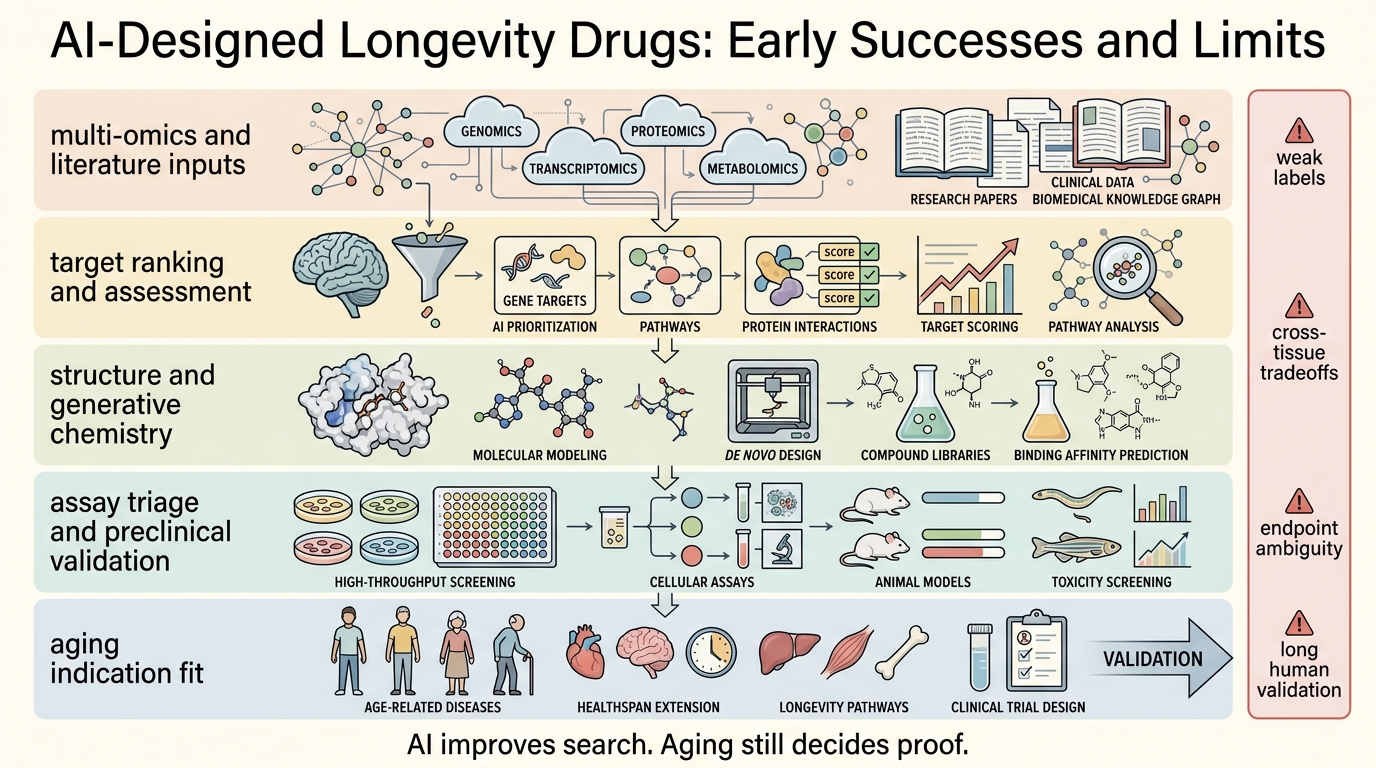
The cleanest success category is target identification and assessment. Ren and colleagues showed a full AI-assisted path from target discovery to lead generation around TNIK in fibrosis, combining multi-omics analysis, network reasoning, and generative chemistry before moving into experimental validation. That is not an aging cure. It is evidence that AI can compress the time between noisy biology and a real drug-development candidate.
The second success category is structure-guided reasoning. AlphaFold 3 did not solve pharmacology, but it improved the practical ability to model biomolecular interactions, which makes early hypothesis generation and medicinal chemistry less guess-driven. In a field such as aging, where pathway choice and off-target risk matter enormously, better structural priors are not cosmetic. They change which experiments deserve to happen next.
The third success category is workflow integration. The 2026 Nature Reviews Drug Discovery perspective on AI-era target identification made the point clearly: the useful systems are not isolated molecule generators. They connect omics, literature, disease context, structural constraints, developability filters, and experimental loops. That systems view fits longevity especially well because aging interventions usually fail when one impressive layer is detached from the rest of the stack.
Why Aging Still Breaks The Simple Story
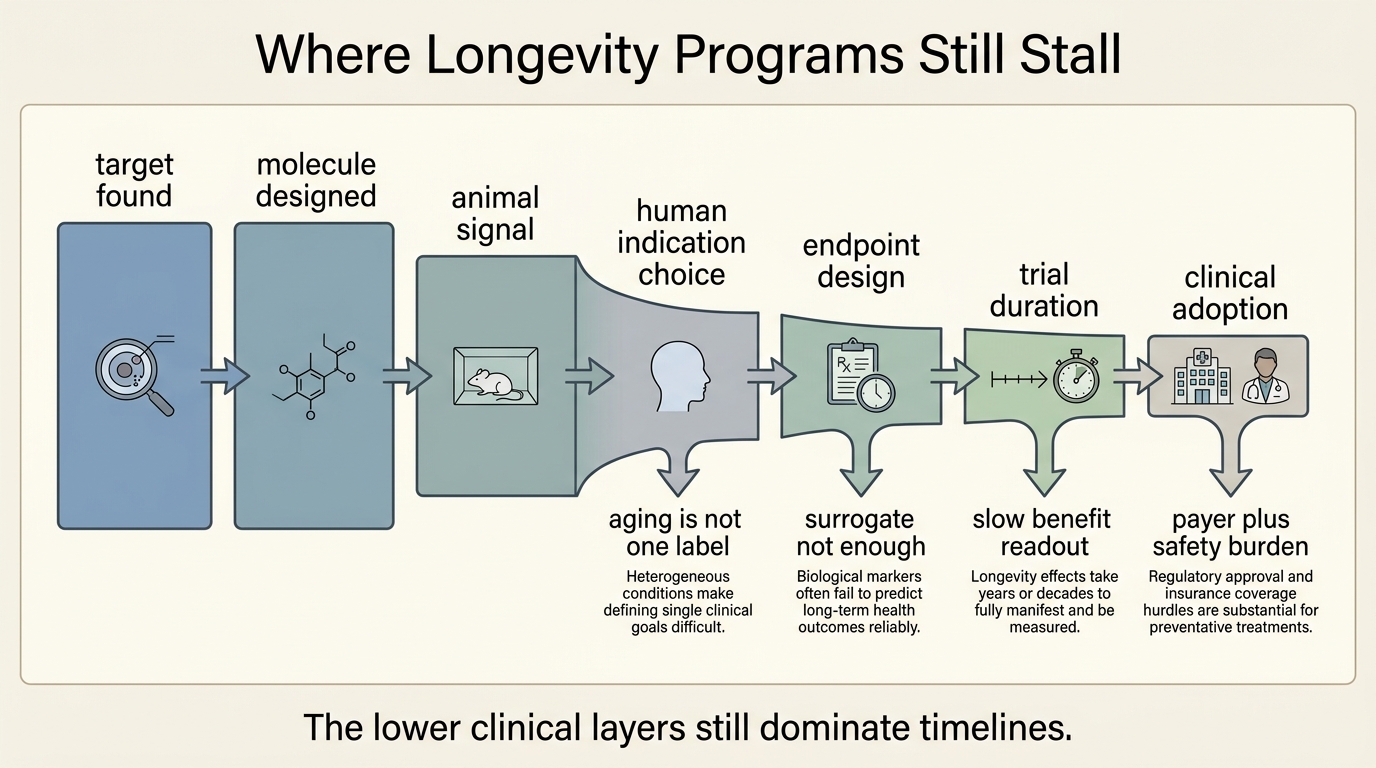
Aging programs face an endpoint problem first. A drug for fibrosis, inflammatory bowel disease, or oncology can target a recognized indication with established trial logic. A drug meant to slow aging across tissues has no equally clean route. Developers often have to enter through a narrower disease, a frailty-related syndrome, or a biomarker package. That is not only a regulatory inconvenience. It changes what counts as success and which programs can even justify human trials.
Aging programs also face a data problem. Reviews of AI in aging research consistently describe sparse validation, heterogeneous datasets, and heavy dependence on proxies. Many studies still stop at in silico ranking or early laboratory signal. That does not make the work useless. It does mean that elegant model outputs are often sitting on weak biological labels, thin longitudinal follow-up, or cross-species assumptions that do not transfer cleanly into geriatric medicine.
The third problem is systems spillover. A target that improves one hallmark can worsen another risk surface. Stronger regeneration pressure can raise oncogenic concern. Immune modulation can help chronic inflammation while weakening defense elsewhere. Senescence, mitochondrial function, extracellular matrix aging, and stem-cell maintenance all interact. AI can help search this network, but it cannot repeal the tradeoffs inside the network.
Where AI Actually Helps Today
- Target triage: integrating omics, pathway maps, and literature to rank which nodes justify wet-lab time.
- Structure and binding inference: shrinking the search space before synthesis and assay work begin.
- Generative chemistry: producing candidate series faster, with better starting priors on activity and developability.
- Assay prioritization: deciding which compounds, cell states, or perturbation regimes deserve scarce experimental bandwidth.
- Biomarker patterning: helping build signatures that may sharpen trial stratification even when they do not yet solve the endpoint question.
That list is substantial. Drug discovery is a funnel, and poor decisions near the top are expensive. If AI removes false starts, shortens iteration, and improves candidate quality before animal or human work, it changes economics materially. The more ambitious claim that AI has already unlocked longevity therapeutics at the patient-benefit layer remains unproven.
What The Hype Still Gets Wrong
The first mistake is timeline confusion. Faster discovery and faster approval are not the same thing. The second is endpoint inflation. A molecule can be promising because it improves screening efficiency, preclinical signal, or disease-biomarker logic without yet proving broad human healthspan benefit. The third mistake is indication leakage. A successful AI-enabled molecule in fibrosis or inflammatory disease does not automatically validate claims about anti-aging medicine as a category.
There is also a commercial reporting bias. Companies are naturally loudest where AI shines most visibly, which is often the discovery layer. The quieter truth is that aging still imposes long feedback cycles, uncertain translation, and measurement ambiguity. That means the field can have real AI progress and still lack near-term clinical clarity on whether a given program meaningfully changes aging trajectories in humans.
Known, Inferred, And Unknown
| Category | Assessment |
|---|---|
| Known | AI now contributes materially to target discovery, structural reasoning, generative chemistry, and early triage in drug development workflows relevant to aging. |
| Known | Primary examples of AI-assisted drug discovery have produced real experimental and clinical candidates outside pure anti-aging indications. |
| Known | Aging programs still face weak endpoints, heterogeneous datasets, and cross-tissue tradeoffs that slow clinical proof. |
| Inferred | The near-term value of AI for longevity is likely to be narrower, faster, and cheaper candidate generation rather than immediate collapse of the downstream clinical burden. |
| Unknown | Which AI-assisted aging programs, if any, will show durable human benefit strong enough to support mainstream medical adoption rather than niche experimental use. |
What This Means For Readers
The correct question is not whether AI matters. It plainly does. The correct question is where in the stack the claimed win occurred. Was it target ranking, molecule design, disease selection, biomarker stratification, animal validation, or human outcome? Each step deserves a different confidence level. When those layers are blurred together, marketing outruns substance.
The clean 2026 position is therefore restrained but not dismissive. AI is improving the longevity discovery toolkit. It is not yet evidence that the field has solved the hard part, which is proving durable human benefit under a credible indication and endpoint framework. Faster search is real progress. It is not the same thing as therapeutic closure.
Further Reading Inside The Site
This article connects directly to AI-Accelerated Drug Discovery in Aging, Regulatory Barriers to Anti-Aging Drugs, Senolytics Moving into Clinical Translation, and Digital Twins for Aging. Those pieces frame the adjacent issues of indication design, translational proof, and decision quality.
Source List
Ren F, Ding X, Fu Y, et al. A Small-Molecule TNIK Inhibitor Targets Fibrosis in Preclinical and Clinical Models. Nature Biotechnology. 2024.
Abramson J, Adler J, Dunger J, et al. Accurate Structure Prediction of Biomolecular Interactions with AlphaFold 3. Nature. 2024.
Pun FW, Podolskiy D, Izumchenko E, et al. Target Identification and Assessment in the Era of AI. Nature Reviews Drug Discovery. 2026.
Mahbub TB, Safaeian P, Sohrabi S, et al. A Comprehensive Review of Artificial Intelligence as a Catalyst in Aging Research: Insights, Gaps and Future Perspectives. Frontiers in Aging. 2026.
Thuault S. Drug Discovery by AI Trained on Aging Biology. Nature Aging. 2024.