Ketones and Longevity: Fuel, Signal, or Both?
Ketones keep attracting longevity attention because they solve two different biological problems at once. They provide an alternate fuel when glucose availability falls, and they appear to alter signaling programs tied to inflammation, oxidative stress, and cellular maintenance. That combination is real. The mistake starts when a real dual role is converted into a broad claim that ketosis or ketone products already meaningfully slow human aging.
The disciplined reading is narrower. Ketone bodies, especially beta-hydroxybutyrate, are both fuel and signal. Endogenous ketogenesis appears physiologically important in mammalian survival under some conditions. Exogenous ketone strategies can change circulating beta-hydroxybutyrate, and some mechanistic pathways respond in ways that make geroscience researchers pay attention. None of that yet amounts to broad human proof that ketogenic diets, ketone esters, or supplement-driven ketosis extend lifespan or reliably improve late-life function across normal aging populations.
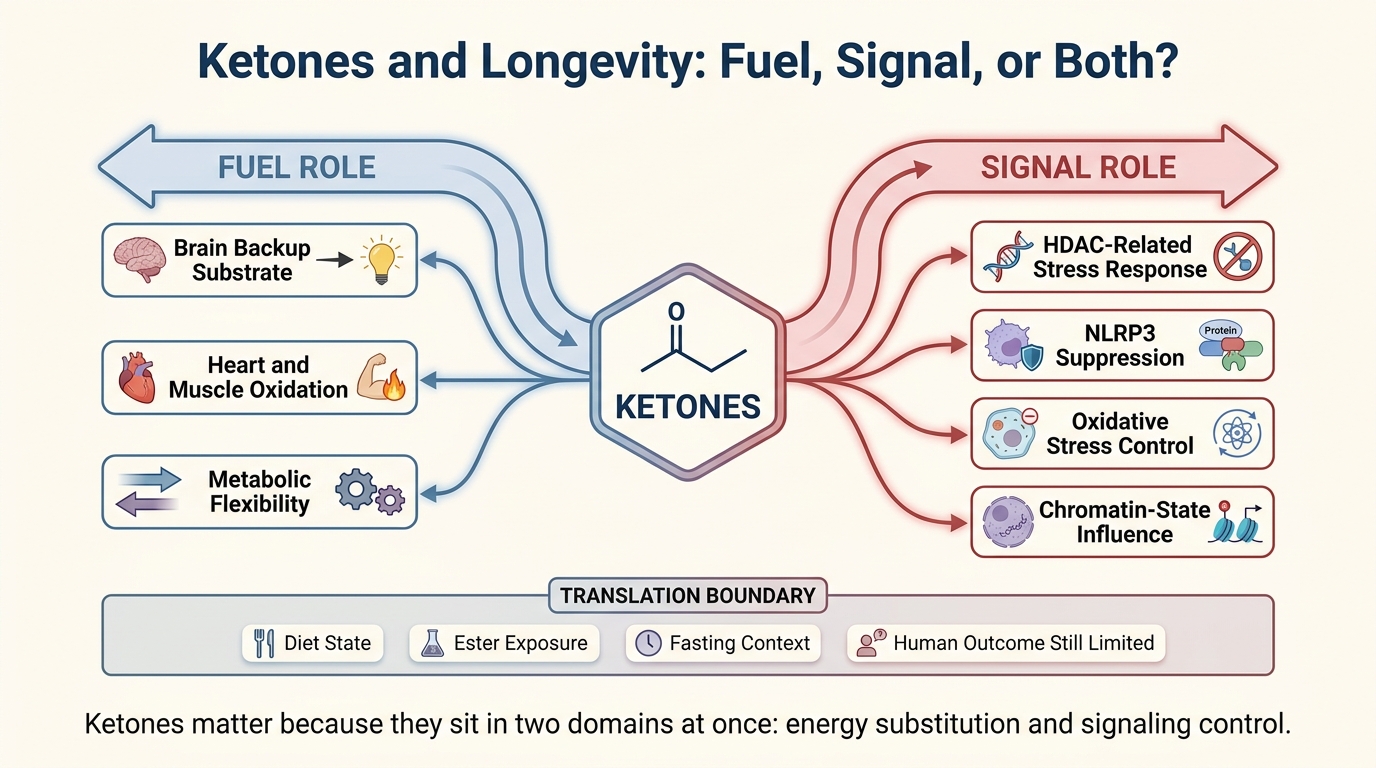
Core thesis: ketones should be taken seriously because they are both energetic substrate and signaling metabolite. That dual role helps explain why fasting and ketosis can influence aging-relevant pathways. It does not justify treating ketones as a validated longevity intervention in humans. The strongest evidence is mechanistic and preclinical. Human evidence is still narrow, contextual, and much better at establishing feasibility or safety than durable anti-aging benefit.
Why Ketones Matter In Aging Biology
Ketone bodies are not niche emergency molecules. During fasting, carbohydrate restriction, or prolonged exercise, the liver converts fatty acids into acetoacetate and beta-hydroxybutyrate, which then become usable fuel for tissues including brain, heart, and skeletal muscle. Cahill's classic starvation review remains important because it showed the systemic point clearly: ketones are part of a conserved metabolic shift that preserves function when glucose dependence would otherwise be costly.
That matters for aging because older organisms often face impaired metabolic flexibility, mitochondrial stress, and weaker stress-response coordination. A metabolite that can reduce pressure on glucose demand while also participating in redox and signaling biology naturally becomes interesting. The attraction is not only calorie replacement. It is systems leverage.
This is why serious ketone discussions should stay separated from diet tribalism. The question is not whether ketogenic diets are culturally attractive or aversive. The question is whether ketone physiology changes aging-relevant processes in ways that survive clinical scrutiny.
Fuel Is The First Role, Not The Whole Story
The fuel argument is the more established one. Ketones can support ATP production in tissues that can oxidize them efficiently, especially when carbohydrate availability is constrained or when glucose handling is impaired. In that sense ketones are a metabolic bridge. They provide usable carbon and reduce reliance on one substrate regime.
For longevity readers, the practical implication is limited but important. Fuel flexibility can be protective without being rejuvenating. A system that tolerates fasting, illness, or transient energy mismatch better is not automatically aging more slowly in a deep causal sense. It may simply be coping better under stress. That distinction is often lost in public discussions of ketosis.
The fuel role also does not map cleanly from fasting ketosis to supplement ketosis to chronic ketogenic dieting. Those are different physiological states with different hormone profiles, protein exposure, micronutrient patterns, and behavioral consequences. Treating them as interchangeable because blood beta-hydroxybutyrate rises in all three cases is analytically weak.
Signal Is The More Interesting Longevity Angle
The signaling case is what turns ketones from metabolic backup into geroscience topic. Shimazu and colleagues showed in 2013 that beta-hydroxybutyrate can inhibit class I histone deacetylases under specific conditions and increase oxidative-stress resistance programs. Youm and colleagues later showed that beta-hydroxybutyrate can suppress NLRP3 inflammasome activation in relevant experimental settings. Those papers did not prove longer human life. They did establish why beta-hydroxybutyrate cannot be reduced to a passive calorie shuttle.
That signaling logic is what keeps ketones on the aging map. Inflammation, stress resistance, chromatin regulation, and proteostasis all matter to aging biology. A metabolite that touches several of those domains becomes a candidate systems modulator. It is therefore reasonable to infer that ketone signaling could matter more than simple energy substitution in some aging contexts.
Inference still has to stay bounded. A molecule can influence aging-relevant pathways without producing large organism-level benefit once dose, tissue access, adaptation, and side effects enter the picture. Aging research is full of pathways that looked decisive mechanistically and turned out much harder translationally.
What The Mammalian Longevity Evidence Actually Shows
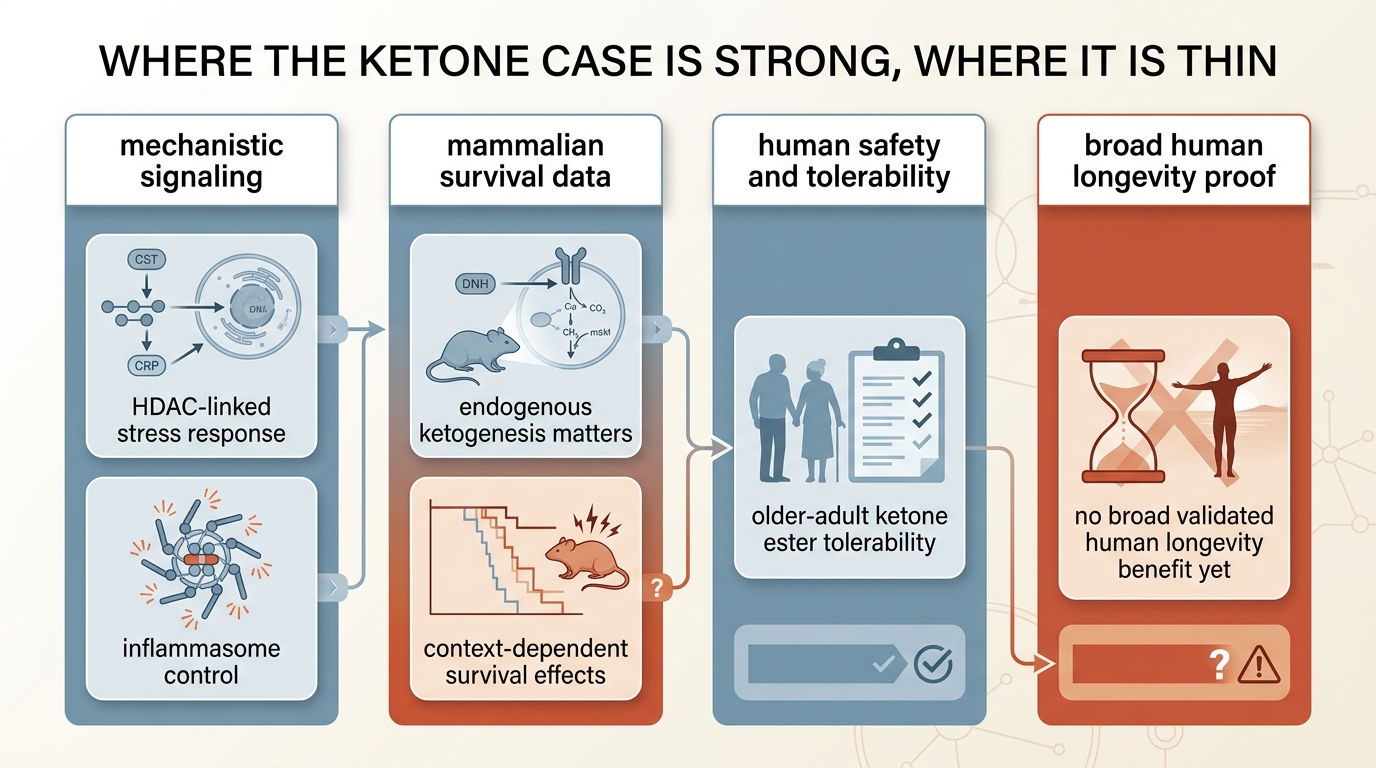
Tomita and colleagues' 2023 Aging Cell paper is one of the most useful recent anchors because it resists simplistic ketone marketing. Their data suggest that loss of endogenous ketogenesis can shorten lifespan in mice, and that ketone-related intervention can sometimes improve survival. The same paper also reported that an ad libitum low-carbohydrate ketogenic diet markedly increased mortality in their normal mice, while ketone-body supplementation showed age- and context-dependent effects. That is not a minor detail. It means ketone biology may be protective in one frame and harmful in another.
The correct conclusion from that study is not that ketones fail. It is that ketone exposure is a context-sensitive system variable. Method of administration, baseline health state, age, and whole-diet structure matter. The field therefore supports neither dismissal nor blanket enthusiasm. It supports conditionality.
That conditionality is exactly why the phrase fuel or signal is too narrow. The stronger answer is both, but only within a broader control system that includes diet composition, timing, protein intake, lipid handling, vascular risk, and disease state. Ketones do not operate in isolation from the rest of metabolism.
Where Human Evidence Stands In 2026
Human evidence is still early and should be described that way. The strongest recent older-adult data do not show broad anti-aging efficacy. Stubbs and colleagues reported in 2024 that a ketone ester was safe and well tolerated over 12 weeks in healthy older adults. That matters because tolerability is a real translational gate. It does not answer the main longevity question.
The next step from the same program is equally clarifying. Exploratory functional and quality-of-life outcomes in healthy older adults did not show statistically significant improvement in that pilot context. This is exactly the kind of result readers need to see plainly. Ketone esters can change metabolic exposure and still fail to deliver obvious functional gain in a small older cohort. That does not kill the hypothesis. It narrows it.
The remaining human promise is therefore domain-specific rather than universal. Ketones may still matter in neuroenergetic stress, frailty, cardiometabolic stress, or specific disease-adjacent states. What is not established is a broad, everyday claim that inducing ketosis in otherwise stable adults produces durable human longevity benefit.
Why Ketogenic Diets And Ketone Esters Should Not Be Collapsed
A common analytical failure is to move from beta-hydroxybutyrate biology to sweeping conclusions about ketogenic diets. That shortcut ignores major differences. A ketogenic diet changes macronutrient pattern, fiber exposure, food selection pressure, satiety, lipid profile dynamics, and often total energy balance. A ketone ester changes circulating ketone exposure more directly without reproducing the full dietary state. Fasting creates still another hormonal and circadian environment.
These are not semantic differences. They are intervention differences. A ketogenic diet can improve one person's glycemic control and worsen another person's lipid risk profile. A ketone ester can raise circulating ketones without fixing the underlying diet or improving body composition. Fasting can produce signaling effects that no bottled ketone fully replicates. Once the interventions are separated properly, many exaggerated public claims become much easier to reject.
Known, Inferred, And Unknown
| Category | Assessment |
|---|---|
| Known | Ketone bodies serve as alternative fuel substrates and can support energy metabolism during fasting, carbohydrate restriction, or other low-glucose states. |
| Known | Beta-hydroxybutyrate also has signaling effects relevant to oxidative stress and inflammatory control, which is why it remains a serious geroscience target. |
| Known | Recent mammalian work shows ketone biology can affect survival in context-dependent ways, including outcomes that differ by intervention type and age. |
| Known | Recent older-adult human studies establish short-term ketone-ester safety and tolerability more clearly than they establish meaningful functional or longevity benefit. |
| Inferred | Some benefits attributed to fasting or carbohydrate restriction may depend partly on ketone signaling, but ketones are unlikely to explain the whole intervention package. |
| Unknown | Which humans, which tissues, which ketone-delivery methods, and which dose-duration patterns can produce durable aging-relevant benefit without offsetting metabolic costs. |
The Practical Reading For LifeMeter
The right 2026 posture is disciplined interest. Ketones are not a fad topic that can be dismissed as pure hype. They sit at a meaningful junction between metabolism and signaling. At the same time, the evidence does not justify flattening that junction into one consumer message. A real pathway is not the same thing as a validated longevity protocol.
For readers building a real anti-aging stack, ketones belong in the category of serious but not settled. They may matter more as tools for targeted metabolic control, disease-adjacent energy rescue, or mechanistic combination strategies than as standalone proof of slower human aging. The field becomes more useful the moment that distinction is kept intact.
Further Reading Inside The Site
This article connects directly to Caloric Restriction Mimetics: What Actually Works in Humans, Intermittent Fasting After the Hype Cycle, and NAD+ Restoration: Mechanism, Hype, and Clinical Signal. Together they show why metabolic interventions should be judged by mechanism, translation quality, and clinical scope rather than by narrative simplicity.
Source List
Cahill GF Jr. Fuel Metabolism in Starvation. Annual Review of Nutrition. 2006.
Shimazu T, Hirschey MD, Newman J, et al. Suppression of Oxidative Stress by β-Hydroxybutyrate, an Endogenous Histone Deacetylase Inhibitor. Science. 2013.
Youm YH, Nguyen KY, Grant RW, et al. The Ketone Metabolite β-Hydroxybutyrate Blocks NLRP3 Inflammasome-Mediated Inflammatory Disease. Nature Medicine. 2015.
Tomita I, Tsuruta H, Yasuda-Yamahara M, et al. Ketone Bodies: A Double-Edged Sword for Mammalian Life Span. Aging Cell. 2023.
Stubbs BJ, Stephens EB, Senadheera C, et al. Daily Consumption of Ketone Ester, Bis-Octanoyl (R)-1,3-Butanediol, Is Safe and Tolerable in Healthy Older Adults in a Randomized, Parallel Arm, Double-Blind, Placebo-Controlled, Pilot Study. Journal of Nutrition, Health and Aging. 2024.
Stubbs BJ, Stephens EB, Mansfield T, et al. Exploratory Functional and Quality of Life Outcomes With Daily Consumption of the Ketone Ester Bis-Octanoyl (R)-1,3-Butanediol in Healthy Older Adults. The Journal of Frailty & Aging. 2025.