Longevity Escape Velocity: Realistic or Misleading?
Longevity escape velocity is one of the most powerful ideas in the field because it converts a vague hope into an explicit engineering claim. It says that if medicine can periodically repair enough age-related damage fast enough, remaining life expectancy could rise faster than chronological time passes. The concept is coherent. The timeline language built around it usually is not.
The attraction is obvious. Standard prevention buys time. Escape velocity promises compounding time. A person does not need a final cure for every pathology at once. They need a sequence of interventions that keeps moving the damage burden back faster than new damage accumulates. That is a logically cleaner framing than simple life-extension marketing, and it explains why the concept still matters.
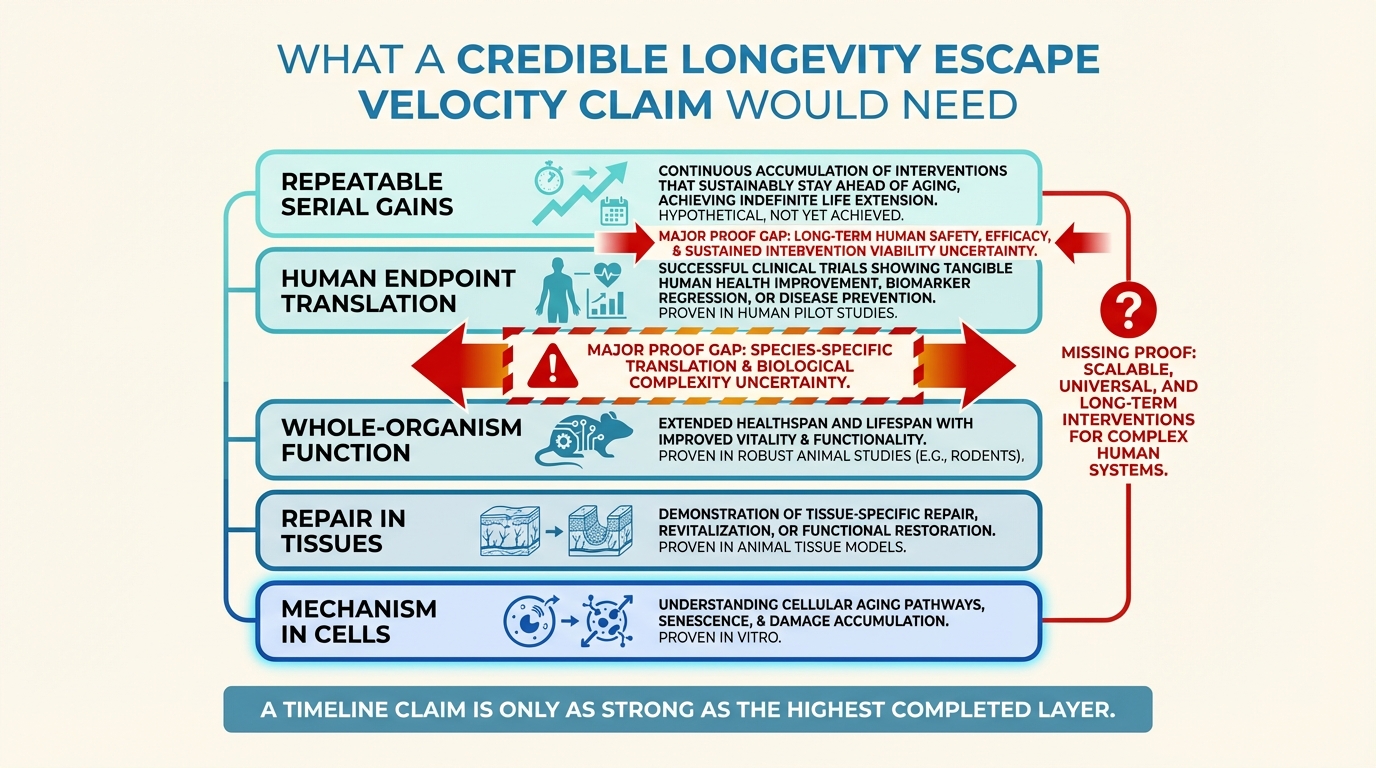
Core thesis: longevity escape velocity is realistic as a strategic model of serial repair, but misleading as a near-dated human forecast. Current geroscience has not shown organism-wide damage repair, durable whole-body rejuvenation, or a validated clinical stack that can repeatedly add large blocks of healthy life faster than aging creates new liabilities.
What The Concept Actually Says
The classic formulation, popularized by Aubrey de Grey, is simple: if medicine adds more than one year of expected remaining healthy life for each year that passes, the patient crosses a moving threshold where future innovation can keep arriving before aging catches up. In that sense LEV is not immortality language. It is a rate language. It depends on the speed and repeatability of repair.
That framing has one real virtue. It treats aging as an accumulation problem rather than a single-disease problem. If damage is heterogeneous and layered, then the relevant question is not whether one drug extends lifespan in mice. The relevant question is whether repair capacity can keep being renewed across tissues, over time, without causing a second catastrophe through cancer, fibrosis, immune injury, or functional disorganization.
Why The Idea Is Intellectually Serious
The concept remains serious because aging does not have to be solved in one move to matter clinically. Serial progress is already how most medicine works. Hypertension control, lipid lowering, infection management, cancer treatment, and organ support all improved through cumulative technical gains rather than a single decisive leap. LEV simply applies that cumulative logic to age-related damage itself.
The concept also correctly emphasizes bridges. A therapy that buys five good years is more valuable in a world of accelerating biomedical progress than in a static world. That is why LEV remains strategically relevant for readers planning around prevention, cardiometabolic risk, and access to future therapies. Time itself can be an asset if the pipeline is real.
Where The Concept Usually Becomes Misleading
The problem starts when a structural idea is turned into a dated forecast. There is no validated human pathway today showing that whole-body age damage can be reset, then reset again, at a pace that outruns ongoing degeneration. The field has signals. It does not have that sequence.
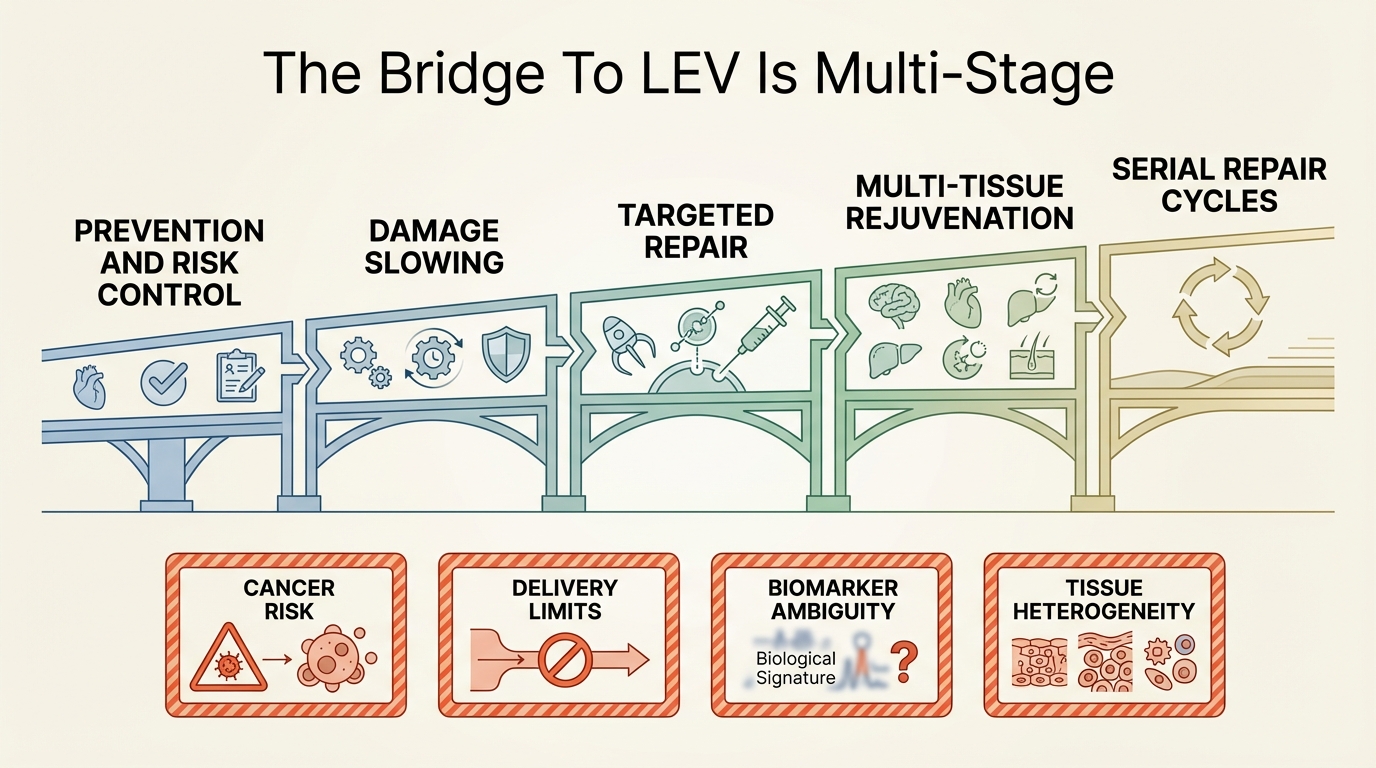
Preclinical reprogramming work makes this easy to misread. Studies such as Ocampo's cyclic OSKM model and later tissue-specific work show that some age-associated features can be improved under tightly controlled conditions. That is established. It does not establish a human platform for periodic, body-wide rejuvenation. Delivery, tissue targeting, cancer risk, and endpoint durability remain rate-limiting.
The same compression error appears in drug discovery rhetoric. A stronger AI pipeline, a sharper biomarker platform, or a better senescence intervention does not by itself imply escape velocity. Each of those may contribute pieces. LEV requires the pieces to compose into repeatable organism-level gains that exceed the pace of new decline. That composition is precisely the part the field has not yet demonstrated.
Whole-Body Repair Is A Much Harder Standard Than Lifespan Extension
The gap between modest delay and true escape velocity is larger than public conversation usually admits. Slowing one pathway, or even several, is not the same thing as maintaining repair dominance over the whole aging process. The body is not one clock. It is a federation of tissues with different renewal rates, damage classes, cancer susceptibilities, and tolerance for intervention.
A serious LEV program therefore needs more than improved biomarkers. It needs repair across stem-cell compartments, extracellular matrix integrity, mitochondrial quality control, immune function, oncologic surveillance, and tissue-specific regeneration. It also needs those gains to hold under repeated use. A therapy that resets one marker but destabilizes lineage identity or raises malignancy risk does not move the patient toward escape velocity. It changes the failure mode.
The Practical Distinction Is Between Bridge Logic And Countdown Logic
Bridge logic is defensible. It says that preserving cardiometabolic health, reducing frailty, and surviving long enough to benefit from better therapies is rational because biomedical capability is still improving. Countdown logic is weaker. It says that a specific decade, clinic stack, or expected breakthrough calendar already justifies confidence in escape velocity. That claim outruns the evidence.
LifeMeter readers should treat this distinction as operational, not philosophical. A bridge strategy supports aggressive prevention, broad healthspan maintenance, and close attention to high-signal translational platforms such as partial reprogramming, senescence intervention, and regenerative repair. Countdown logic tempts people into timeline certainty that the biology does not warrant.
Known, Inferred, And Unknown
| Category | Assessment |
|---|---|
| Known | Longevity escape velocity is a rate-based concept in which medical progress would need to add healthy life faster than chronological time removes it. |
| Known | Current rejuvenation signals are still dominated by preclinical and tissue-restricted evidence rather than validated, repeatable whole-body human repair. |
| Known | Partial reprogramming and related repair platforms remain tightly constrained by delivery, safety, lineage control, and endpoint durability. |
| Inferred | LEV is best used as a strategic planning frame for bridge-building, not as a near-term calendar prediction for people alive today. |
| Unknown | Whether future interventions can be stacked serially across tissues with enough safety and repeatability to produce sustained organism-level repair dominance in humans. |
What A Disciplined Reader Should Take From The Idea
The disciplined use of LEV is neither dismissal nor hype. It is to treat the concept as a decision filter. If an intervention does not plausibly preserve function, extend bridge time, or contribute to a future repair stack, it does not belong in the conversation. If it does, it still has to be judged at its actual evidence level rather than at the level of the dream it evokes.
That makes LEV realistic in one sense and misleading in another. It is realistic as a long-horizon description of what success would probably look like: serial, cumulative, repair-based gains rather than one magic bullet. It is misleading whenever that long-horizon structure is repackaged as though the threshold itself were already near, measured, or clinically scheduled.
Further Reading Inside The Site
This article connects directly to Partial Cellular Reprogramming: Reset Without Cancer Risk?, AI-Designed Longevity Drugs: Early Successes and Limits, and Longevity Clinics: Science, Protocols, and Variability. Together they separate serious bridge technologies from the stronger claim that escape velocity is already close at hand.
Source List
de Grey ADNJ. Escape Velocity: Why the Prospect of Extreme Human Life Extension Matters Now. PLOS Biology. 2004.
López-Otín C, Blasco MA, Partridge L, Serrano M, Kroemer G. Hallmarks of aging: An expanding universe. Cell. 2023.
Ocampo A, Reddy P, Martinez-Redondo P, et al. In Vivo Amelioration of Age-Associated Hallmarks by Partial Reprogramming. Cell. 2016.
Xu L, Ramirez-Matias J, Hauptschein M, et al. Restoration of neuronal progenitors by partial reprogramming in the aged neurogenic niche. Nature Aging. 2024.