NAD+ Restoration: Mechanism, Hype, and Clinical Signal
NAD+ became a longevity obsession for a legitimate reason. It sits inside energy handling, DNA repair, stress signaling, and inflammatory control. The mistake starts one step later. Mechanistic centrality is treated as if it already proved that oral NAD precursors broadly slow human aging. The field does not support that jump.
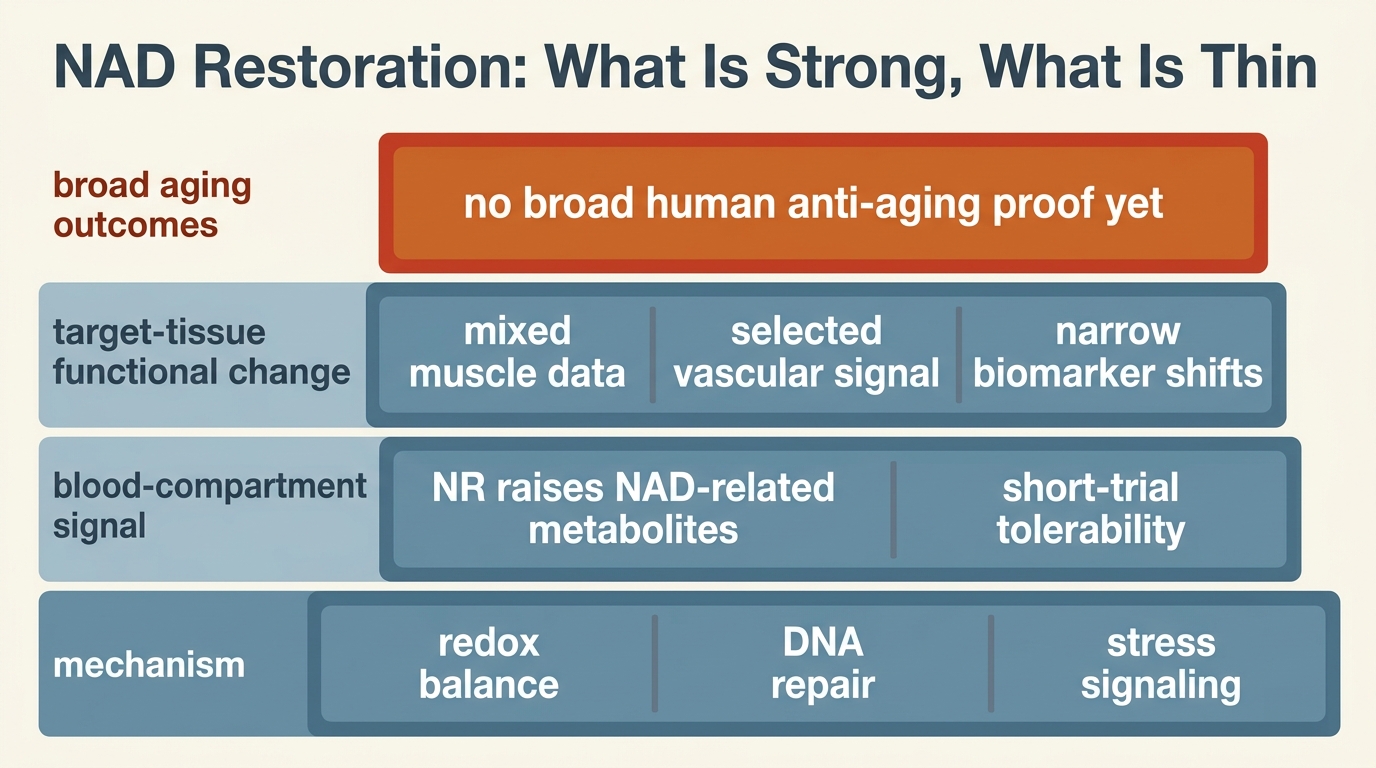
The analytical split is straightforward. First, NAD metabolism is deeply implicated in aging biology. Second, precursors such as nicotinamide riboside and nicotinamide mononucleotide can move NAD-related metabolites in blood and sometimes in narrower compartments. Third, broad human anti-aging benefit has not been established from that fact alone. The supplement market compresses those three claims into one story. The evidence does not.
Core thesis: NAD restoration has a strong mechanistic rationale and remains a plausible translational target, but the human claim is still narrow. Oral precursors can raise circulating NAD-related metabolites and may move selected physiological markers in some settings. They have not yet shown consistent, broad, clinic-ready evidence for slowing human aging across functional, metabolic, or disease endpoints.
Why NAD Biology Became Central To Aging Research
NAD is not a niche metabolite. It sits at the center of core cellular processes. It participates in oxidation-reduction reactions, supports mitochondrial metabolism, and serves as a consumed substrate for enzymes involved in DNA repair and stress adaptation. That makes it unusually attractive in aging research because aging phenotypes include mitochondrial decline, genomic instability, inflammatory signaling, and loss of stress resilience. A molecule linked to all of those processes invites a unifying theory.
That theory gained traction because animal and mechanistic work produced a coherent picture. Aging tissues often show altered NAD metabolism, rising activity of NAD-consuming enzymes such as CD38, and downstream effects that can plausibly impair energetic and repair pathways. Chini and colleagues' 2024 review is useful here because it does not rely on marketing language. It maps how senescence, inflammation, NAD consumption, and tissue dysfunction can form a reinforcing loop. That loop is biologically interesting regardless of whether any current supplement fully fixes it in humans.
The mechanistic story is therefore not the weak point. NAD biology is important enough that any serious longevity reader should understand it. The weak point is translational compression. A central pathway does not automatically become an intervention with large human effect size. Biology is full of critical nodes that resist simple supplementation logic once dosing, tissue access, baseline status, disease context, and compensatory feedback are taken seriously.
What Human NAD Boosting Actually Shows So Far
The most reproducible human finding is that certain precursors can increase NAD-related metabolites in blood. Martens and colleagues showed in 2018 that chronic nicotinamide riboside supplementation in healthy middle-aged and older adults was well tolerated and stimulated NAD metabolism. Dellinger and colleagues reported a similar blood-level signal for NRPT. Those studies matter because they answer a basic feasibility question: oral precursors are not pharmacologically inert.
But a blood or circulating metabolite signal is not the same as a durable clinical signal. That is where the field becomes less decisive. In obese, insulin-resistant men, Dollerup and colleagues reported that 12 weeks of nicotinamide riboside did not improve insulin sensitivity or whole-body glucose metabolism. The same research program also found no meaningful improvement in skeletal-muscle mitochondrial respiration, content, or morphology. Those are not trivial nulls. They test the exact place where public rhetoric is strongest: if cellular energy is improved, metabolism should improve in a visible human way.
The evidence is not uniformly negative. Some trials and substudies suggest selected benefits or promising biomarker shifts. Martens and collaborators reported signals around systolic blood pressure and arterial stiffness in older adults, while Vreones and colleagues showed that oral nicotinamide riboside raised NAD+ and altered selected neuronal extracellular-vesicle biomarkers linked to neurodegenerative pathology. Those results are worth following. They do not yet justify the stronger claim that a general NAD booster has become a validated anti-aging intervention.
Why Tissue Biology Matters More Than The Marketing Suggests
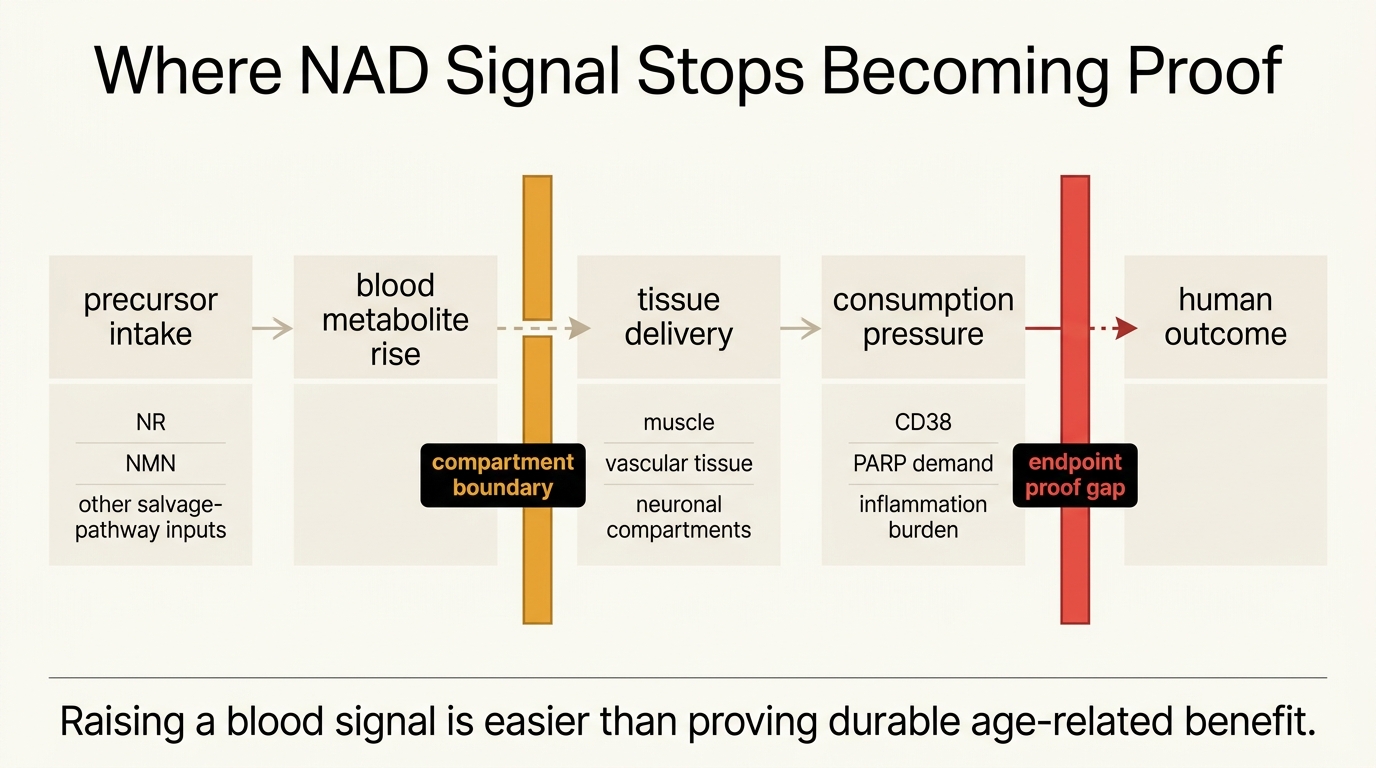
One reason translation remains difficult is that the relevant question is not simply whether an oral precursor enters the body. The relevant question is where meaningful NAD restoration occurs, in which compartment, for how long, and under what baseline conditions. Blood signals can coexist with weak or absent effects in skeletal muscle or other target tissues. That distinction has become more visible precisely because better trials have started measuring muscle biopsies, respiratory function, and clamp-based metabolic outcomes rather than relying only on circulating metabolites.
This is a recurring problem in longevity translation. A molecule may sit upstream of many valuable processes and still fail to produce broad benefit when delivered as a supplement. The pathway can be limited by transport, enzymatic conversion, local consumption, disease state, or compensatory rewiring. In the NAD case, one of the most important counterpoints is that rising NAD consumption, including CD38-mediated loss associated with inflammation and senescence, may matter as much as precursor supply. If the drain remains open, adding more substrate may have bounded effect.
That is why serious researchers increasingly discuss NAD metabolism as a system rather than as a single deficiency problem. Restoration could require combinations of precursor delivery, tissue targeting, inflammation control, and context-specific patient selection. That is a more plausible medical thesis than the retail thesis that one universal precursor can reverse age-related decline at the organism level.
NR, NMN, And The Problem Of Category Drift
Another source of confusion is that the public often treats NAD restoration as one product. It is not. Different compounds, doses, formulations, and clinical settings are being grouped under one umbrella. Nicotinamide riboside and nicotinamide mononucleotide are not identical interventions. Disease-state studies, healthy-aging supplementation studies, and short metabolic trials are also not identical evidentiary categories. Yet marketing language frequently implies that any positive signal from one branch validates the entire category.
The category is also drifting semantically. Sometimes NAD restoration means direct precursor supplementation. Sometimes it means broader manipulation of salvage pathways or consumption pathways. Sometimes it is shorthand for a whole package that also includes exercise, fasting, and mitochondrial claims. That drift allows stronger mechanistic papers and weaker commercial claims to borrow each other's credibility. Readers need to keep the boundaries sharper than the market does.
For LifeMeter, the useful discipline is to ask which exact claim is being made. Is the claim that NAD metabolism is relevant to aging biology? That is well supported. Is the claim that oral precursors raise circulating NAD-related metabolites? That is also supported. Is the claim that current NAD-boosting regimens have already shown broad, durable slowing of human aging? That remains unproven.
What Would Count As Real Clinical Progress
- Tissue-specific confirmation. Stronger evidence that relevant tissues, not only blood, experience meaningful and durable NAD restoration.
- Functional outcomes. Trials that move beyond metabolite changes to muscle function, vascular function, cognition, or disease-relevant outcomes with adequate power.
- Responder logic. Evidence that baseline deficiency, inflammation burden, age, or disease state identifies who benefits and who does not.
- Mechanism-plus-endpoint coherence. Clinical effects that line up with the proposed biology rather than isolated biomarker drift.
- Longer-horizon safety and durability. Sustained data on use beyond short supplementation windows and outside highly selected populations.
Until those conditions are met, NAD restoration should be viewed as a promising translational program rather than a solved consumer protocol. That framing is not skeptical for the sake of being skeptical. It is the normal evidentiary standard that any intervention category should face before broad age-modifying claims are treated as operational.
Known, Inferred, And Unknown
| Category | Assessment |
|---|---|
| Known | NAD metabolism is deeply involved in energy handling, DNA repair, and stress-response pathways relevant to aging biology. |
| Known | Human studies show that nicotinamide riboside and related precursor regimens can increase circulating NAD-related metabolites and are generally tolerated in short trials. |
| Known | Several controlled human trials have not shown consistent improvement in insulin sensitivity, skeletal-muscle mitochondrial function, or broad metabolic performance despite supplementation. |
| Inferred | The largest near-term benefit, if it exists, is more likely to appear in selected tissues or subpopulations than as a universal anti-aging effect in the general population. |
| Unknown | Whether any current NAD-restoration strategy can deliver durable improvements in meaningful human aging outcomes rather than narrower biomarker or compartment-level changes. |
The Practical Reading For 2026
NAD restoration deserves continued scientific attention because the biology is central and the intervention logic is tractable enough to test. It does not deserve the level of consumer certainty that surrounds it. The field has already moved beyond the question of whether NAD matters. It is now inside the harder question of when, where, and for whom moving NAD actually changes outcomes that matter.
The correct LifeMeter posture is disciplined interest. NAD biology is too important to dismiss, but the current human evidence is too mixed to turn into a default anti-aging recommendation. Readers should separate pathway importance from intervention maturity. The first is established. The second is still being negotiated in real trials.
Further Reading Inside The Site
This article connects directly to Hallmarks of Aging Revisited, Caloric Restriction Mimetics: What Actually Works in Humans, and Longevity Clinics: Science, Protocols, and Variability. Together they separate mechanistic importance from clinic-ready evidence.
Source List
Chini CCS, Cordeiro HS, Tran NLK, Chini EN. NAD Metabolism: Role in Senescence Regulation and Aging. Aging Cell. 2024.
Martens CR, Denman BA, Mazzo MR, et al. Chronic Nicotinamide Riboside Supplementation Is Well-Tolerated and Elevates NAD+ in Healthy Middle-Aged and Older Adults. Nature Communications. 2018.
Dellinger RW, Santos SR, Morris M, et al. Repeat Dose NRPT Increases NAD+ Levels in Humans Safely and Sustainably. NPJ Aging and Mechanisms of Disease. 2017.
Dollerup OL, Christensen B, Svart M, et al. A Randomized Placebo-Controlled Clinical Trial of Nicotinamide Riboside in Obese Men: Safety, Insulin-Sensitivity, and Lipid-Mobilizing Effects. American Journal of Clinical Nutrition. 2018.
Dollerup OL, Chubanava S, Agerholm M, et al. Nicotinamide Riboside Does Not Alter Mitochondrial Respiration, Content or Morphology in Skeletal Muscle From Obese and Insulin-Resistant Men. Journal of Physiology. 2020.
Freeberg KA, Craighead DH, Martens CR, et al. Nicotinamide Riboside Supplementation for Treating Elevated Systolic Blood Pressure and Arterial Stiffness in Midlife and Older Adults. Frontiers in Cardiovascular Medicine. 2022.
Vreones MP, Mustapic M, Moaddel R, et al. Oral Nicotinamide Riboside Raises NAD+ and Lowers Biomarkers of Neurodegenerative Pathology in Plasma Extracellular Vesicles Enriched for Neuronal Origin. Aging Cell. 2023.
Zhang J, Wang Y, Liu T, et al. The Effect of Nicotinamide Mononucleotide and Riboside on Skeletal Muscle Mass and Function: A Systematic Review and Meta-Analysis. Nutrition Reviews. 2025.