Do Multivitamins Slow Biological Aging? What the New COSMOS Clock Trial Shows, and What It Does Not
The new COSMOS result is stronger than wellness marketing and weaker than a longevity breakthrough. It is a randomized signal that deserves attention precisely because it does not yet justify sweeping claims.
On March 9, 2026, investigators from the COSMOS randomized clinical trial reported that two years of a daily multivitamin-multimineral were associated with slower epigenetic aging across five clock measures in a blood-based substudy of 958 older adults with an average age of 70. Mass General Brigham’s summary translated the magnitude into roughly four months less biological aging over the two-year period, with the strongest benefits seen in participants who began the trial biologically older than their chronological age. That is a real result. It is also the kind of result that gets distorted as soon as it leaves a journal and enters the supplement economy.
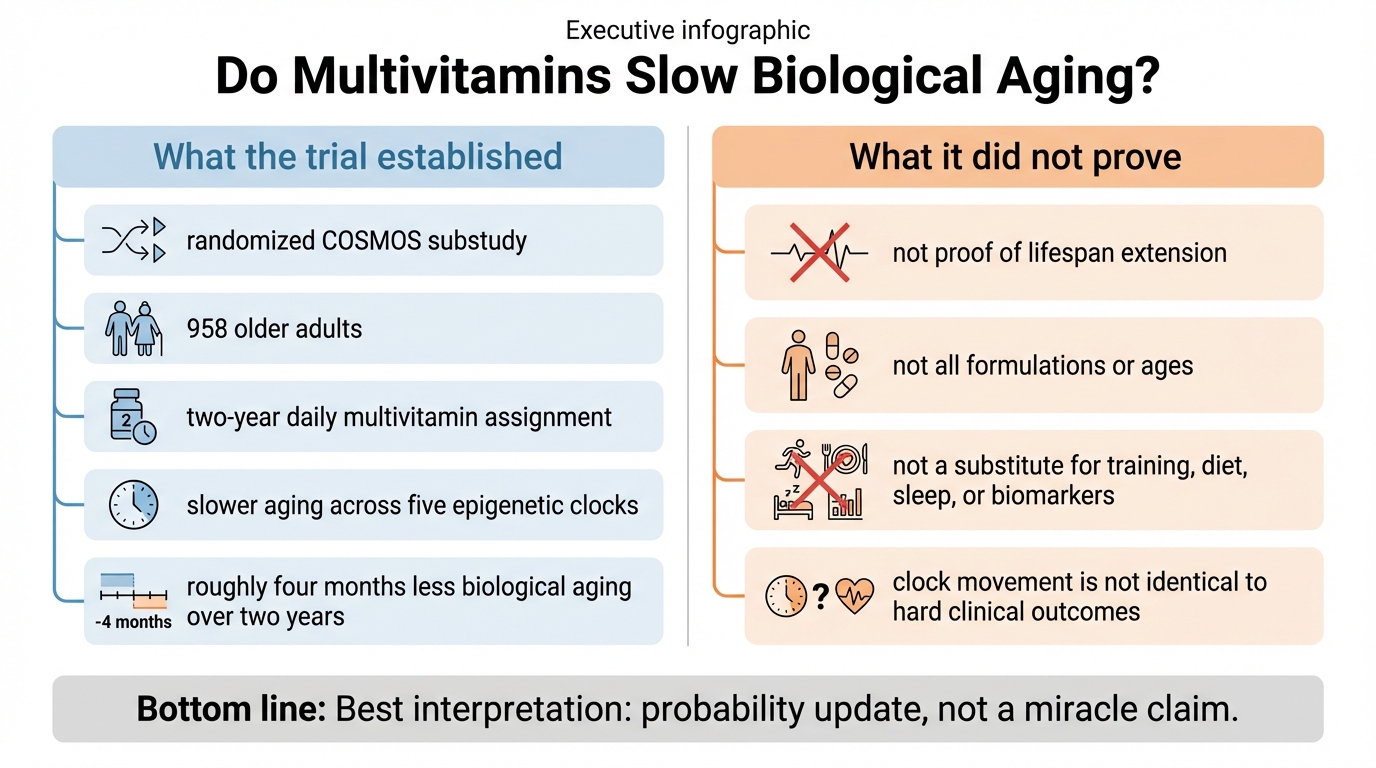
The practical issue is straightforward. Many longevity readers already understand that biological age clocks can mislead when treated as stand-alone verdicts. The COSMOS paper matters because it is not a loose observational association. It is randomized evidence. But even randomized clock movement is still an intermediate signal. It is not the same thing as proven extension of healthy lifespan, lower mortality, or a validated general recommendation that every adult should take a multivitamin forever.
What Is Established
This was a randomized intervention, not a retrospective pattern hunt
The strongest feature of the new paper is design quality. COSMOS was already a large randomized trial platform in older U.S. adults. The clock analysis drew from a randomly selected blood-sample subset rather than a self-selected group of supplement enthusiasts. That structure does not eliminate all bias, but it is much more decision-grade than the usual nutrition content cycle built on cross-sectional surveys, food-frequency noise, and confounding by income, education, or overall health behavior.
The observed effect was consistent across all five clocks, with stronger significance in two mortality-predictive clocks
According to the institutional summary, the multivitamin arm showed slower aging across all five epigenetic clocks studied, and statistically significant slowing in the two clocks the authors described as predictive of mortality. That matters because isolated movement in one model can reflect measurement quirks or model-specific behavior. Convergence across several clocks is harder to dismiss as pure noise. It still does not prove downstream clinical benefit, but it raises the probability that something biologically meaningful is happening.
The finding sits on top of a broader COSMOS pattern, not in isolation
The new paper is not the first time COSMOS has shown a multivitamin-related benefit. Prior cognitive analyses from the same trial platform reported modest improvements in memory and global cognition in older adults. That does not validate the clock result mechanically, but it changes the interpretive context. A clock shift attached to a trial platform that has already produced some clinical signals deserves more weight than a clock shift appearing alone.
What Is Not Yet Established
This does not prove lifespan extension or broad healthspan extension
Epigenetic clocks are useful, but they are still model-based abstractions. A 2025 review in Nature Reviews Genetics emphasized persistent challenges around interpretation, cell-type heterogeneity, and model construction. The clocks are informative because they compress real biological information, not because they function as direct readouts of future years lived. The COSMOS result therefore supports the claim that a multivitamin may influence biological aging markers in older adults. It does not support the claim that a multivitamin has now been shown to slow human aging in the full causal sense most readers hear in that sentence.
This does not show that every multivitamin, dose, or population will benefit equally
The intervention in COSMOS was specific. The participants were older adults. The treatment duration was two years. The formulation was not a generic placeholder for any bottle sold under the word “multivitamin.” Nutrition trials often hide effect modification inside the averages. The same system has already reported that blood-pressure effects vary by baseline diet quality and baseline blood pressure. The most likely practical interpretation is that benefit is uneven, not universal.
This does not make multivitamins a substitute for better measurement or better basics
If a reader uses this paper to avoid fixing sleep, strength, cardiorespiratory fitness, protein adequacy, metabolic control, or basic biomarker surveillance, the paper has been misused. A multivitamin is a low-friction intervention. That is part of its appeal. It is also part of its ceiling. A low-friction intervention can move a risk distribution without replacing the larger levers that control aging trajectory.
Established fact: In a randomized COSMOS substudy, older adults assigned to a daily multivitamin showed slower movement on several epigenetic aging clocks over two years.
Reasoned inference: The result is strong enough to justify further study of multivitamins as a low-cost healthy-aging intervention, especially in older adults with nutritional gaps or accelerated biological age.
Still unknown: Whether the clock signal reliably translates into durable changes in morbidity, disability, or lifespan, and how much the effect depends on formulation or baseline nutritional status.
Why This Result Matters More Than Most Supplement Headlines
Most supplement stories fail at the source level. They begin with weak observational data, escalate into mechanism-heavy claims, and end in broad consumer recommendation. This one begins with randomization. That does not make it conclusive. It makes it worth reading carefully. In a field filled with noisy proxies, a pragmatic intervention that shows repeated benefit across several clocks and emerges from a real trial platform is unusually substantial.
It also lands in the right part of the decision stack for LifeMeter readers. A large share of longevity medicine is still dominated by high-cost, low-access, or poorly validated interventions. Multivitamins sit at the opposite end: cheap, scalable, and easy to implement. If a low-cost intervention can produce even modest biological benefit in a well-run trial, it deserves more attention than another speculative story about frontier biology that has not yet crossed into regulated human evidence. The right comparison is not with fantasy. It is with what is actually available to millions of people now.
How To Use The Signal Without Fooling Yourself
1) Treat this as a probability update, not a verdict
The rational move is not to say, “multivitamins slow aging.” The rational move is to say, “the probability that a daily multivitamin produces a modest beneficial effect on biological aging in older adults is higher today than it was before March 9, 2026.” That sentence is less dramatic, but it is truer.
2) Prioritize fit over ideology
Some readers are reflexively pro-supplement. Others are reflexively dismissive because multivitamins have a long history of overpromising. Both instincts are weak substitutes for case selection. An older adult with limited dietary range, absorption issues, or multiple marginal deficiencies is not the same case as a younger adult with excellent diet quality and little evidence of nutritional shortfall. This paper does not erase that distinction.
3) Keep clocks tied to clinical and functional anchors
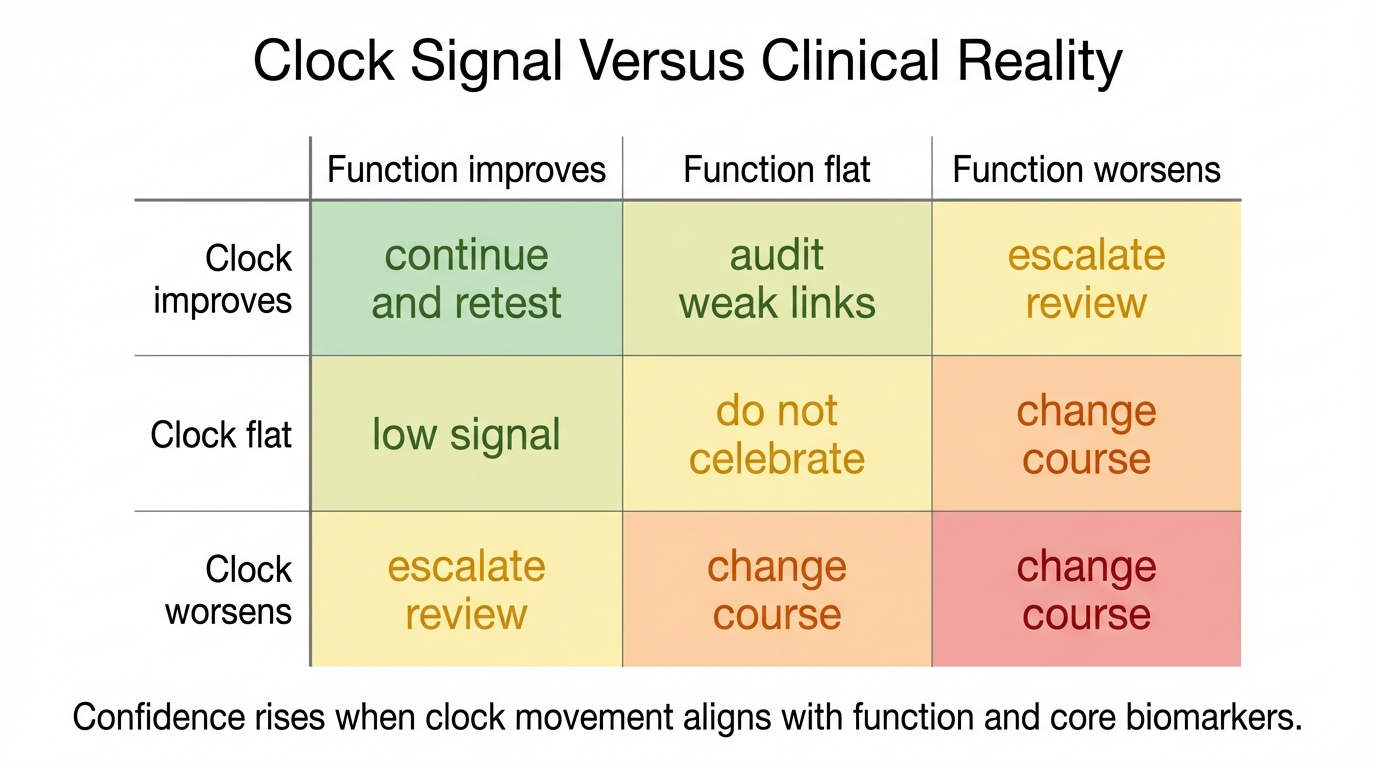
If you track clocks at all, pair them with more grounded markers: strength, waist-to-height ratio, blood pressure, glucose control, ApoB, cardiorespiratory fitness, symptom burden, and cognitive function where relevant. That is the same rule LifeMeter uses elsewhere. Single-domain movement invites overinterpretation. Multi-domain coherence is where confidence rises.
Who Should Care Most Right Now
The highest-interest audience is older adults, clinicians working in preventive medicine, and readers trying to build a conservative longevity stack rather than a speculative one. This is especially relevant for people who are already operating in the world of bloodwork, functional tracking, and modest but repeatable intervention gains. For that audience, the question is not whether a multivitamin is glamorous. The question is whether it clears the hurdle of being cheap, safe, and directionally useful enough to deserve a place next to exercise, diet quality, sleep, and medication optimization where indicated.
The answer after this paper is still conditional. It is not a universal yes. It is also no longer an easy no.
What To Watch Next
Three follow-up paths matter. First, replication outside this exact platform. Second, stronger mapping between the clock shifts and harder outcomes such as disability, frailty, cognition, cancer incidence, and survival. Third, subgroup resolution: which baseline nutritional patterns, clinical profiles, or biological-age states capture the largest effect. If those pieces strengthen, multivitamins move from “plausible low-cost support” toward “default preventive add-on in selected older adults.” If they do not, the current result remains useful but bounded.
That bounded reading is enough. A field that wants credibility has to learn how to value modest, well-identified gains instead of forcing every new result into the category of breakthrough. The COSMOS multivitamin clock paper is not a breakthrough in the frontier-biotech sense. It is something rarer in everyday longevity practice: a relatively clean signal in a space usually dominated by noise.
Source List
Li, S., et al. (2026, March 9). Effects of daily multivitamin-multimineral and cocoa extract supplementation on epigenetic aging clocks in the COSMOS randomized clinical trial. Nature Medicine via PubMed.
Mass General Brigham. (2026, March 9). COSMOS trial results show daily multivitamin use may slow biological aging.
Teschendorff, A. E., & Horvath, S. (2025). Epigenetic ageing clocks: statistical methods and emerging computational challenges. Nature Reviews Genetics.
Mass General Brigham. (2023, January 18). Third major study finds evidence that daily multivitamin supplements improve memory and slow cognitive aging in older adults.
Mass General Brigham. (2025, December 3). Long-term benefits of daily multivitamin use may vary by diet quality and baseline blood pressure.