The Alzheimer’s Blood Test Era Has Started: What Changes for Patients and Primary Care?
The first FDA-cleared blood test to aid Alzheimer’s diagnosis marks a real shift in access and triage, but it does not reduce diagnosis to one blood draw without context.
On May 16, 2025, the FDA cleared the Lumipulse G pTau217/ß-Amyloid 1-42 Plasma Ratio. This marks a shift from a world where amyloid confirmation often meant PET scans or lumbar puncture toward a more scalable front door in routine medicine. It does not mean diagnosis is now one blood draw and done.

The test is cleared for adults aged 55 and older with signs and symptoms of cognitive decline, and results must be interpreted with other clinical information. That is not legal fine print. It is the rule that determines whether this tool helps patients or creates confusion.
What Actually Changed
Before clearance, many patients hit bottlenecks: specialist delays, expensive imaging, or invasive CSF testing before stronger diagnostic confidence was possible. The blood-test option lowers friction at the first decision point. In FDA-reviewed data, 91.7% of positive results and 97.3% of negative results aligned with PET/CSF reference testing, while about one in five results were indeterminate.
That means this remains a triage-and-diagnostic support tool, not an automatic endpoint. The operational value is that primary care can move higher-confidence positive or negative patients faster into the right next step while escalating ambiguous cases more efficiently.
Who Should Be Tested Right Now
The intended population is symptomatic adults 55 and older with clinically assessed cognitive decline. This is not broad asymptomatic consumer screening. In practice, testing should follow structured history, family collateral input, brief cognitive assessment, depression screening, reversible-cause labs, and functional review.
False Positives and False Negatives
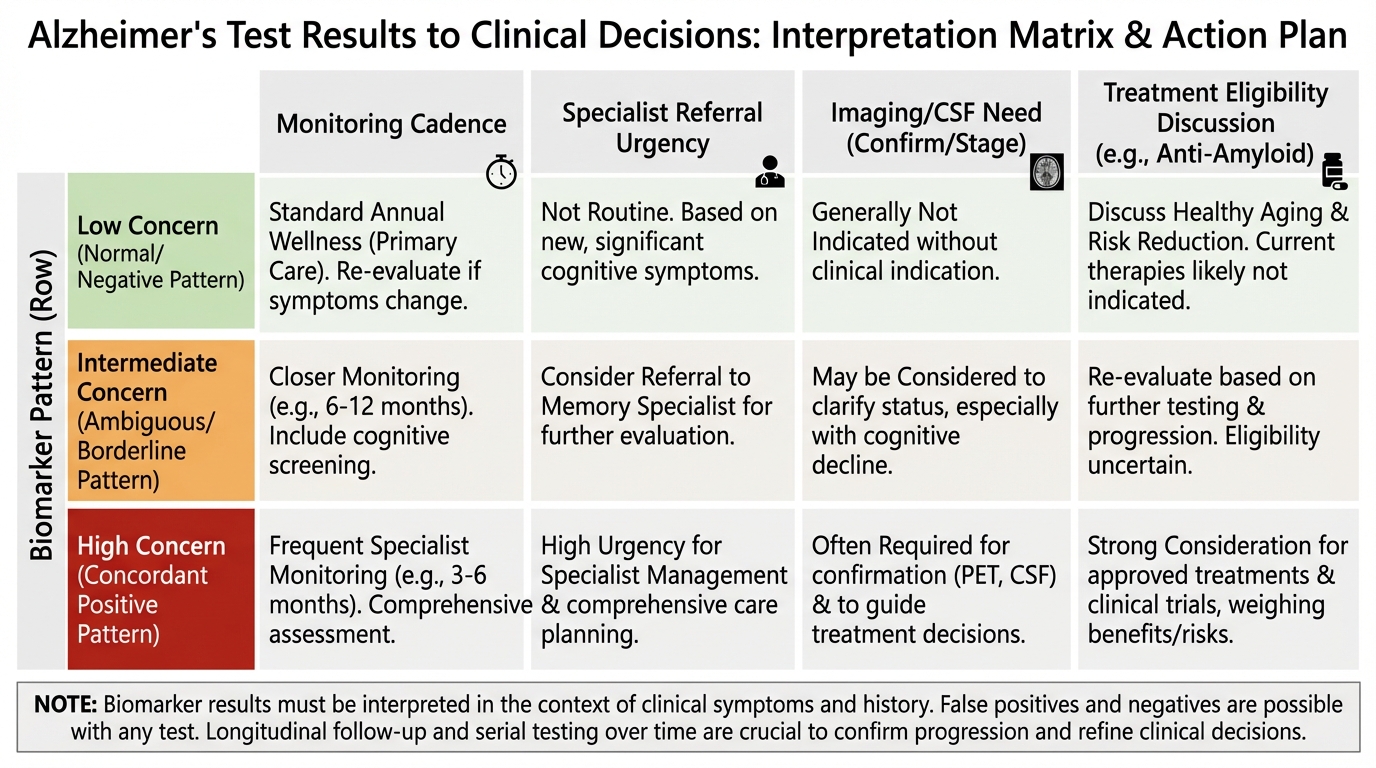
Every biomarker test carries tradeoffs. False positives can drive distress and misdirect care. False negatives can delay treatment and create false reassurance. Indeterminate results create uncertainty but still provide pathway value when paired with clear follow-up rules.
How Primary Care Changes Day to Day
The biggest shift is operational ownership. Primary care increasingly owns early triage decisions that were previously deferred. Clinics need explicit playbooks for ordering, pretest counseling, and result-specific next actions. Treating this as a simple add-on lab will underperform; treating it as pathway redesign will improve throughput and patient experience.
Treatment Timing Implications
Disease-modifying options exist for selected early-stage patients, which makes timing more consequential. Earlier biomarker-guided workup can improve treatment eligibility timing. But earlier does not mean faster at any cost: anti-amyloid pathways still require careful staging, risk discussion, MRI monitoring, and longitudinal follow-up.
What Is Overstated
Overstatement 1: "Now Alzheimer’s is diagnosed from one blood draw in primary care." Not accurate. The test aids diagnosis and must be integrated with clinical context.
Overstatement 2: "A positive blood test means treatment should start immediately." Not automatically. Suitability depends on stage, imaging, risk profile, and patient goals.
Overstatement 3: "This is population screening for everyone over 55." Not the intended use.
Where This Is Headed
The likely future is layered diagnostics: plasma biomarkers, cognitive tools, imaging pathways, and specialist triage integrated into a clearer system. Over the next few years, primary care will likely handle more first-line biomarker-informed triage while memory specialists concentrate on ambiguous cases and treatment-intensive follow-up.
What Patients and Families Should Do
Start with a structured primary care visit, not direct-to-consumer testing or social media claims. Bring a family member for collateral history. Ask what a positive, negative, or indeterminate result would concretely change in the plan before ordering the test.
Key Takeaways
The first FDA-cleared Alzheimer’s blood test improves access and triage, especially in primary care, but it is not stand-alone diagnosis.
It is intended for symptomatic adults 55 and older and should be interpreted with full clinical context.
False positives, false negatives, and indeterminate results are central, not edge cases.
Earlier biomarker-guided workup can improve treatment timing, but safe therapy decisions still require staging, imaging, and follow-up.
Source List
FDA (May 16, 2025). FDA clears first blood test used in diagnosing Alzheimer’s disease.
Johns Hopkins Medicine (2025). FDA-approved blood test detects early markers of Alzheimer’s disease.
FDA (July 6, 2023). FDA converts Leqembi to traditional approval.
FDA (July 2, 2024). FDA approves Kisunla for adults with Alzheimer’s disease.
FDA (2025). FDA recommends additional MRI monitoring for patients taking Leqembi.