The New Lp(a) Era: Who Should Test Once and What the Result Can Change
Lp(a) is usually inherited, absent from a standard lipid panel, and relevant to cardiovascular risk. A single measurement can make a prevention conversation more complete.
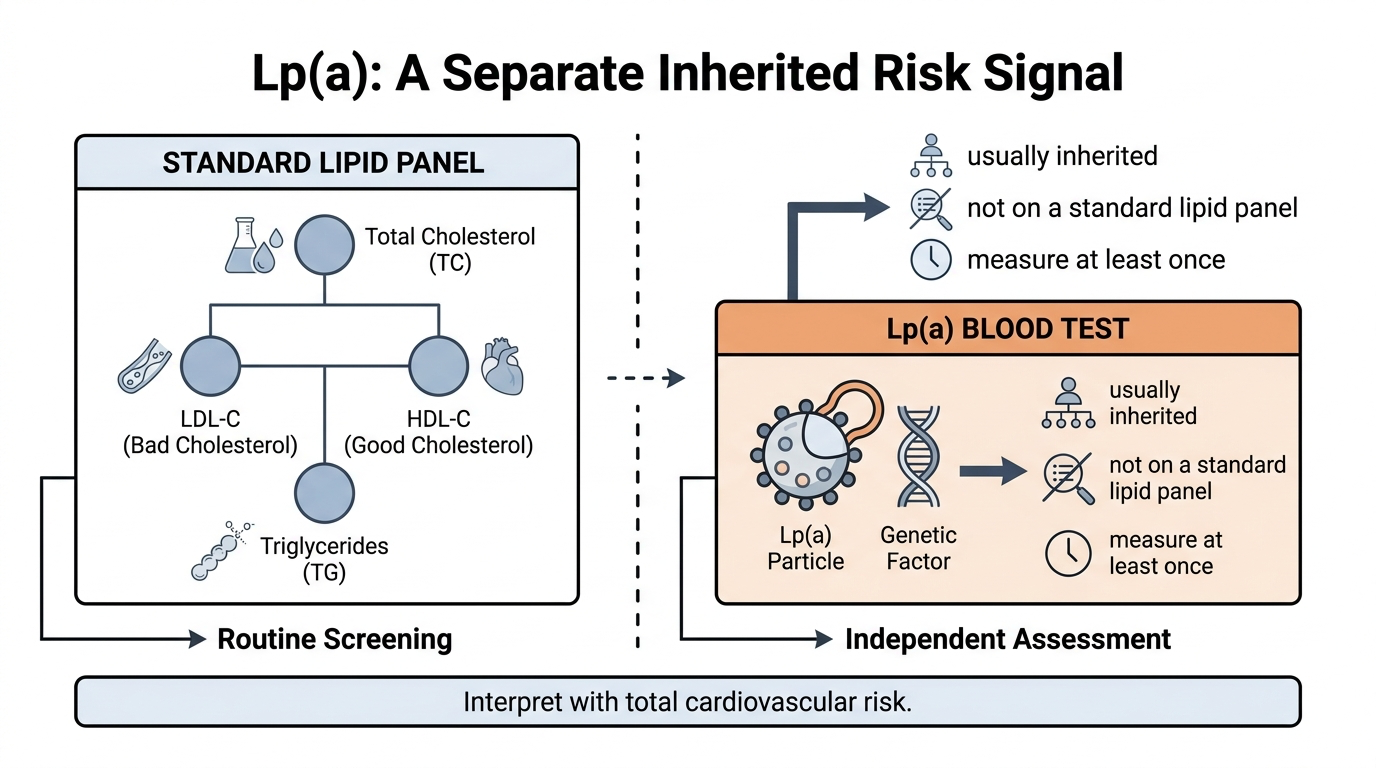
A standard lipid panel is still the starting point for cardiovascular prevention. It normally reports total cholesterol, LDL cholesterol, HDL cholesterol, and triglycerides. It does not normally include lipoprotein(a), abbreviated Lp(a). That omission matters because Lp(a) is a cholesterol-carrying particle whose level is mostly inherited and whose elevation can add to heart attack and stroke risk.
The 2026 ACC/AHA multisociety dyslipidemia guideline recommends measuring Lp(a) at least once in adulthood for atherosclerotic cardiovascular disease risk assessment. The purpose is not to turn one laboratory result into a diagnosis. It is to identify a risk signal that can otherwise remain invisible.
Why one measurement is useful
Lp(a) levels are mostly determined by genetics and usually remain relatively stable over time. The American Heart Association states that the test is the only way to know an individual level and recommends every adult be tested at least once. A standard panel cannot be used as a substitute.
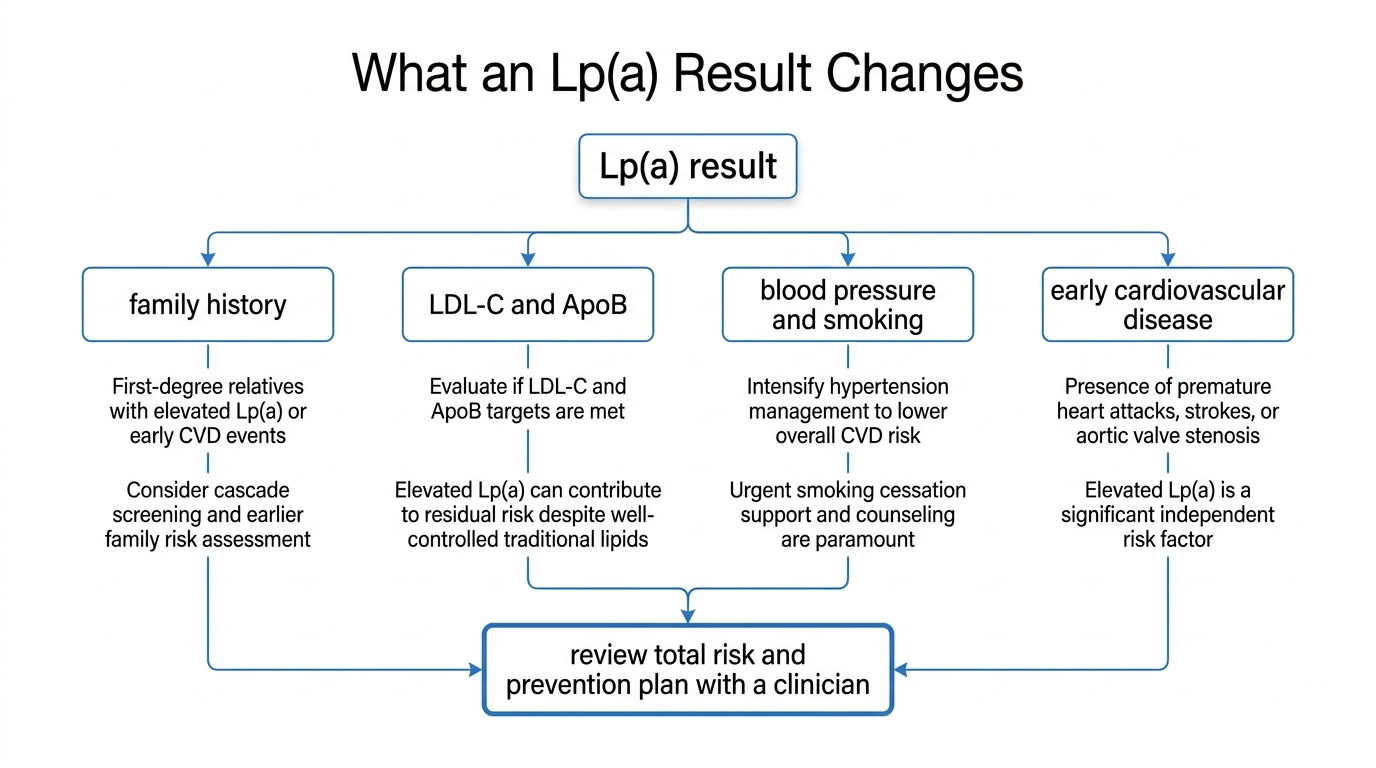
The result can be particularly useful when there is a family history of early cardiovascular disease or stroke, known early disease in the individual, or uncertainty about the intensity of prevention. A high result does not establish that disease is present. A lower result does not remove other established risks. It changes the quality of the conversation by making the risk estimate less incomplete.
Who should discuss testing
The current guideline recommendation is broad: every adult should have Lp(a) measured at least once. The clinical conversation deserves particular attention when a first-degree relative has premature atherosclerotic cardiovascular disease, familial hypercholesterolemia, or a high Lp(a) result. The guideline also recommends testing first-degree relatives in those higher-risk circumstances.
People already managing LDL-C should not assume that an Lp(a) test makes their existing plan obsolete. The main value is better calibration. A clinician can combine the result with age, blood pressure, LDL-C and ApoB when useful, diabetes, smoking, kidney disease, family history, and, in selected cases, coronary artery calcium information.
Read the result in sequence
| Step | Question | Why it matters |
|---|---|---|
| 1. Confirm the test | Was Lp(a) specifically ordered and reported in its stated unit? | It is not automatically included with routine cholesterol testing. |
| 2. Establish the baseline | What are LDL-C, triglycerides, blood pressure, glucose status, smoking exposure, kidney health, and family history? | Lp(a) does not replace the main risk factors. |
| 3. Interpret the level | How does the result fit the laboratory range and the person’s full risk profile? | The same result can have a different implication in different contexts. |
| 4. Decide in context | Does the fuller picture support a different prevention discussion? | No isolated biomarker determines care by itself. |
What the result cannot do
Lp(a) does not measure plaque directly. It does not reveal whether a person will have an event, and it cannot account for all exposure to other risk factors. The American Heart Association identifies 125 nmol/L, or 50 mg/dL, as a level at which risk may increase, but units are not interchangeable through a fixed conversion because assays and particle characteristics differ.
A high result is not an automatic instruction to begin or intensify a specific medicine. It is a reason to review the complete prevention plan with a clinician. The evidence-based response often includes improving control of established modifiable risks, especially LDL-C, blood pressure, diabetes, and tobacco exposure.
Turn the result into a better prevention plan
Start by confirming whether Lp(a) has ever been measured. Keep a copy of the result and its unit. Bring it to a clinician who can connect it to the rest of the record, including family history and prior cardiovascular testing. If relatives have a history of early disease, ask whether family testing is appropriate.
LifeMeter's 2026 dyslipidemia guide explains how LDL-C, ApoB, Lp(a), long-range risk, and coronary calcium fit into one prevention framework. The return on prevention analysis examines why early control of established risks matters. The Biomarker Trend Analyzer can help organize repeated results, although it does not diagnose disease or select treatment.
Sources
American Heart Association, 2026 guideline on the management of dyslipidemia.
American Heart Association, Lipoprotein(a) patient guide.
American Heart Association, key points from the current cholesterol guideline.
This article is educational and does not provide medical advice or individual treatment recommendations.