ApoB Adds a Risk Signal LDL Can Miss
Two people can have the same LDL cholesterol and a different number of artery-entering particles. ApoB helps expose that difference.
A standard lipid panel remains the starting point for cardiovascular prevention. LDL cholesterol, usually shortened to LDL-C, is useful because decades of research connect higher exposure to greater risk and show that lowering it reduces cardiovascular events. The number can still leave an important question unanswered: how many cholesterol-carrying particles are moving through the blood?
ApoB addresses that question. Each atherogenic particle carries one molecule of apolipoprotein B. These particles include LDL and several related particles capable of entering the artery wall. Measuring ApoB therefore gives a practical estimate of particle number. LDL-C measures the cholesterol cargo inside LDL particles. The measurements often move together, but not always.
Why the mismatch matters
Imagine a fixed amount of cargo crossing a city. It can travel in a few full trucks or many lightly loaded trucks. A cargo measure sees the same total. A vehicle count does not. In the bloodstream, more particles create more opportunities to enter and remain in the artery wall. This is why a modest LDL-C can sometimes coexist with a higher-than-expected ApoB.
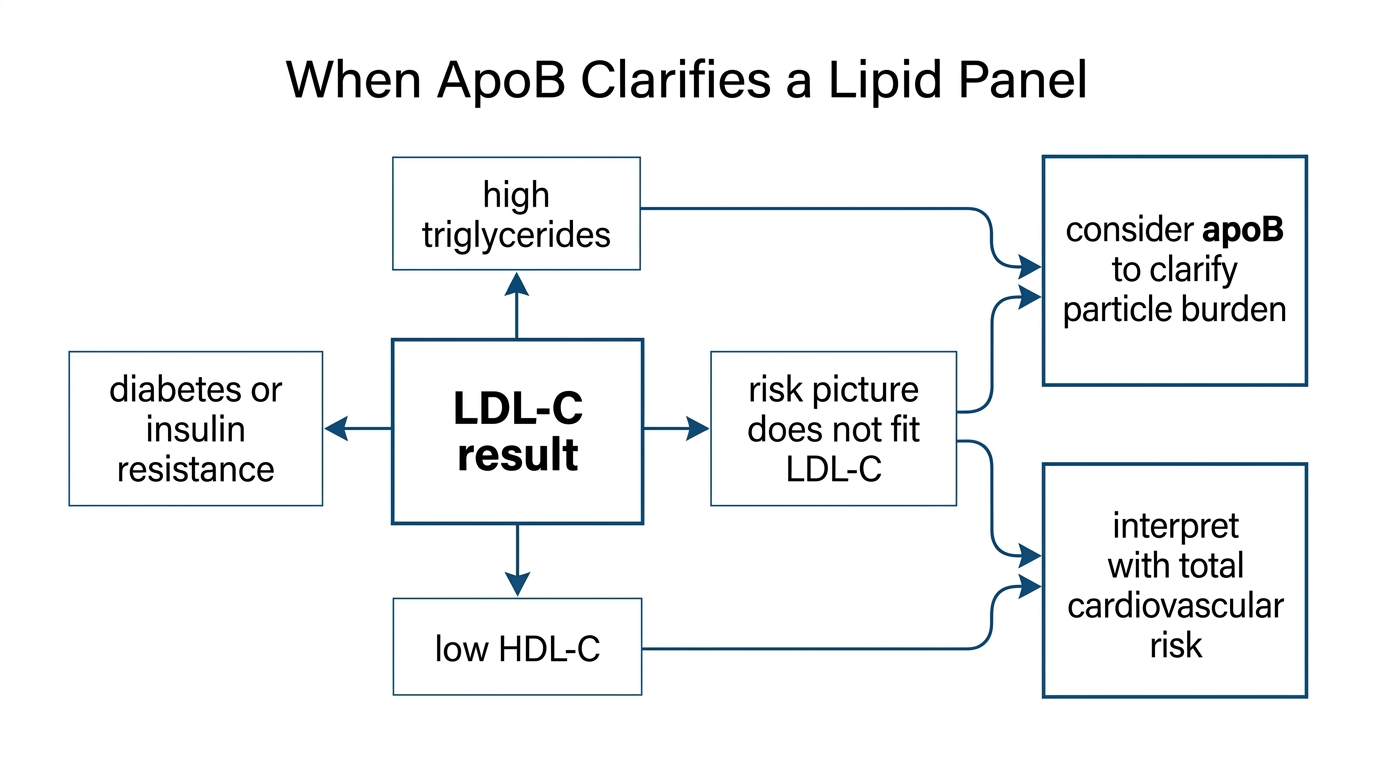
The 2026 multisociety dyslipidemia guideline describes ApoB as useful when LDL-C and the broader risk picture disagree, particularly in people with elevated triglycerides, diabetes, cardiovascular-kidney-metabolic disease, known cardiovascular disease, or a low achieved LDL-C after treatment. The National Lipid Association also supports ApoB as a complementary measure when cholesterol mass may not represent particle burden well.
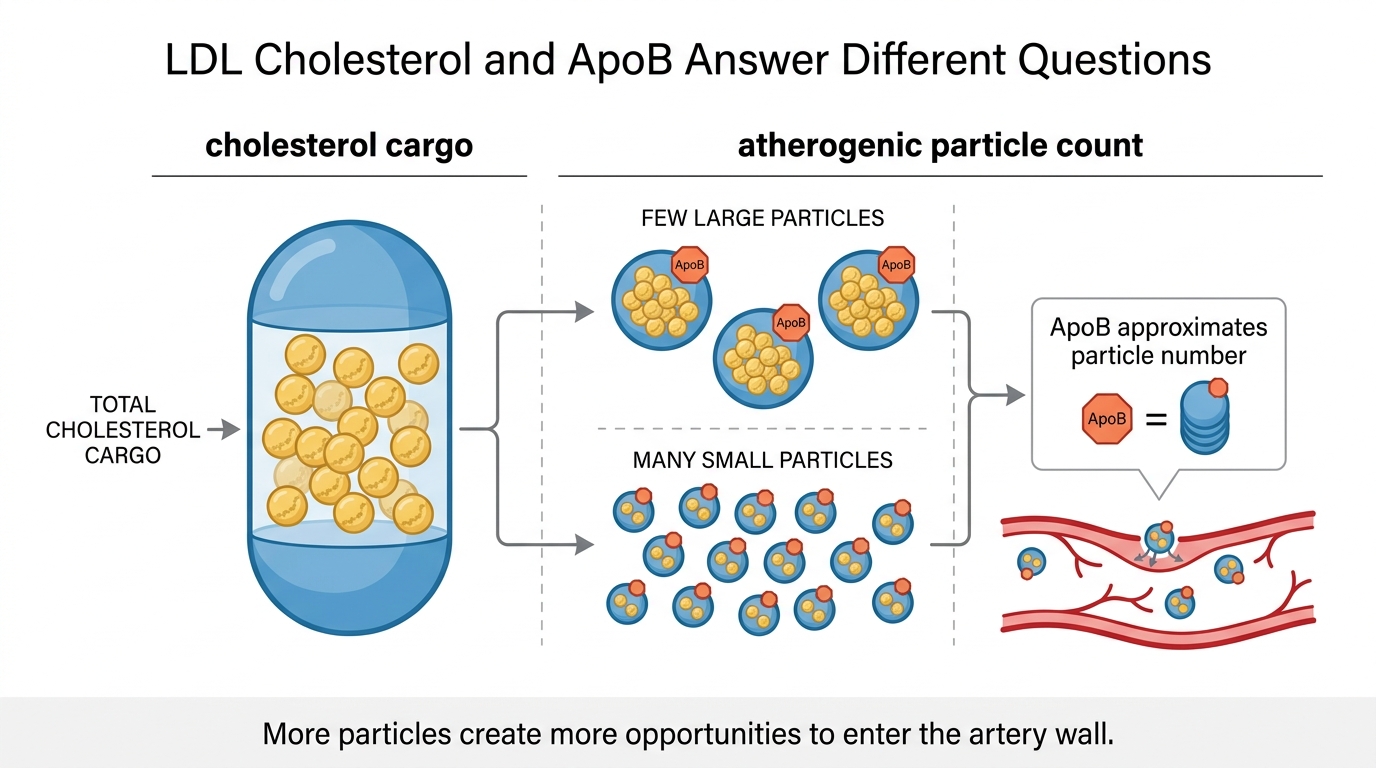
Discordance is not a rare laboratory curiosity. Metabolic conditions can change the amount of cholesterol inside each particle. In those settings, LDL-C can look reassuring while particle number remains higher. The opposite pattern can also occur. That is why the result should clarify a risk estimate, not replace one.
Who may gain useful information
ApoB is most useful when it can change a decision. A clinician may consider it when a standard panel does not fit the rest of the patient, when triglycerides are elevated, when diabetes or insulin resistance changes the lipid pattern, or when treatment has lowered LDL-C but residual risk remains a concern.
That does not mean every adult needs frequent ApoB testing. A low-risk person with an internally consistent lipid panel may gain little from adding another number. A person with an ambiguous pattern may gain a clearer answer about whether the apparent LDL-C understates particle burden. Testing is a decision aid, not a badge of sophistication.
Read the number in sequence
| Step | Question | Why it matters |
|---|---|---|
| 1. Establish the baseline | What are LDL-C, non-HDL-C, triglycerides, blood pressure, glucose status, smoking exposure, kidney health, and family history? | ApoB does not replace the main risk factors. |
| 2. Find the ambiguity | Does the lipid panel fit the metabolic and clinical picture? | Testing has the highest value when it can resolve a mismatch. |
| 3. Add ApoB if useful | Does particle burden look higher or lower than LDL-C suggests? | Discordance can alter the discussion about treatment intensity. |
| 4. Decide in context | Would a different treatment plan improve the person's total risk? | No isolated biomarker determines care by itself. |
What ApoB cannot tell you
ApoB does not measure plaque directly. It does not reveal how long the current particle burden has been present, and it does not account for blood pressure, tobacco exposure, inflammation, fitness, kidney disease, or family history. It also does not replace lipoprotein(a), which identifies a separate inherited risk signal.
A result above a laboratory reference range is not an automatic instruction to begin or intensify medication. Thresholds depend on baseline risk, existing disease, treatment status, and the guideline framework being used. The practical question is whether the result changes an evidence-based prevention decision.
Turn measurement into action
For most people, the useful next step is not to order every advanced lipid test. It is to make the standard baseline complete, identify any unresolved contradiction, and ask whether ApoB would clarify it. If the answer is yes, interpret the result with a clinician who can connect the number to the full cardiovascular picture.
LifeMeter's broader 2026 dyslipidemia guide explains how LDL-C, ApoB, lipoprotein(a), long-range risk, and coronary calcium fit into one prevention framework. The return on prevention analysis explains why early control of established risk factors matters more than chasing a perfect panel. The free Biomarker Trend Analyzer can organize repeated results over time, although it does not diagnose disease or select treatment.
Sources
2026 ACC/AHA multisociety guideline on the management of dyslipidemia.
National Lipid Association expert clinical consensus on ApoB.
Large primary-prevention cohort study of LDL-C and ApoB discordance.
This article is educational and does not provide medical advice or individual treatment recommendations.