VO2 Max by Age: What It Measures and How to Raise It
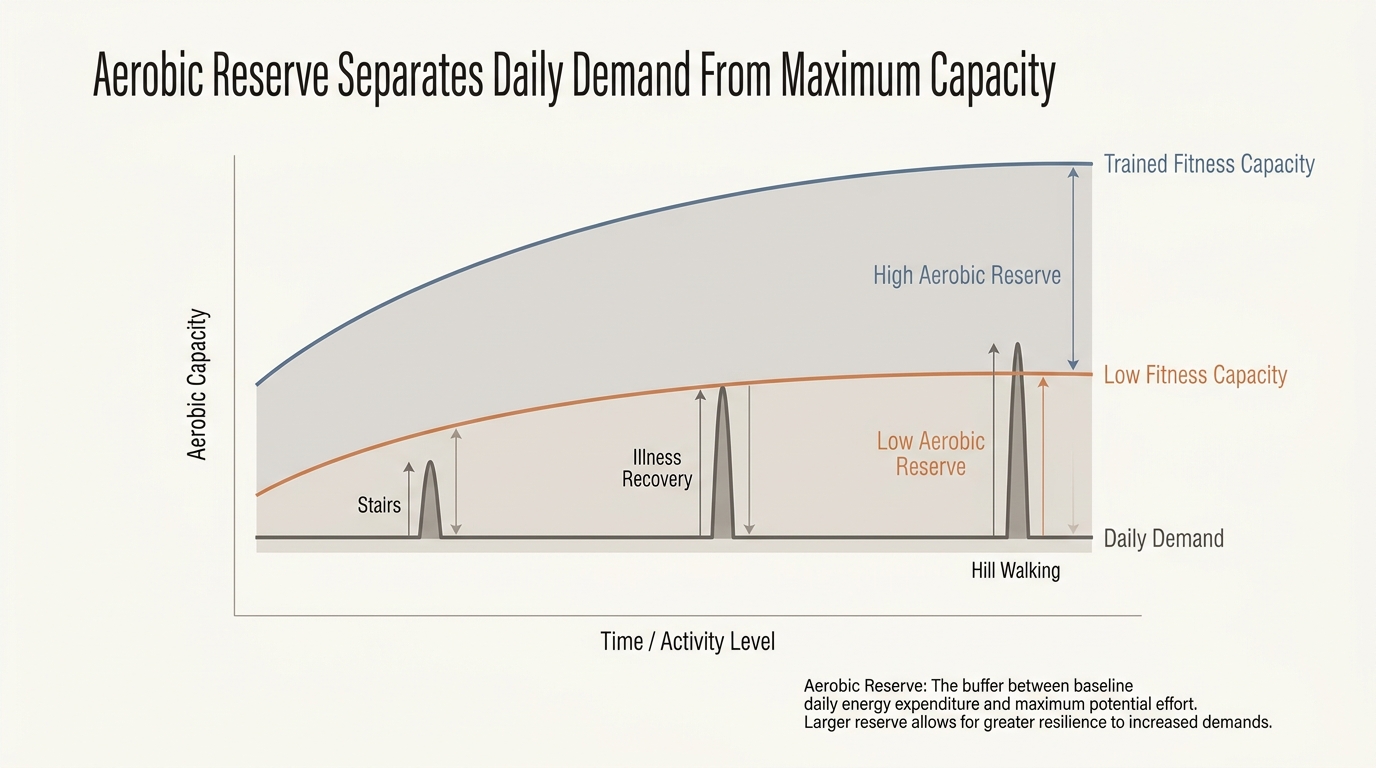
VO2 max is the ceiling on how much oxygen the body can use during hard work. It is not a vanity number for runners. It is a practical measure of reserve: the distance between ordinary life and the point where stairs, illness, surgery, or age turn effort into limitation.
Aerobic fitness has one unusual advantage in preventive medicine: it can be measured, classified, trained, and followed. A clinical treadmill test estimates peak oxygen uptake in milliliters per kilogram per minute. A lab-based cardiopulmonary exercise test measures it more directly. Neither test predicts an individual lifespan with precision. Both capture a system that matters when the body has to meet a demand quickly.
The useful aim is not an elite number. Moving from a low fitness category to the next higher one creates more functional margin than arguing about whether a wearable estimate is exact.
What the number measures
Oxygen must move from air to lungs, blood, heart, working muscle, and mitochondria. VO2 max reflects the combined capacity of that chain under near-maximal effort. A result is influenced by age, sex, body size, genetics, hemoglobin, medications, training history, and test protocol. That is why one absolute threshold should not be treated as a universal prescription.
The better comparison is usually against people of similar age and sex using the same method. A falling estimate can be a useful prompt to check training, illness, weight change, sleep, anemia, or medication effects. It is not a diagnosis. Wearables infer the number from heart rate and pace; they can track direction, but a formal test is the better tool when the result will change clinical or training decisions.
The survival signal is strong, not magical
A 2018 cohort study of 122,007 patients referred for exercise testing found that higher cardiorespiratory fitness was associated with lower all-cause mortality across age groups, including very high fitness levels. The study was observational: fitter people can differ from less-fit people in ways a treadmill test cannot fully remove. The direction is still consistent with a large body of evidence linking higher fitness with lower cardiovascular and total mortality.
Association does not mean that every added milliliter of oxygen use causes a fixed number of extra years. Fitness may partly summarize earlier advantages, disease burden, and behavior. The practical implication survives that uncertainty. Low fitness is a modifiable risk signal and a direct limit on physical capability. Treating it as invisible because it is not a cholesterol measurement is a category error.
Capacity is protective before it is impressive. A higher ceiling makes the same walk, hill, hospital stay, or return from illness consume less of the available system.
How to raise it without turning training into theater
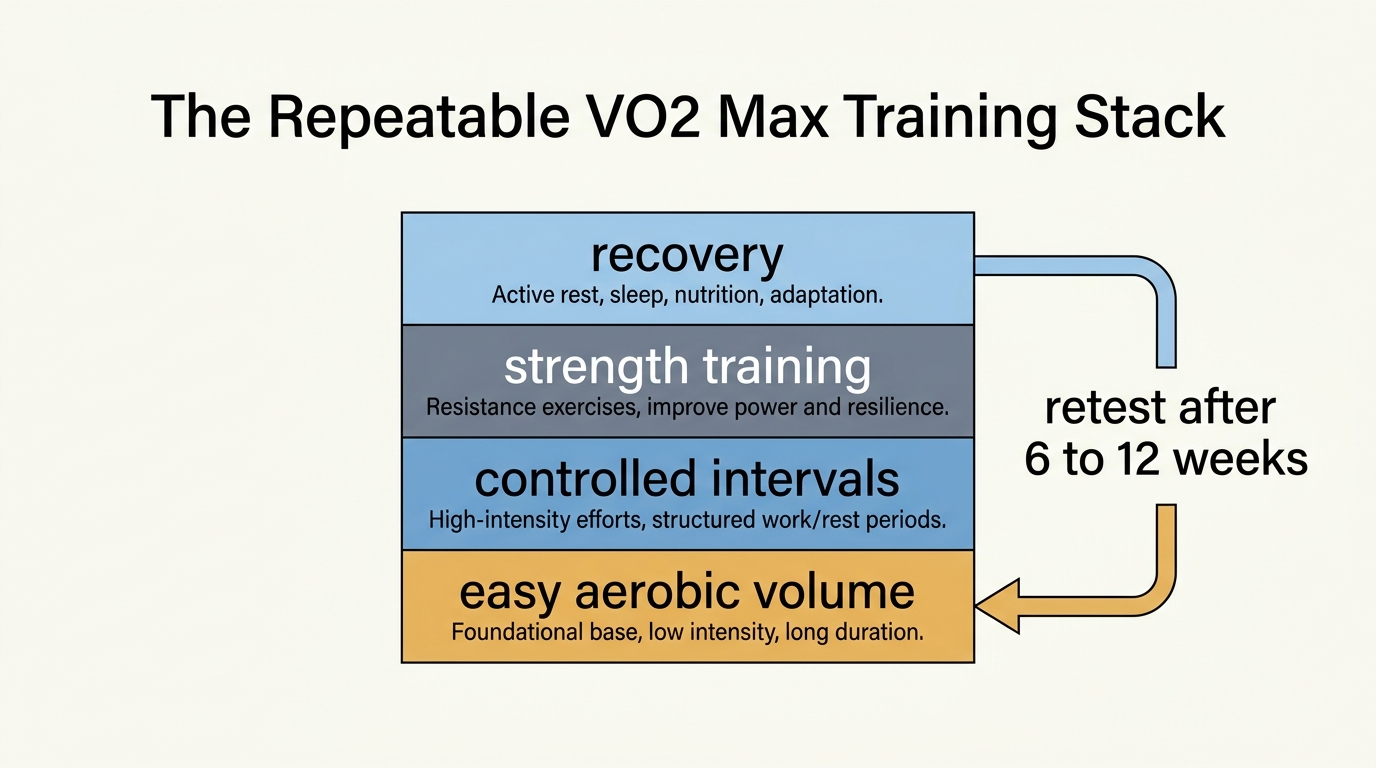
Most adults should begin by accumulating regular easy-to-moderate aerobic work that can be repeated for months. Public-health guidance calls for 150 minutes a week of moderate activity or 75 minutes of vigorous activity, plus muscle-strengthening work on two days. For an untrained person, brisk walking, cycling, swimming, or incline walking can establish the base. The rule is progression: increase duration or workload slowly enough that the next session remains possible.
Intervals are an efficient addition once a base exists. One or two sessions a week that alternate hard but controlled efforts with recovery can raise peak capacity more than easy work alone. The exact work-to-rest ratio is less important than repeatable hard efforts, recovery, and avoiding injury. Someone with symptoms, known cardiovascular disease, or a major change in exercise tolerance should seek clinical guidance before high-intensity training.
Use the free calculator as a baseline, not a verdict
LifeMeter's free longevity calculator can help make the surrounding risk profile visible: activity, smoking, blood pressure, sleep, and metabolic health interact. Enter a conservative baseline, then rerun it after six to twelve weeks of consistent training. The directional change is more useful than pretending one estimate resolves risk.
| Known | Interpretation |
|---|---|
| Higher measured fitness is consistently associated with lower mortality in observational cohorts. | Fitness belongs in prevention planning. |
| Exercise training can improve peak oxygen uptake. | Progressive aerobic work is actionable. |
| An individual VO2 max does not yield an individual life-expectancy forecast. | Use it as a reserve metric, not a prophecy. |
Sources
American College of Sports Medicine and American Heart Association. Physical Activity and Public Health. 2007.
Mandsager K, et al. Association of Cardiorespiratory Fitness With Long-term Mortality Among Adults Undergoing Exercise Treadmill Testing. JAMA Network Open. 2018.
U.S. Department of Health and Human Services. Physical Activity Guidelines for Americans, 2nd edition.