Grip Strength by Age: What It Reveals About Functional Risk
A hand dynamometer is not a longevity oracle. It is a quick measure of force that, in older-adult cohorts, has tracked later difficulty with daily activities. The useful response to a low result is assessment and training, not a diagnosis from one squeeze.
A seven-year prospective study of 2,493 Mexican American adults aged 65 and older found that participants in the lowest baseline grip-strength quartile had higher risk of new activities-of-daily-living limitations than those in the highest quartile. The study establishes an association in that population. It does not show that weak grip alone causes disability, or supply one threshold for every adult.
Why one measure has value
Grip testing is inexpensive, repeatable, and feasible in a clinic or at home with an appropriate dynamometer. It samples far more than hand muscles: pain, arthritis, effort, body size, neurologic function, frailty, and recent illness can all move the result. That is why its value lies in the pattern and the context.
The 2018 Health and Retirement Study analysis found grip-weakness cutpoints identified older Americans at elevated risk of later physical disability. The cohort was adults 65 and older. Extending that finding to a healthy 40-year-old would be inference, not an established conclusion.
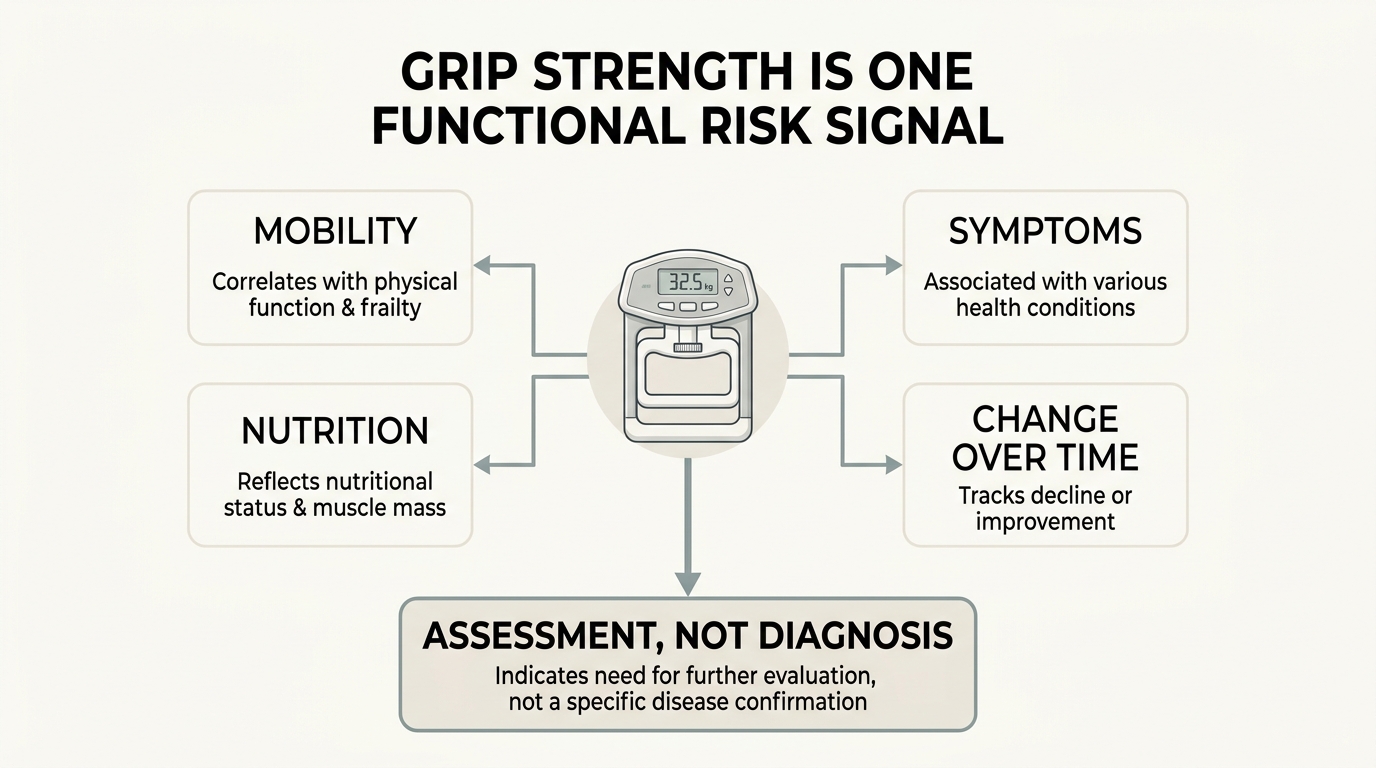
How to use the number
Use the same device, hand position, and protocol when tracking. Record the best of several attempts, then compare with prior results rather than treating a single reading as a ranking. A persistent decline, a large asymmetry, or a result paired with new falls, unintentional weight loss, pain, numbness, or loss of daily function merits clinical assessment.
For most people, the practical intervention remains unglamorous: progressive resistance work, adequate protein and energy intake, sleep, and treatment of disease or pain that is limiting movement. Hand grippers can train grip, but they do not substitute for loading the legs, trunk, and pulling muscles that support transfers and walking.
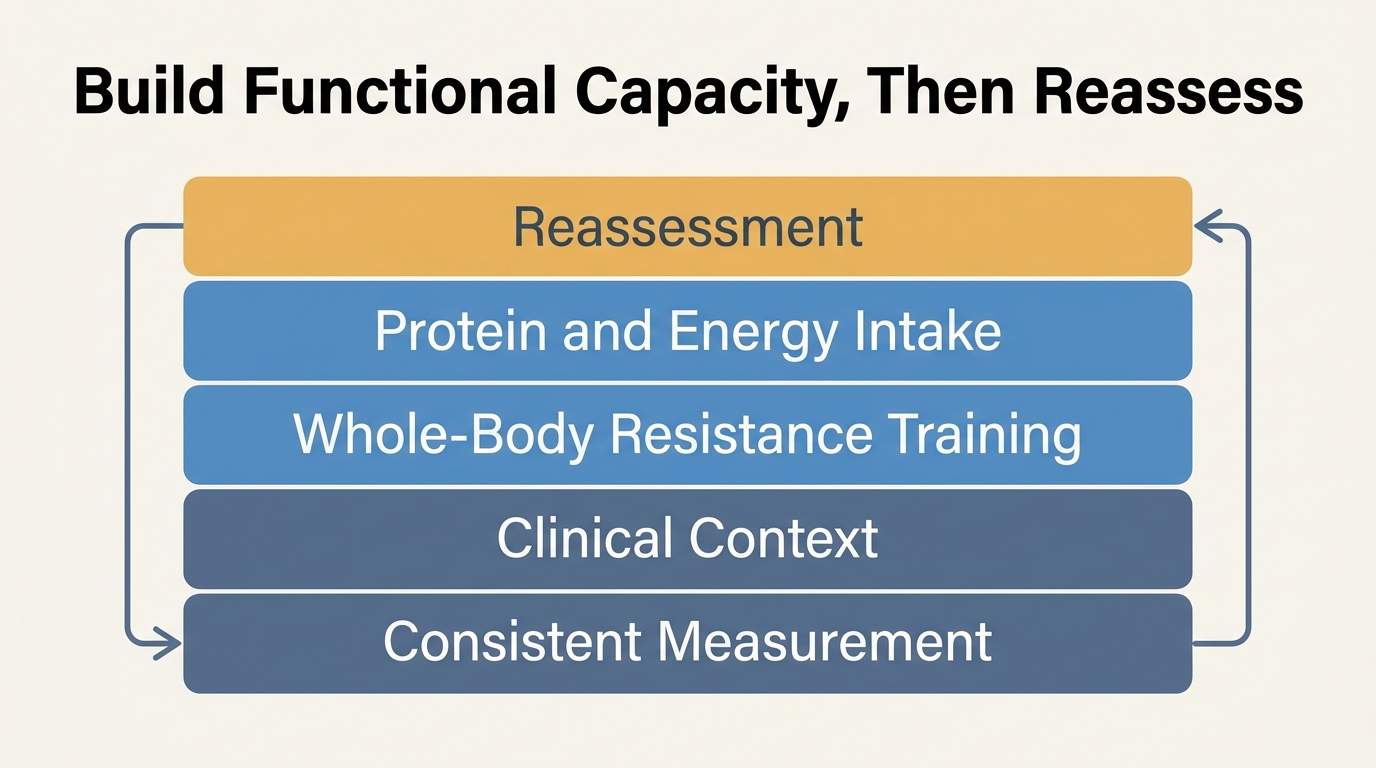
The number that matters most is often the change. A declining grip result can make a broader loss of capacity visible before it is ignored as normal aging.
Use the free calculator to set the broader baseline
LifeMeter's free longevity calculator cannot interpret a dynamometer result, but it can make the larger prevention baseline visible: activity, smoking, blood pressure, sleep, and metabolic health. Use it to identify which modifiable risks deserve attention while functional capacity is still trainable.
| Known | What follows |
|---|---|
| Lower grip strength predicted later disability in specific older-adult cohorts. | Grip can be a useful screening signal. |
| Many conditions affect a grip result. | One result cannot diagnose frailty or predict an individual future. |
| Resistance training improves strength. | Whole-body progressive training is more useful than chasing a single grip score. |
Sources
Al Snih S, et al. Hand grip strength and incident ADL disability in elderly Mexican Americans over a seven-year period. American Journal of Public Health. 2005.
McGrath R, et al. Muscle Weakness and Physical Disability in Older Americans. Journal of the American Geriatrics Society. 2018.