Sarcopenia Before Frailty: The Real Midlife Longevity Pivot
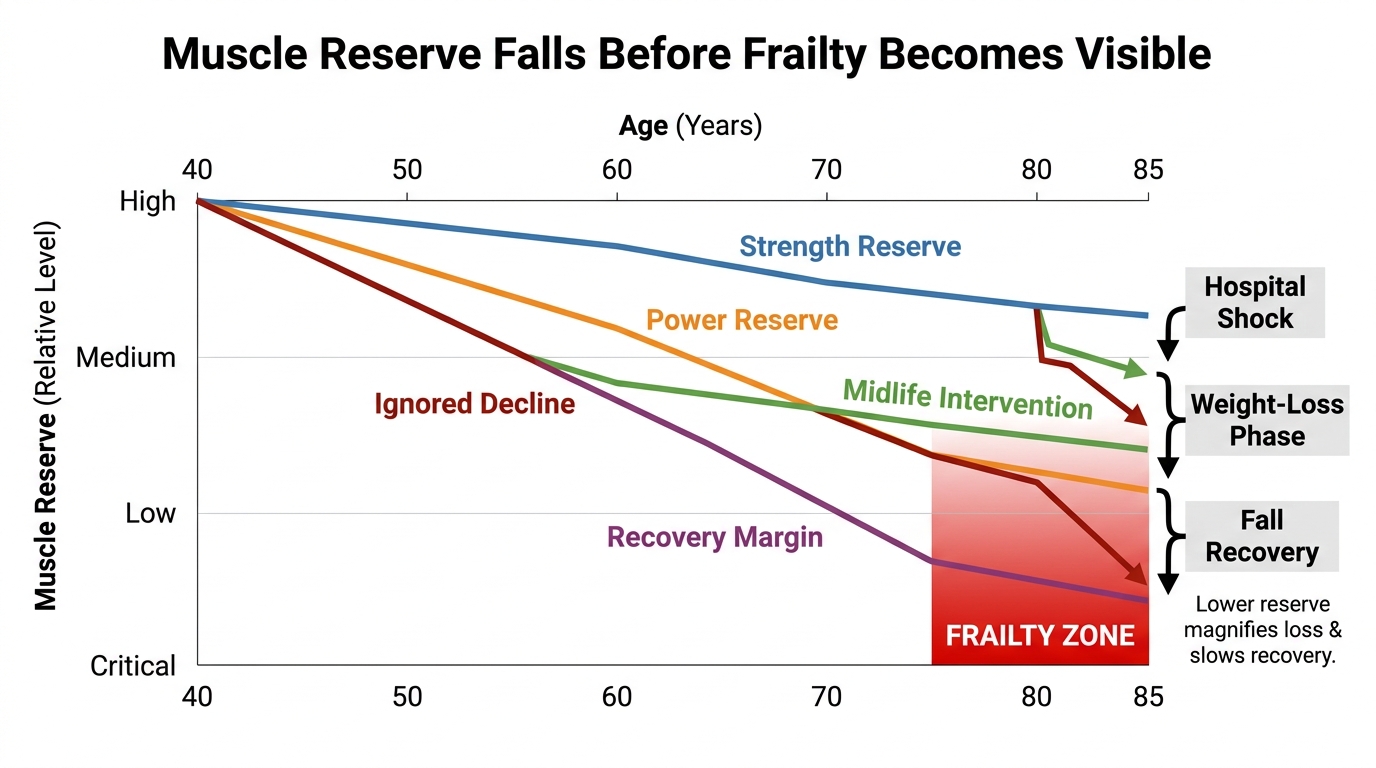
Most people imagine muscle loss as a problem that appears at the edge of old age, after visible frailty is already obvious. The stronger reading is harsher and more useful. The real muscle problem starts earlier, while people still look normal, work normally, and assume future reserve will take care of itself. By the time frailty is easy to see, the cheaper prevention window has already narrowed.
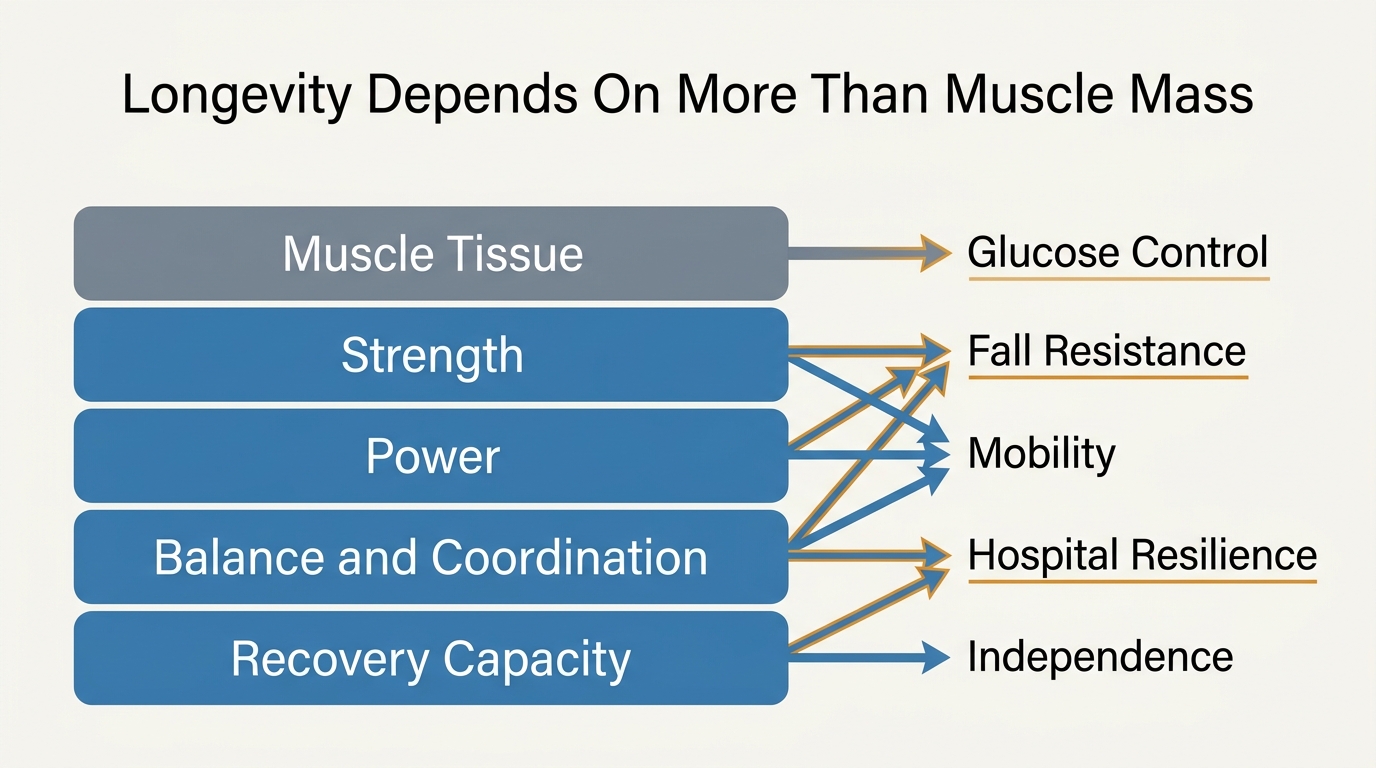
Sarcopenia matters to longevity because muscle is not just locomotion tissue. It is metabolic sink, glucose buffer, protein reserve, shock absorber for illness, and one of the main organs through which people preserve independence under stress. When that reserve erodes, the damage is not limited to appearance or athletic output. The organism loses room to tolerate infection, surgery, bed rest, caloric disruption, weight loss, and inactivity. The result is a steeper path into disability than people usually expect.
Established fact comes first. Strength, gait speed, chair-rise capacity, and power measures predict falls, disability, hospitalization, and mortality far better than visual impressions of fitness. Reasoned inference comes next. If the variables that most strongly predict late-life loss are already drifting in midlife, then waiting for the frailty label is a late and inefficient strategy. The target is not simply more muscle. The target is preservation of usable reserve before a shock reveals how little margin remained.
Core thesis: frailty is often the late visible consequence of a long invisible muscle-reserve problem. The practical longevity pivot is not the first fall. It is the earlier period when strength, power, and recovery capacity are still recoverable at lower biological and behavioral cost.
Why the problem starts before the diagnosis
Sarcopenia is usually defined through low muscle mass, low strength, or low performance depending on the framework. That is useful clinically, but it can mislead strategically. A person can sit above a formal threshold while already losing the reserve that protects mobility and recovery. In that sense, sarcopenia is less like a switch and more like a shrinking buffer. The body can compensate for longer than the person realizes, especially if daily life does not demand much force, speed, or balance.
This is why midlife matters. Decades that look healthy on paper can still contain a gradual exchange of resilient tissue for fat mass, lower movement quality, poorer sleep, higher inflammatory tone, and lower protein turnover efficiency. None of that guarantees frailty. It does change the slope. If the slope is left alone, each later insult costs more: a hospitalization leads to steeper deconditioning, a diet phase strips more lean tissue, a sedentary job extracts more stiffness, and a menopausal or illness transition leaves less room for rebound.
Mass matters, but function matters more
One reason public discussion gets confused is that muscle mass, strength, and power are related but not interchangeable. Mass alone can miss the real problem. Two people can carry similar lean mass while diverging sharply in grip strength, lower-body power, balance, and recovery speed. For longevity, function is often the more decisive layer because it determines whether tissue can be recruited when speed or force is suddenly required.
Power is especially underappreciated. Strength measures how much force can be produced. Power adds time. Falls, slips, missed steps, and emergency movements are not solved by abstract strength alone. They depend on how fast force can be expressed. This is one reason older adults can look acceptable on standard activity metrics while still moving toward a more fragile biomechanical state. What disappears first is often not the ability to move at all, but the ability to respond quickly enough when movement becomes non-optional.
| Layer | What it tells you | Longevity relevance |
|---|---|---|
| Muscle mass | How much tissue is present | Useful baseline, but weak alone if function is poor |
| Strength | How much force can be produced | Correlates with independence, metabolic reserve, and mortality risk |
| Power | How fast force can be expressed | Central for fall prevention, movement recovery, and shock tolerance |
| Performance | What the system can actually do under load | Closest to real-world resilience under daily and acute stress |
Why sarcopenia is also a metabolic story
Muscle is one of the main sites where glucose can be cleared and stored. That means the muscle problem is also a metabolic problem. Loss of muscle quality does not just reduce mobility. It reduces the amount of tissue available to handle energy intake cleanly. That makes insulin resistance harder to avoid, increases the likelihood that weight loss comes from the wrong compartment, and narrows the line between a tolerable sedentary spell and a metabolic slide.
This is where the article connects directly to Insulin Sensitivity as a Longevity Lever and GLP-1 and Functional Age. A weight intervention that lowers mass while quietly sacrificing lean tissue can improve one marker while weakening future resilience. The real question is not only whether weight falls. It is whether the organism exits the intervention stronger, weaker, or simply lighter.
The decisive transitions happen in ordinary life
People often look for one dramatic cause. In practice, the decline is usually cumulative. Less resistance training. More sitting. Higher alcohol intake. Lower protein quality. Sleep disruption. Pain that discourages movement. Menopause. Illness recovery that never fully restores prior output. Repeated dieting without strength retention. None of these has to be catastrophic on its own. Their effect is that reserve declines while the person still feels functionally fine.
That is the real midlife pivot. The body still responds to training, nutrition, and skillful programming, but the cost of neglect begins compounding faster. Once people reach late life with weak reserve, the system becomes less forgiving. A hospital stay can strip lean mass quickly. A fracture can create permanent mobility loss. A respiratory infection can trigger a long deconditioning spiral. Frailty often looks sudden only because the invisible reserve had been thinning for years.
What the intervention stack actually looks like
The evidence is strongest for boring things done consistently: progressive resistance training, adequate protein, enough total energy to support training adaptation, recovery, and enough general movement to prevent the trained hour from being canceled by the other twenty-three. Sleep matters because recovery capacity is part of the adaptation loop. Vitamin D, creatine, and other adjuncts can matter at the margin in selected contexts, but they do not replace force production, training progression, or dietary adequacy.
What remains uncertain should be stated clearly. It is established that stronger and better-functioning people age more successfully on average. It is not established that any one sarcopenia-focused intervention by itself produces a clean lifespan extension signal in humans. The mechanistic case is persuasive. The clinical endpoint proof is more mixed because muscle interacts with nearly every other system that shapes late-life outcomes.
How to read your own risk
The useful self-audit is not aesthetic. It is operational. Are loads that were easy three years ago now difficult? Has lower-body power fallen? Do you recover more slowly from small injuries or travel? Has recent weight loss reduced strength? Can you still climb, carry, rise, and decelerate well? If those answers are moving the wrong way, the longevity issue may already be present even if standard disease markers still look acceptable.
This is why the topic belongs beside Functional Age vs Chronological Age and Compression of Morbidity vs Lifespan Extension. The point is not to chase physique. The point is to keep a body that can tolerate stress with less dependence, less recovery failure, and less late-life collapse after one bad event.
This analysis draws on the geriatric and sports-medicine literature showing that low strength, slow gait, and poor chair-rise performance predict disability and mortality better than visual fitness alone.
It also relies on the broader metabolic literature linking lean tissue quality to glucose handling, inflammatory load, and recovery capacity, while recognizing that direct lifespan claims in humans remain harder to isolate than healthspan and function claims.
The central uncertainty is not whether muscle reserve matters. It is how aggressively health systems and individuals should intervene before formal sarcopenia thresholds are crossed, and which monitoring stack best captures early decline without overmedicalizing ordinary variation.