Bone-Density Screening: Who Should Get Tested?
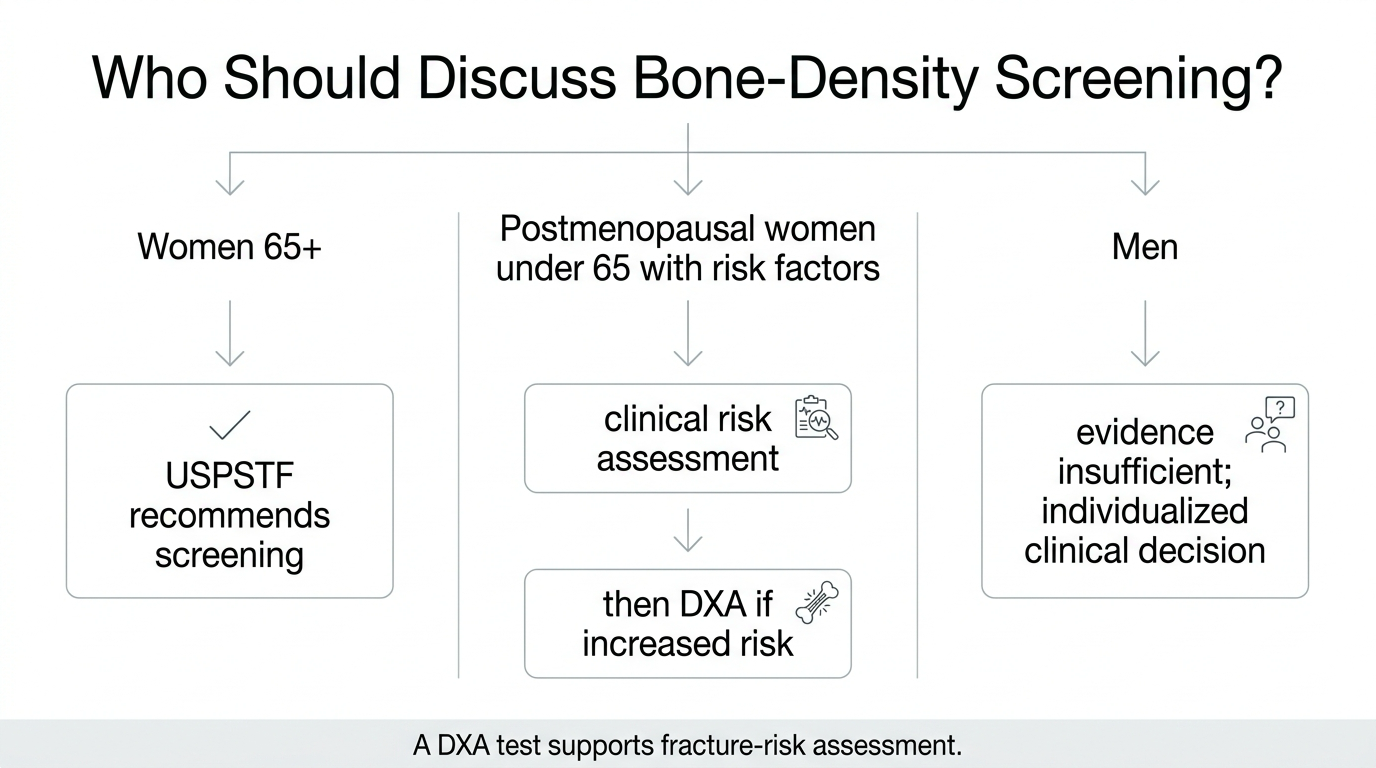
The USPSTF recommends osteoporosis screening for women 65 and older, and for younger postmenopausal women at increased fracture risk. A central DXA scan is the usual screening test.
A bone-density test is not a general wellness score. It is one part of a fracture-prevention decision: identify people likely to benefit from screening, measure bone density where appropriate, and then use the result in a clinical plan.
Start with the recommendation that applies
The USPSTF gives a grade B recommendation for women 65 and older. It also recommends screening postmenopausal women younger than 65 who have one or more risk factors and are found to be at increased fracture risk through clinical assessment. For men, the USPSTF finds the evidence insufficient to determine the balance of benefits and harms; that is not a recommendation against screening.
What the scan measures
Central dual-energy x-ray absorptiometry, or DXA, usually measures bone mineral density at the hip and lumbar spine. It uses a low dose of radiation. The test helps estimate fracture risk, but it does not by itself predict every fracture or replace a discussion of falls, medicines, medical conditions, and prior fractures.
The USPSTF notes that screening can combine DXA with fracture-risk assessment. FRAX is one commonly used tool, but its result is an input to a clinical conversation, not an automatic treatment decision.
Risk factors before age 65
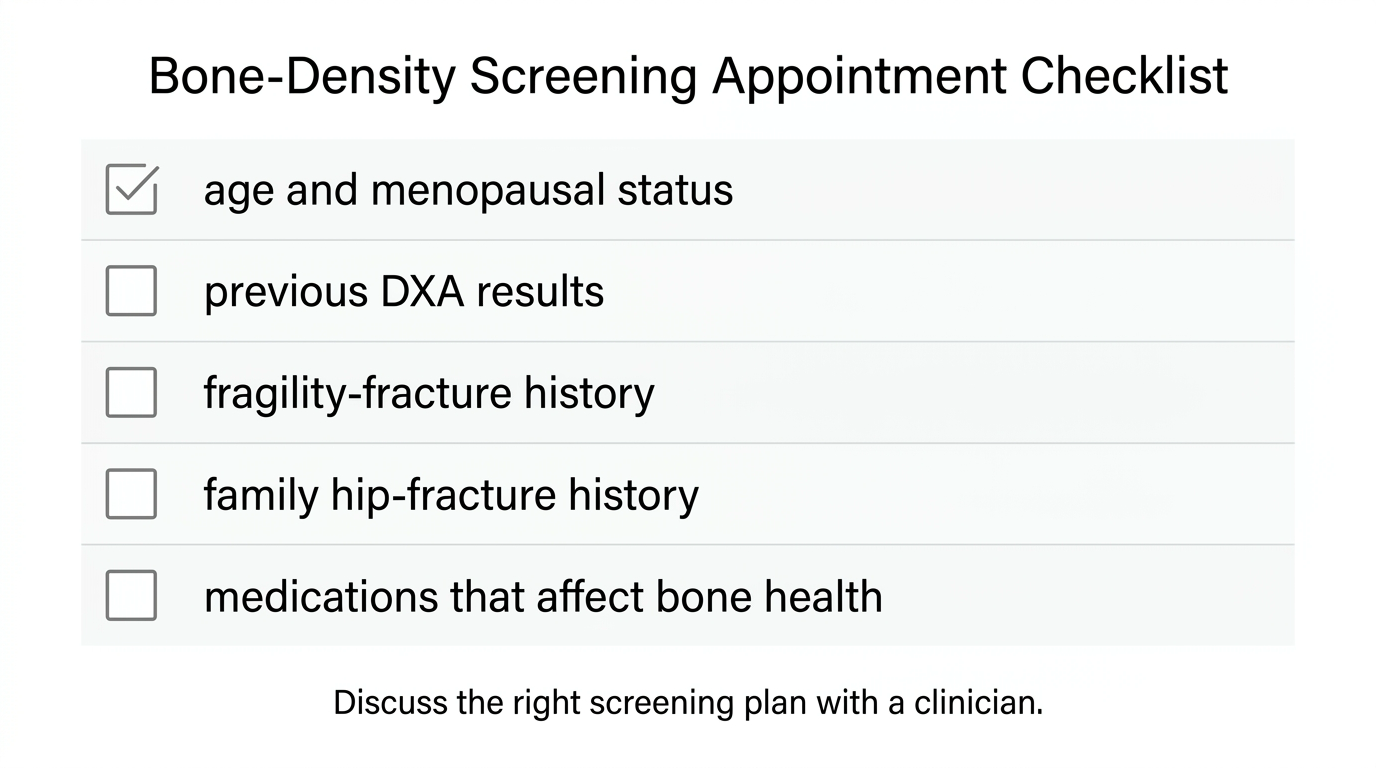
For postmenopausal women younger than 65, the USPSTF describes low body weight, parental history of hip fracture, cigarette smoking, and excess alcohol consumption as risk factors to consider alongside menopausal status. Other conditions and medicines can affect bone health, including chronic glucocorticoid use. The clinician can decide whether a formal risk assessment supports DXA screening.
| Question | Why it matters |
|---|---|
| Are you a woman 65 or older? | USPSTF recommends osteoporosis screening to prevent fractures. |
| Are you postmenopausal and younger than 65? | Risk factors and a clinical assessment guide whether DXA is warranted. |
| Have you had a fragility fracture or been diagnosed with osteoporosis? | This is no longer a routine screening question; clinical evaluation should guide the next step. |
| Are medicines or medical conditions affecting bone health? | They can change the appropriate evaluation and timing. |
Do not infer a universal repeat interval
The USPSTF found that repeating bone-density testing over four to eight years did not add accuracy in predicting fractures in the cohort studies it reviewed. This does not prescribe a single interval for every person. Baseline result, age, clinical risks, treatment decisions, and the reason for the first test can all change what follow-up makes sense.
Prepare for the clinical conversation
Bring any prior DXA report, fracture history, medication list, and family history of hip fracture. The functional-risk guide adds context on maintaining independence, while the prevention planning framework explains why evidence-led screening belongs in a wider health plan.
Sources
This article is educational and does not provide medical advice, diagnosis, or an individual screening recommendation.