Partial Cellular Reprogramming: Reset Without Cancer Risk?
Partial cellular reprogramming matters because it is one of the few longevity ideas that plausibly aims at biological age state rather than downstream damage alone. The evidence base is now strong enough to reject two lazy narratives at once. It is no longer fair to call the field pure fantasy. It is still not defensible to describe it as a solved rejuvenation platform or as a safety question that engineering has already settled.
The phrase "without cancer risk" still requires immediate discipline. The strongest current claim is not that researchers solved oncogenic danger. The stronger claim is narrower. Under bounded conditions, including short induction windows, tissue restriction, reduced factor sets, and explicit shutdown logic, several groups have shown rejuvenation or repair signals without obvious teratoma formation in the specific models tested. That is meaningful progress. It is not a general safety verdict.
Core thesis: the credible version of partial reprogramming is a constrained engineering thesis. It says some tissues may be reset enough to improve repair or function before they cross into identity loss. The field has evidence for that bounded zone in animals. It does not yet have long-horizon evidence showing that the zone stays stable under repeated dosing, broader delivery, or human-scale translation.
The Original Warning Still Governs The Field
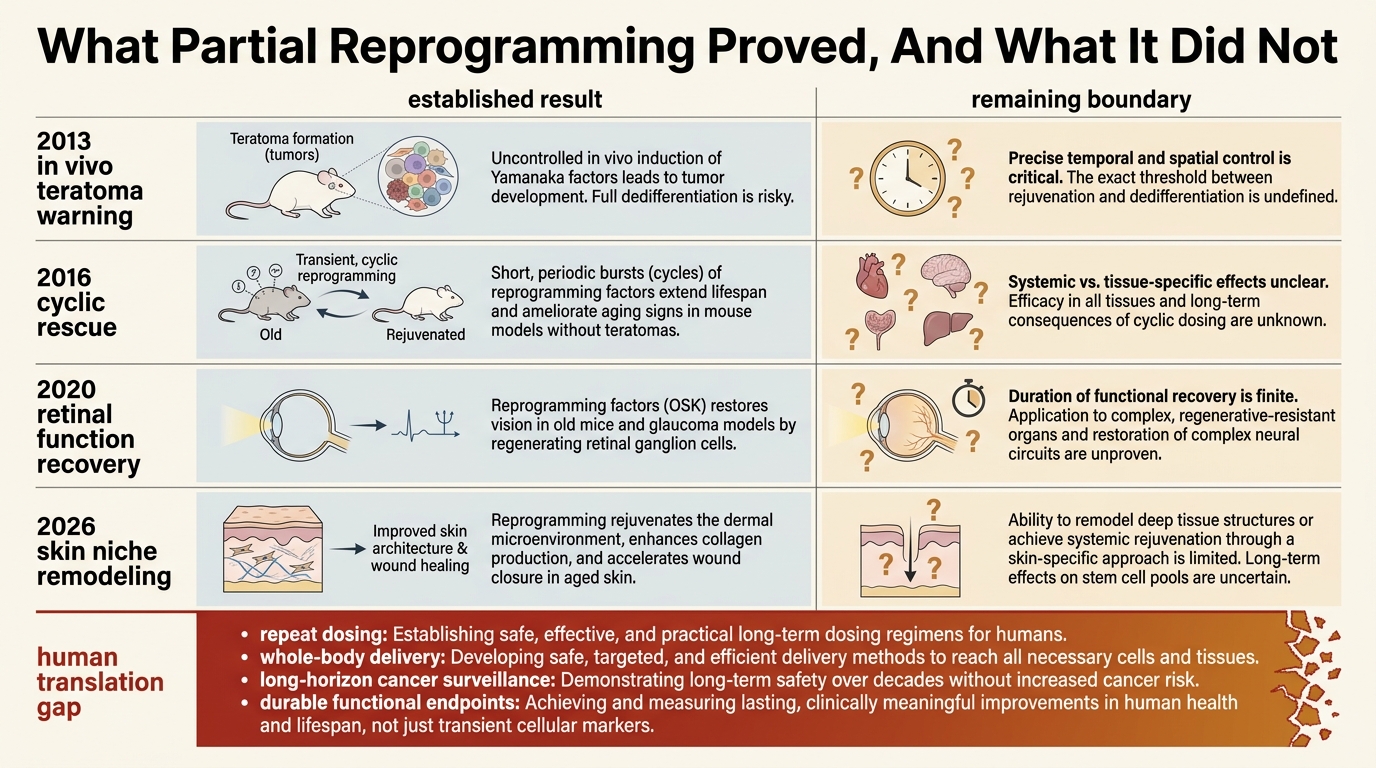
The modern story still begins with the 2013 Nature paper from Abad and colleagues. That study showed that in vivo reprogramming could generate teratomas and induced pluripotent stem-cell-like states with totipotency features. The point was not subtle. When reprogramming runs too far inside living tissue, rejuvenation language stops being useful because the system is sliding toward dedifferentiation and tumor biology.
That early result remains foundational because it sets the burden of proof for every later claim. Any serious reset protocol has to explain why a specific construct preserves lineage identity, why exposure stops before pluripotency, why proliferative escape is controlled, and why delayed pathology is unlikely. A field can accumulate encouraging mechanistic data and still fail this burden if its safety logic remains mostly inferential.
What The Better Studies Established After That
The 2016 Cell paper from Ocampo and colleagues changed the discussion because it showed that cyclic partial reprogramming could improve age-associated hallmarks and regeneration in a progeroid mouse model without the teratoma pattern seen under more aggressive induction. That did not prove broad safety. It did establish that schedule mattered. The biological response was not binary between "nothing happens" and "catastrophe." Timing created a middle regime worth studying.
The 2020 Nature study from Lu and colleagues strengthened the case by moving from general hallmarks language to tissue-level function. In retinal ganglion cells, OSK expression restored youthful DNA methylation patterns, promoted axon regeneration after injury, and improved vision-related outcomes in mouse models. This is why the field could no longer be dismissed as a slogan. A targeted in vivo intervention linked molecular reset to a meaningful functional output.
The 2024 gene-therapy study from Cano Macip and colleagues pushed the argument further toward translational ambition by reporting lifespan and age-related improvements in aged mice after AAV-mediated OSK delivery. That result is notable, but it requires careful reading. The study came from a company-affiliated team, used a specific vector and dosing logic, and still did not answer what long-horizon malignancy surveillance would look like under broader clinical deployment. Established fact and translation readiness remain separate categories.
What The January 30, 2026 Skin Study Added
The January 30, 2026 Nature Communications study from Kwak and colleagues matters because it sharpened the tissue-engineering version of the thesis. Using transient mosaic epidermal reprogramming, the authors reported that reprogramming a fraction of epidermal cells could remodel neighboring cells and niches to improve skin homeostasis and wound repair. That result is interesting not only because repair improved, but because the design focused on bounded exposure and local tissue context rather than abstract whole-organism rejuvenation rhetoric.
This is the kind of evidence the field needs more of. It treats partial reprogramming as a local control problem. Which cells are exposed? For how long? What is the surrounding niche doing? What functional improvement appears? What adverse pathology fails to appear over the observation window? Those are better questions than whether aging has been "reversed" in the promotional sense.
The skin study still does not settle the translation problem. Skin is accessible, observable, and unusually suitable for localized intervention logic. A protocol that looks disciplined in epidermal tissue does not automatically generalize to brain, liver, heart, or systemic delivery. The right inference is that bounded reprogramming keeps surviving contact with better experimental design. The wrong inference is that the difficult organs are now solved by analogy.
The Real Bottleneck Is Control Architecture
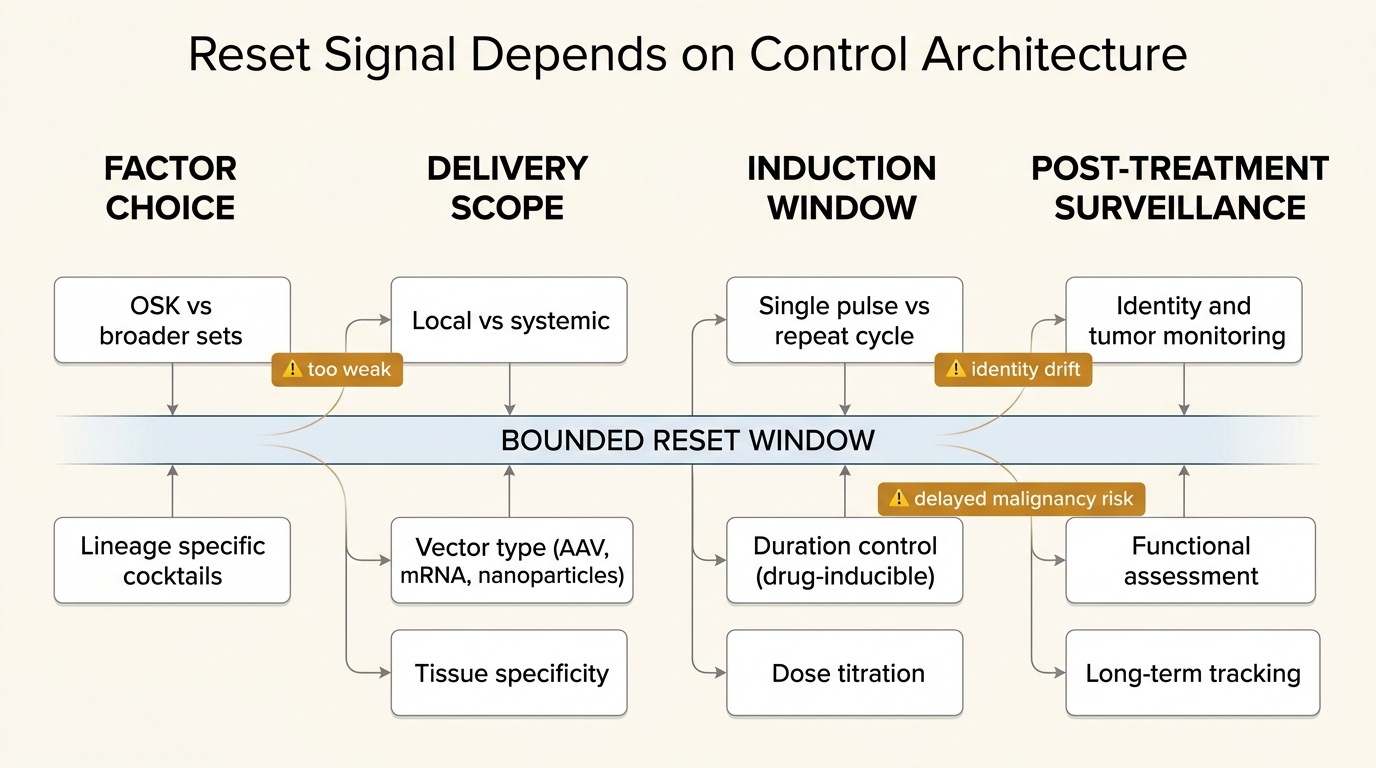
Most public summaries still frame the problem as if factor choice alone were decisive. That is too narrow. A serious therapeutic program needs a control stack: delivery restricted to the intended cells, induction strong enough to produce effect but short enough to preserve identity, shutdown logic that actually terminates expression, and follow-up that can detect late pathology rather than only short-run repair. In practice, the safety case lives inside that stack.
This is why the best way to read encouraging reprogramming results is as systems-engineering demonstrations, not as proof that one molecular recipe solved aging. The molecular recipe matters. The schedule, vector, tissue, and surveillance plan matter just as much. A protocol that looks elegant in a bounded mouse experiment may still fail the translation test if the control architecture does not remain reliable under repeat dosing or broader distribution.
Why Cancer Risk Remains An Open Question
The unresolved issue is not whether researchers know tumor risk exists. It is whether they can characterize and bound that risk over clinically relevant time horizons. Most positive studies run on animal timescales and with constrained constructs. Many emphasize methylation-age movement, transcriptomic rejuvenation, or local regeneration. Those are useful endpoints. None is a substitute for long-duration malignancy surveillance under repeated exposure.
This is where the 2024 Aging Cell review is useful. It treats partial reprogramming as an emerging rejuvenation technology while still emphasizing that delivery, dosage, factor choice, tissue context, and commercial incentive all complicate interpretation. The review literature does not read like a field that solved safety. It reads like a field that has identified a plausible operating window and is now trying to determine whether that window remains stable outside a few favorable settings.
A second unresolved issue is control architecture. A practical therapy would need more than a promising factor set. It would need reliable targeting, clean induction timing, shutoff assurance, and meaningful post-treatment monitoring. In other words, the engineering stack is part of the biology. Any summary that treats delivery as a secondary implementation detail is missing the core constraint.
Known, Inferred, And Unknown
| Category | Assessment |
|---|---|
| Known | Uncontrolled in vivo reprogramming can generate teratoma risk and identity disruption. That warning remains current. |
| Known | Bounded protocols using cyclic or tissue-restricted factor expression can produce regeneration or rejuvenation signals in mice without obvious pluripotency in the specific models tested. |
| Known | The January 30, 2026 skin study supports the idea that local niche remodeling can be part of the benefit, not just cell-intrinsic reset. |
| Inferred | The field likely has a real intermediate regime in which some age-linked features can move before full dedifferentiation occurs. |
| Unknown | Whether repeated dosing, broader organ exposure, or human therapeutic timelines can preserve that regime without delayed oncogenic cost. |
What Would Count As A Serious Translation Step
A serious advance would not be another broad claim that methylation age moved. It would be a tissue-specific study with controlled delivery, functional gain, lineage preservation, and sufficiently long follow-up to make delayed pathology harder to dismiss. Better still would be repeated-dosing data showing that the intervention remains inside the same safety window after multiple cycles rather than only after one bounded experiment.
For LifeMeter readers, the practical conclusion is clear. Partial reprogramming has moved from speculative metaphor to preclinical platform. The platform still carries a first-order cancer question, and that question now includes the reliability of the whole control stack rather than oncogenesis in the abstract. That is not a reason to ignore the field. It is the reason to read every positive result as a tightly scoped engineering claim rather than as a generic age-reversal headline.
Further Reading Inside The Site
This article pairs directly with Yamanaka Factors in Vivo: Progress and Constraints, Epigenetic Reprogramming Enters Human Trials, and AI + Systems Biology for Biological Age Clocks. Together they separate mechanistic reset signal from the much harder question of controlled human translation.
Source List
Abad M, Mosteiro L, Pantoja C, et al. Reprogramming in vivo produces teratomas and iPS cells with totipotency features. Nature. 2013.
Ocampo A, Reddy P, Martinez-Redondo P, et al. In vivo amelioration of age-associated hallmarks by partial reprogramming. Cell. 2016.
Lu Y, Brommer B, Tian X, et al. Reprogramming to recover youthful epigenetic information and restore vision. Nature. 2020.
Paine PT, Nguyen A, Ocampo A. Partial cellular reprogramming: A deep dive into an emerging rejuvenation technology. Aging Cell. 2024.
Cano Macip C, Hasan R, Hoznek V, et al. Gene therapy-mediated partial reprogramming extends lifespan and reverses age-related changes in aged mice. Cellular Reprogramming. 2024.
Kwak M, Choi E, Jo Y, et al. Mosaic partial epidermal reprogramming remodels neighbors and niches to refine skin homeostasis and repair. Nature Communications. Published January 30, 2026.