Sirtuins in Humans: From Yeast Biology to Clinical Relevance
Sirtuins became famous because the early biology was genuinely interesting. A conserved family of NAD-dependent enzymes appeared to connect nutrient state, stress response, chromatin control, mitochondrial function, and lifespan-relevant pathways. The mistake was not taking sirtuins seriously. The mistake was assuming that mechanistic importance in cells and lower organisms had already established a broad human longevity lever.
The modern position is more disciplined. Sirtuins clearly matter in metabolism, stress signaling, mitochondrial regulation, inflammation control, and genome maintenance. That is established biology. What remains unresolved is a much narrower question: can manipulating specific sirtuins in humans produce durable, clinically meaningful slowing of aging rather than isolated metabolic or inflammatory effects. That question is still open.
Core thesis: sirtuins deserve their place in aging biology because they sit near several real control points. But the human evidence does not justify treating them as a validated longevity intervention class. The strongest current reading is that sirtuins are important modulators inside aging-relevant systems, while their direct clinical value depends on isoform, tissue, disease context, pharmacology, and endpoint choice.
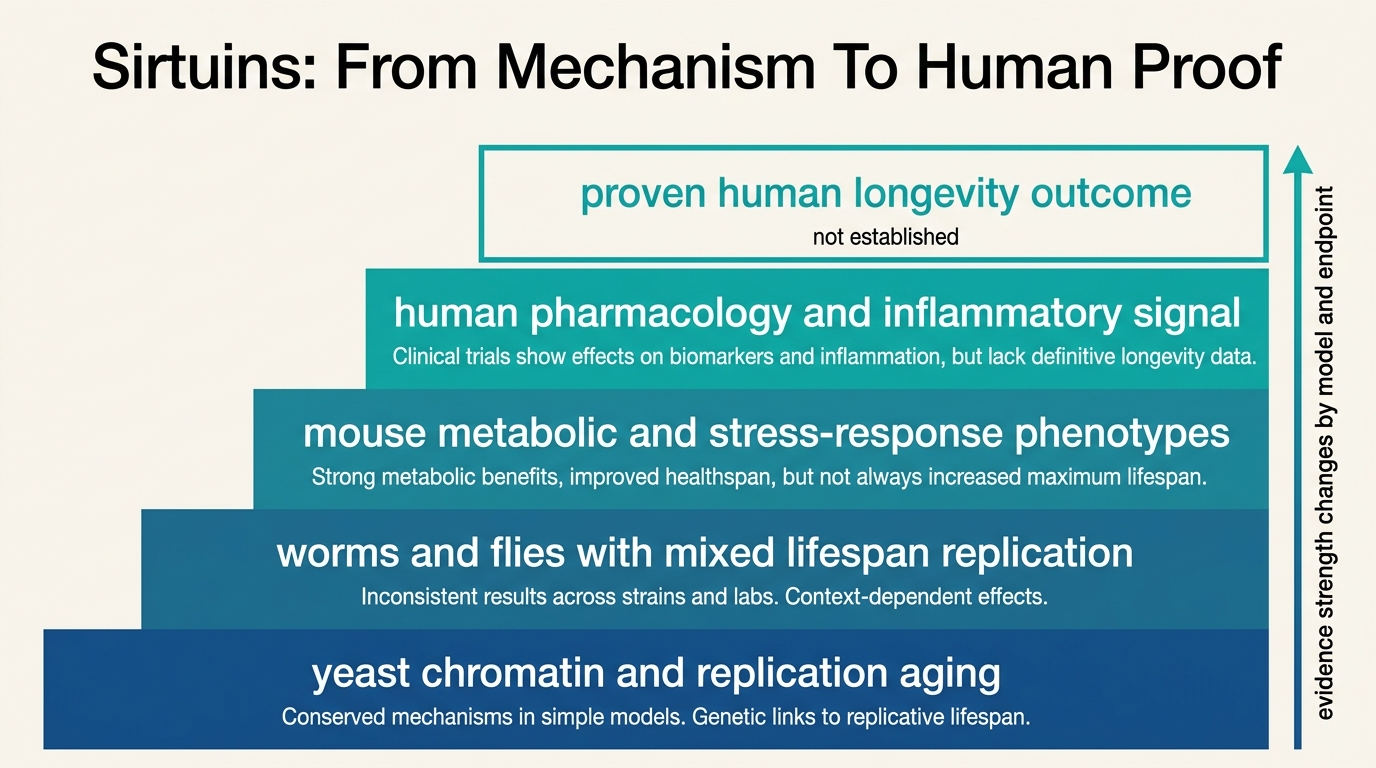
Why Sirtuins Mattered So Much In The First Place
The original excitement had a clean logic. Sir2 in yeast linked chromatin silencing and longevity-relevant behavior to NAD availability, which immediately connected energy state to gene regulation. That made sirtuins attractive as candidate mediators of calorie restriction, metabolic stress adaptation, and cellular maintenance. The concept was elegant because it offered a biochemical bridge between nutrient sensing and slower aging.
That bridge still matters. In mammals, sirtuins influence mitochondrial biogenesis, inflammatory tone, DNA-damage response, autophagy-related signaling, circadian regulation, and aspects of stem-cell or neuronal resilience. The family is not a scientific dead end. The correction is that one cannot treat seven mammalian sirtuins across multiple compartments as though they were a single longevity dial.
The Lower-Organism Evidence Was Real, But Never Clean Enough For A Straight-Line Translation
Some of the most influential early findings came from yeast and then from model organisms where increased Sir2 dosage or related manipulations appeared to affect lifespan. Those studies established that sirtuin biology was not trivial. They did not establish that every later pro-longevity claim built on a stable foundation. Replication disputes, strain effects, transgene background issues, and species-specific context made the story less uniform than the popular retelling suggested.
The relevant lesson is methodological. Conserved pathways can remain real even when early magnitude claims are revised downward. That is what happened here. Burnett and colleagues challenged strong lifespan claims in worms and flies, while the broader literature kept pointing to context-dependent roles in stress response and metabolic control. The field therefore moved from a simple headline, activate sirtuins and live longer, to a narrower frame: sirtuins are one node in a larger adaptive network whose lifespan effects depend on model, tissue, dose, and background biology.
Mammalian Relevance Looks More Like Conditional Control Than A Universal Longevity Switch
Mammalian studies strengthened the case that sirtuins are biologically consequential while also making the translation problem harder. SIRT1 overexpression in mice produced some calorie-restriction-like metabolic phenotypes, and SIRT1 appears necessary for some caloric-restriction responses. But that is not the same as showing robust lifespan extension from simply raising sirtuin activity. Necessity inside one adaptive program is different from sufficiency as a broad intervention strategy.
That distinction matters for LifeMeter readers because many longevity narratives quietly collapse mechanism, mediation, and intervention into one claim. A protein can be central to stress adaptation and still fail as a clean drug target. It may act differently by tissue, have tradeoffs across developmental stage or cancer context, require intact NAD availability, or produce benefits only under a specific metabolic state. Those complications are not noise around the thesis. They are the thesis.
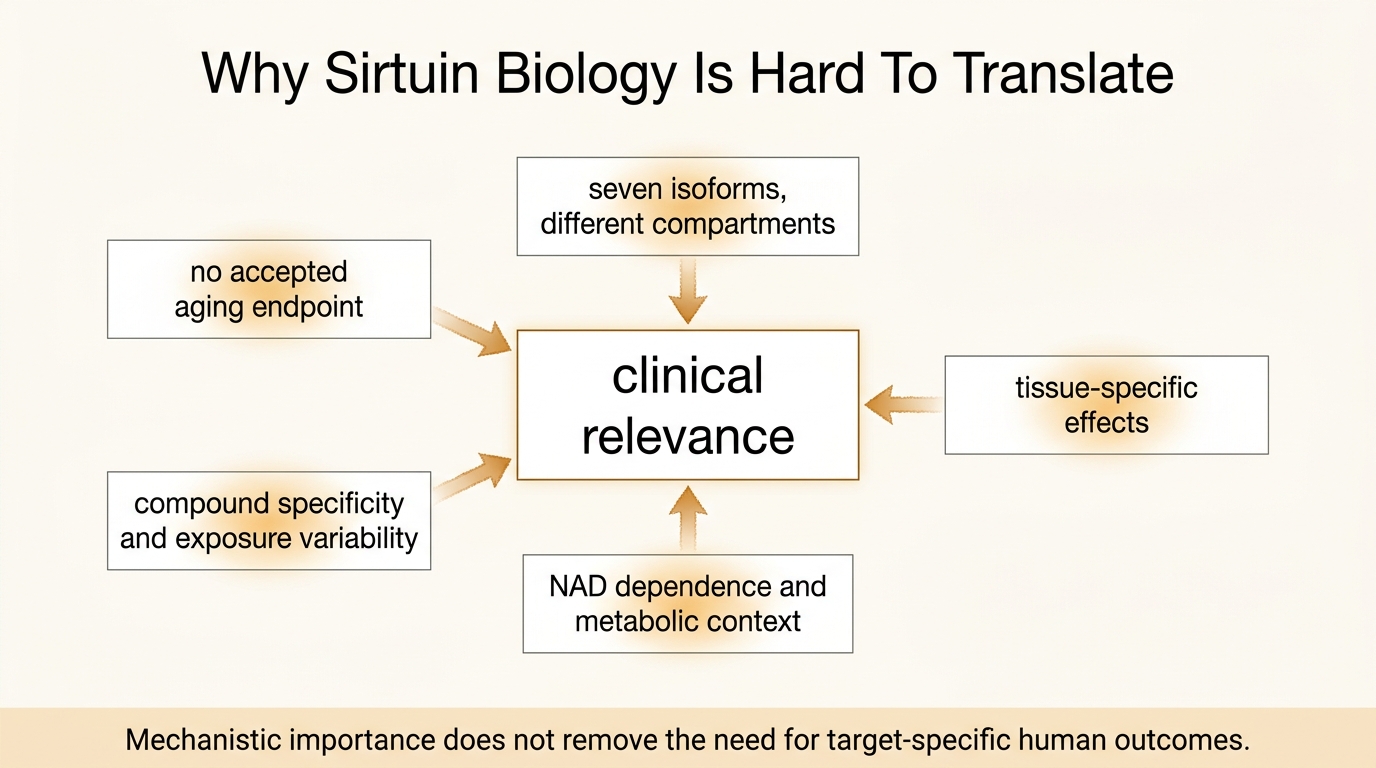
Human Studies Show Activity, But Not A Proven Longevity Outcome
Human intervention evidence remains the limiting layer. Small-molecule SIRT1 activators such as SRT2104 reached early clinical testing and showed that the target class was pharmacologically approachable. Some studies reported changes in inflammatory signaling, vascular measures, or histologic endpoints. Yet the program never produced a convincing human longevity result, and even narrower disease outcomes were inconsistent, modest, or limited by exposure variability.
This is the central translation boundary. A pathway can be real and still fail to produce a durable medicine. In sirtuin biology the barriers include compound specificity, uneven tissue penetration, uncertain target engagement, off-target interpretation, and the lack of accepted human endpoints that could translate a mechanistic shift into a credible claim about aging itself. This is why sirtuin enthusiasm now overlaps so strongly with the discussion in NAD Restoration: Mechanism, Hype, and Clinical Signal. Both topics are strongest at the mechanistic layer and weaker at the human-outcome layer.
What Can Be Said With Confidence Right Now
- Established: sirtuins are genuine NAD-dependent regulators with major roles in chromatin state, metabolism, stress response, and cellular maintenance.
- Established: the evidence across organisms is not uniform enough to support a simple claim that more sirtuin activity reliably means longer life.
- Established: human clinical work has shown pharmacologic tractability and some biologic signal, but no accepted proof of broad longevity benefit.
- Inferred: sirtuins are more likely to matter clinically as context-specific modifiers of metabolic, inflammatory, neurodegenerative, or tissue-repair processes than as a universal anti-aging switch.
- Inferred: future progress will depend less on vague activation claims and more on isoform-specific, tissue-aware, endpoint-disciplined programs.
Known, Inferred, And Unknown
| Category | Assessment |
|---|---|
| Known | Sir2 and mammalian sirtuins belong to a conserved family of NAD-dependent enzymes tied to stress response, metabolic regulation, and chromatin control. |
| Known | Early lifespan findings in lower organisms helped establish the field, but later work showed that the magnitude and generality of those effects were more contested than the simplified story implied. |
| Known | Human studies with SIRT1 activators demonstrated pharmacologic engagement but did not establish broad anti-aging efficacy or validated longevity endpoints. |
| Inferred | The most plausible clinical future for sirtuin biology lies in narrower disease or tissue contexts rather than in a single umbrella intervention for aging itself. |
| Unknown | Whether isoform-specific modulation, better biomarkers, or improved delivery can turn sirtuin biology into a reproducible human intervention class with meaningful functional outcomes. |
The Better Reading Of The Sirtuin Story
The mature interpretation is neither dismissal nor hype. Sirtuins were not a false lead. They were an instructive one. The field learned that conserved nutrient-sensing enzymes can sit near aging-relevant control points without automatically yielding a simple human therapy. That lesson generalizes well beyond sirtuins. It applies to calorie-restriction mimetics, NAD restoration strategies, and many later biomarkers or pathway claims that sound compelling before the endpoint question arrives.
That is why sirtuins still matter on LifeMeter. They sharpen the distinction between mechanism and translation. They show how a biologically serious pathway can remain clinically unresolved for years, not because the biology vanished, but because human longevity requires more than pathway plausibility. It requires a druggable intervention, defensible target engagement, and outcomes that survive outside the lab.
Further Reading Inside The Site
This article connects directly to NAD Restoration: Mechanism, Hype, and Clinical Signal, Caloric Restriction Mimetics: What Actually Works in Humans, and Metformin as a Longevity Drug: Evidence vs Assumption. Together they show why conserved metabolic biology does not remove the need for disciplined human evidence.
Source List
Kaeberlein M, McVey M, Guarente L. The SIR2/3/4 complex and SIR2 alone promote longevity in Saccharomyces cerevisiae by two different mechanisms. Genes & Development. 1999.
Imai S, Armstrong CM, Kaeberlein M, Guarente L. Transcriptional silencing and longevity protein Sir2 is an NAD-dependent histone deacetylase. Nature. 2000.
Burnett C, Valentini S, Cabreiro F, et al. Absence of effects of Sir2 overexpression on lifespan in C. elegans and Drosophila. Nature. 2011.
Bordone L, Cohen D, Robinson A, et al. SIRT1 transgenic mice show phenotypes resembling calorie restriction. Aging Cell. 2007.
Mercken EM, Mitchell SJ, Martin-Montalvo A, et al. SIRT1 but not its increased expression is essential for lifespan extension in caloric-restricted mice. Aging Cell. 2013.
Sebastián C, Satterstrom FK, Haigis MC, Mostoslavsky R. From Sirtuin Biology to Human Diseases: An Update. Journal of Biological Chemistry. 2012.
Hoffmann E, Wald J, Lavu S, et al. Pharmacokinetics and tolerability of SRT2104, a first-in-class small molecule activator of SIRT1, after single and repeated oral administration in man. British Journal of Clinical Pharmacology. 2013.
van der Meer AJ, Scicluna BP, Moerland PD, et al. The selective Sirtuin 1 activator SRT2104 reduces endotoxin-induced cytokine release and coagulation activation in humans. Critical Care Medicine. 2015.
Krueger JG, Suárez-Fariñas M, Cueto I, et al. A randomized, placebo-controlled study of SRT2104, a SIRT1 activator, in patients with moderate to severe psoriasis. PLOS ONE. 2015.