Sleep Apnea Is a Longevity Story Hiding in Plain Sight
In April 2026, the National Center for Health Statistics reported that 30.5 percent of U.S. adults slept less than seven hours in a 24-hour period. The federal sleep brief was about duration, not apnea. Current National Heart, Lung, and Blood Institute guidance supplies the missing next step: when poor sleep reflects untreated obstructive sleep apnea, the cost is not only fatigue. It is repeated physiological stress with direct relevance for lifespan.
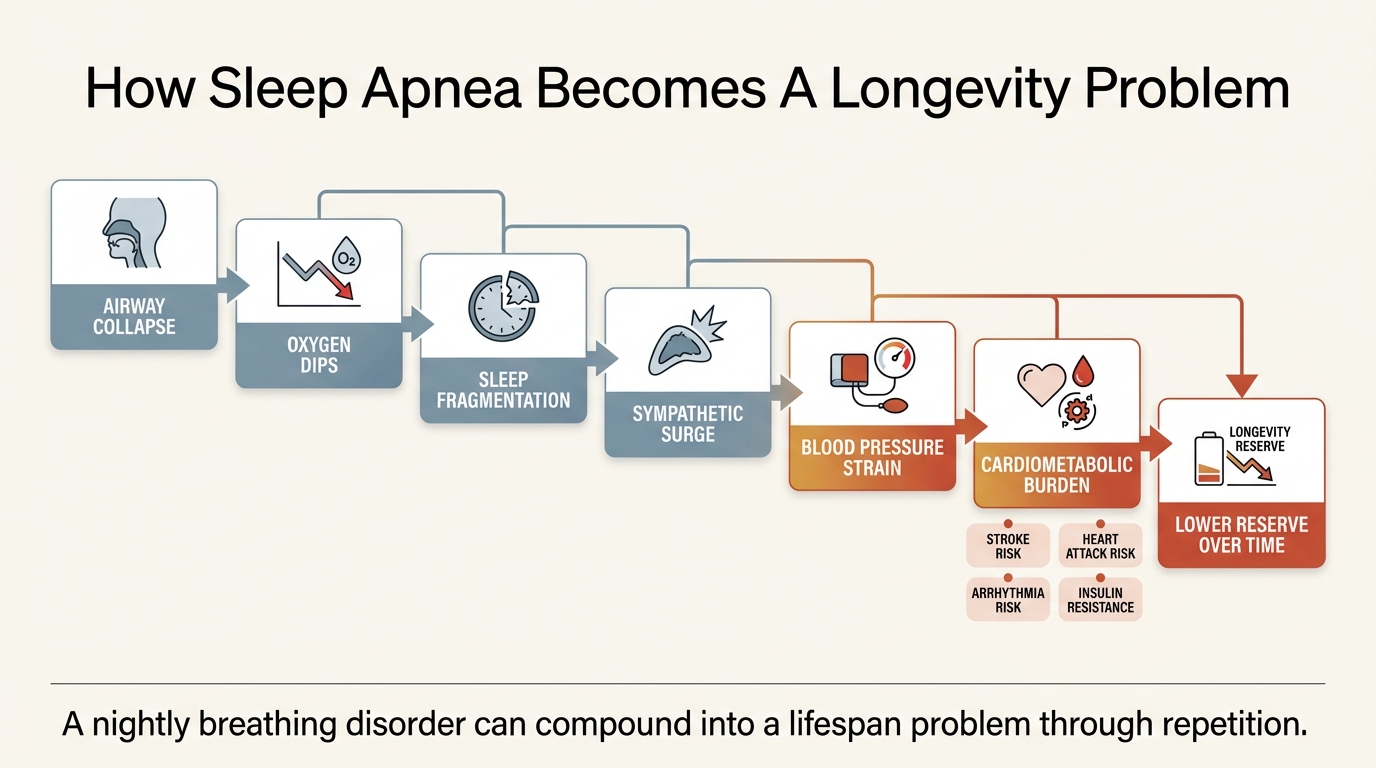
Sleep apnea is still routinely framed as a snoring problem, an energy problem, or a quality-of-life nuisance. That framing is too small. Untreated obstructive sleep apnea can raise the risk of high blood pressure, stroke, heart attack, irregular heart rhythm, insulin resistance, and other conditions that meaningfully shape how long and how well people live. The clinical damage arrives through repetition. Airway collapse interrupts sleep, oxygen drops, carbon dioxide rises, sympathetic tone increases, blood pressure spikes, and recovery quality degrades. A single night may look survivable. Years of the same pattern are a different story.
The current evidence bar matters here. The April 2026 CDC brief does not claim that 30.5 percent of adults have sleep apnea. That would be a misuse of the source. What the brief does establish is that poor sleep remains common at the population level, and NHLBI guidance establishes that untreated sleep apnea is one of the major medical reasons poor sleep should not be dismissed as benign. The inference is practical, not speculative: a large pool of adults with inadequate or poor-quality sleep means a large pool of adults who should not assume the issue is only stress, age, or bad habits.
Core claim: sleep apnea belongs in longevity planning because the established harms line up with the main pathways that compress healthspan: cardiovascular strain, metabolic dysfunction, cognitive impairment, and reduced recovery capacity.
What The April 2026 Federal Sleep Brief Actually Established
NCHS Data Brief 559 reported four relevant facts from the 2024 National Health Interview Survey. First, 30.5 percent of adults slept less than seven hours. Second, only 54.8 percent reported waking up well-rested. Third, 15.4 percent had trouble falling asleep most days or every day. Fourth, 18.1 percent had trouble staying asleep most days or every day. Those are not apnea-specific findings, but they define the size of the population-level sleep problem with a current federal source and a current date.
That matters because sleep complaints still get sorted too quickly into lifestyle categories. Someone snores, wakes unrefreshed, drifts into afternoon fatigue, or sees blood pressure worsen over time, and the default explanation becomes stress, parenting, weight gain, or a bad mattress. Those explanations can be partly true. They do not rule out a breathing disorder. Longevity planning fails when a reversible or manageable medical driver gets treated as background noise.
What NHLBI Says About Untreated Sleep Apnea
NHLBI states plainly that sleep apnea is a common condition in which breathing stops and starts during sleep, and that untreated sleep apnea can raise the risk of serious problems including stroke, heart attack, diabetes, and shortened performance during waking hours. This is the right evidence standard for a longevity argument. It does not require exaggeration. If a condition increases major cardiometabolic risks and degrades restorative sleep, it already qualifies as a lifespan and healthspan issue.
The mechanism is not mysterious. Obstructive sleep apnea repeatedly narrows or blocks the upper airway during sleep. That produces intermittent hypoxia, sleep fragmentation, and a stress-response pattern that keeps blood pressure and autonomic activation from settling where they should. Over time, the result is not only feeling tired. The result can be endothelial strain, worse glucose handling, worsened arrhythmia risk, and a lower reserve margin when the body is asked to recover from illness, injury, training, or age-related decline.
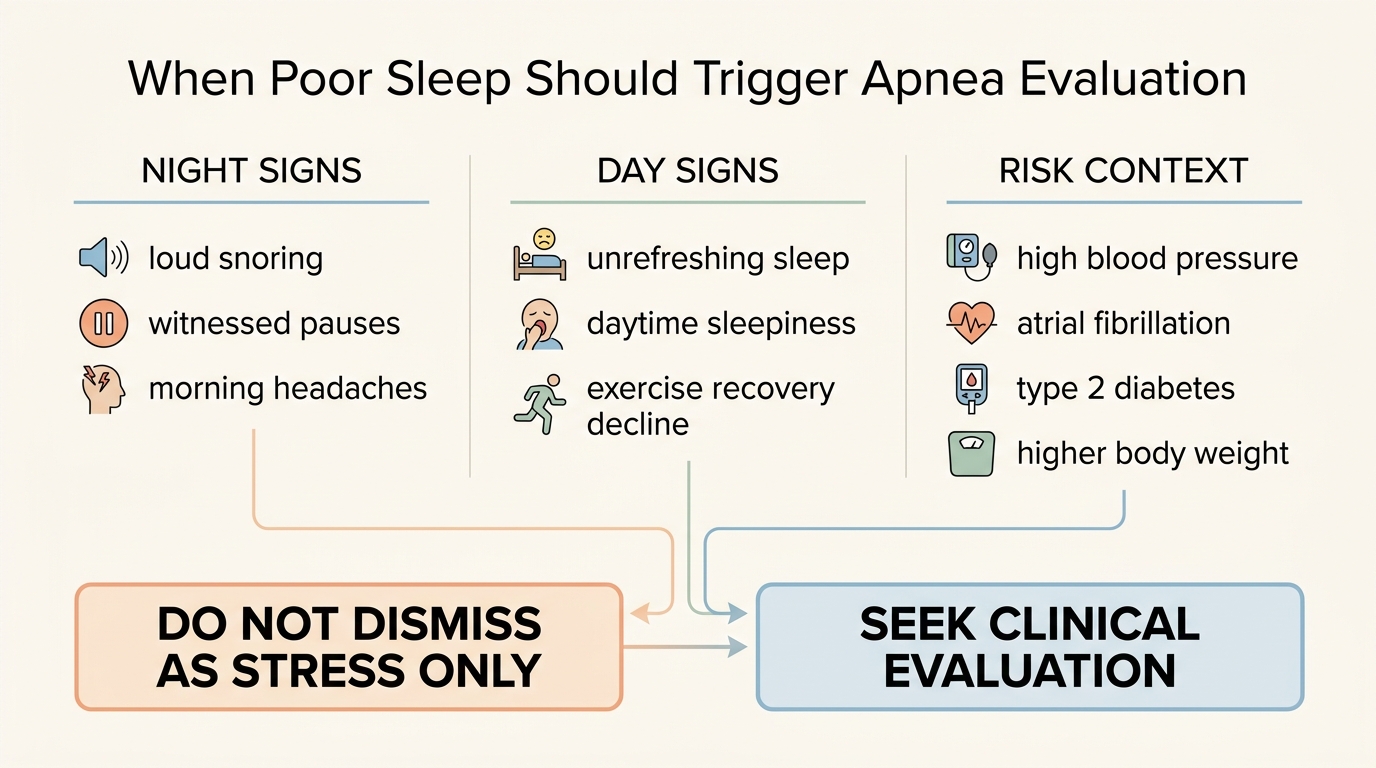
Sleep apnea also collides with the same risk clusters that already dominate midlife prevention. Higher body weight, resistant hypertension, atrial fibrillation, type 2 diabetes, and cardiovascular disease all overlap with apnea screening logic. That does not mean every person with those conditions has apnea. It means longevity work that ignores apnea may leave one of the more actionable physiologic stressors untouched while focusing on smaller levers.
You do not lose years only through rare catastrophic disease. You also lose them through repeated nightly oxygen drops and pressure surges that look ordinary until they accumulate.
Why This Is A Longevity Story, Not Only A Sleep-Medicine Story
LifeMeter is interested in survival curves, functional reserve, and the difference between headline health and real runway. Sleep apnea touches all three. A person can maintain normal work output for years while carrying chronic sleep disruption, elevated blood pressure, slower recovery, and higher downstream risk. That is exactly how midlife deterioration often hides. The system performs well enough to avoid alarm while reserve falls quietly in the background.
The disorder also creates measurement traps. Someone can optimize lipids, train regularly, buy wearables, and pursue high-end preventive care while still leaving repeated nocturnal airway obstruction unaddressed. In that case, a large amount of effort is being applied downstream of a major upstream stressor. The lesson is not that sleep apnea explains every cardiovascular or aging problem. The lesson is that a longevity stack with a blind spot for sleep-disordered breathing is incomplete.
There is also a quality-of-proof distinction worth preserving. Established fact: untreated sleep apnea is associated with and can raise the risk of serious health problems. Reasoned inference: for a meaningful subset of adults pursuing longevity, diagnosis and management of apnea will have a larger marginal payoff than adding another supplement, assay, or optimization gadget. Unknown: the exact size of that subset inside the current LifeMeter audience, because the April 2026 federal sleep brief did not estimate apnea prevalence directly.
Who Should Think Past “I Am Just Tired”
The most useful shift is from symptom labels to pattern recognition. Loud habitual snoring, witnessed pauses in breathing, morning headaches, waking unrefreshed, hard-to-control blood pressure, obesity, daytime sleepiness, atrial fibrillation, and type 2 diabetes should move the conversation toward evaluation rather than casual sleep advice. Even people without obvious sleepiness can still carry meaningful risk if the airway problem is present and chronic.
That is why apnea can stay hidden in high-functioning adults. They adapt. They use caffeine, normalize fatigue, or treat poor sleep as a productivity tax. By the time the issue becomes unmistakable, the visible problem may be hypertension, arrhythmia, weight-regain dynamics, or declining exercise tolerance rather than sleep itself. The disorder reaches the longevity ledger indirectly and then gets credited to whatever diagnosis surfaces later.
Known, Inferred, And Unknown
| Category | Assessment |
|---|---|
| Known | NCHS reported in April 2026 that 30.5 percent of U.S. adults slept less than seven hours in 2024, while 18.1 percent reported trouble staying asleep most days or every day. |
| Known | NHLBI states that untreated sleep apnea can raise the risk of serious health problems including stroke, heart attack, and diabetes. |
| Inferred | Because poor sleep is common and untreated apnea has high downstream cost, apnea screening belongs much closer to the center of practical longevity work than it currently does. |
| Inferred | For many adults with persistent unrefreshing sleep plus cardiometabolic risk factors, the next high-value step is evaluation for a breathing disorder rather than another generic sleep hack. |
| Unknown | The April 2026 federal sleep brief does not tell us what proportion of short-sleep or poor-sleep adults specifically had obstructive sleep apnea. |
What To Do With The Calculator
The LifeMeter calculator will not diagnose sleep apnea, but it does help frame the planning question correctly. If the likely driver of lower resilience is not abstract aging but a remediable nightly physiologic stressor, then a longevity plan should treat that as a first-order correction. The point is not to force certainty from a general model. The point is to place sleep-disordered breathing in the part of the stack where major, boring, high-yield interventions belong.
Use The Free Calculator As A Reality Check
Model the long-horizon side of the problem, then ask whether the biggest actionable gap is really another optimization layer or a missed sleep-breathing diagnosis.
Open LifeMeterFurther Reading Inside The Site
This article pairs naturally with America Reached 79 Years, Sarcopenia Before Frailty, and The 2026 Dyslipidemia Rewrite. Together they make the same point from different angles: the largest longevity gains often come from identifying major risk structures early, not from chasing exotic interventions late.
Source List
National Center for Health Statistics. Short Sleep Duration and Sleep Difficulties Among Adults: United States, 2024. NCHS Data Brief No. 559. Published April 2026.
National Heart, Lung, and Blood Institute. Sleep Apnea. Last updated January 9, 2025.
National Heart, Lung, and Blood Institute. Living With Sleep Apnea. Last updated January 9, 2025.
National Heart, Lung, and Blood Institute. Causes and Risk Factors for Sleep Apnea. Last updated January 9, 2025.