Sleep Fragmentation as an Aging Mechanism
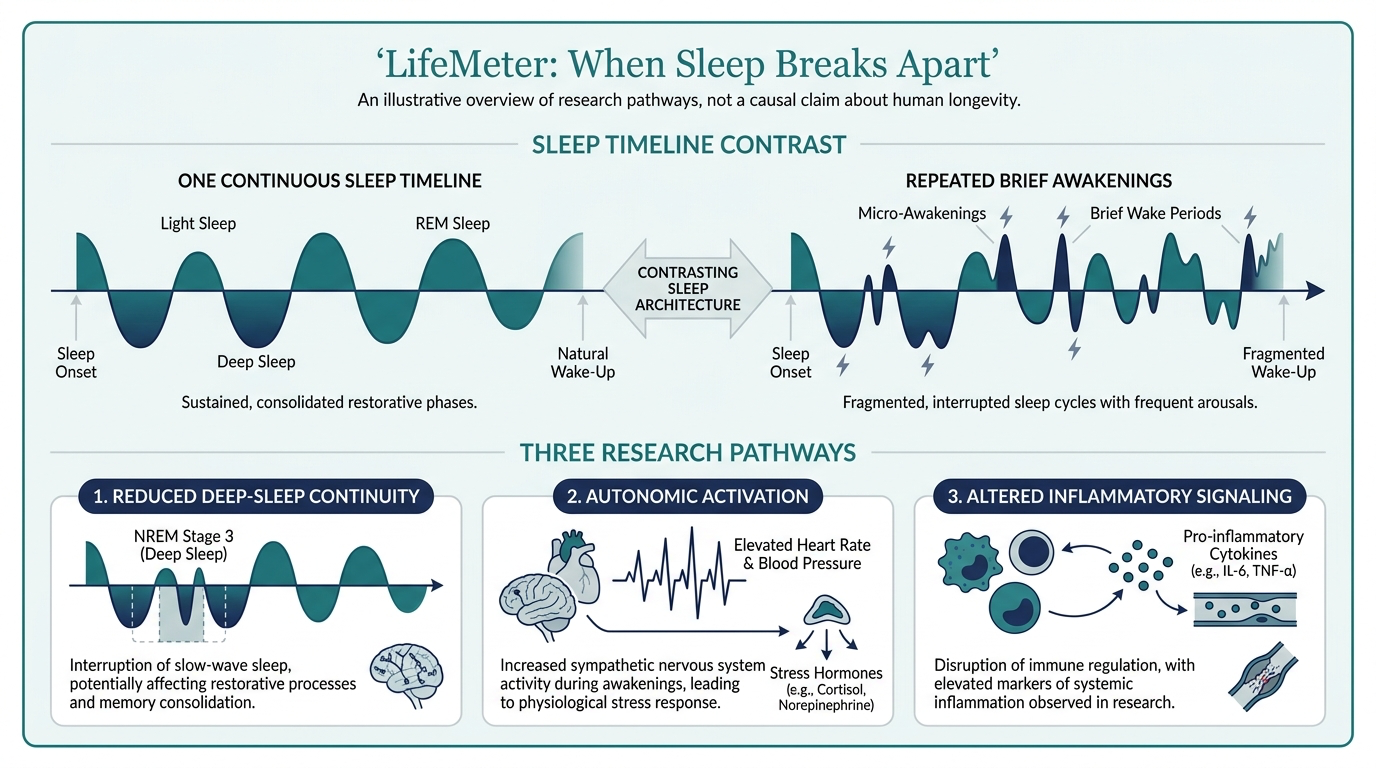
A person can spend eight hours in bed and still have a night that never settles. Repeated brief awakenings interrupt the continuity of deep and REM sleep, even when most of them are forgotten by morning. That pattern matters for aging research because sleep is a period of neural, metabolic, and cardiovascular regulation. The evidence supports a serious risk signal; it does not yet prove that repairing fragmentation slows human biological aging.
Sleep fragmentation means repeated transitions from sleep toward wakefulness or lighter sleep. It is related to, but distinct from, short sleep duration. A wearable may estimate both, but a movement-based consumer score cannot tell whether a breathing disorder, pain, a medicine, or a noisy room caused the interruptions. The practical question is not how to maximize a proprietary sleep score. It is whether disrupted sleep is persistent, functionally significant, and explainable.
What changes with age
The National Institute on Aging notes that older adults often sleep for shorter stretches, spend less time in some sleep stages, and wake more often. Age alone does not make poor sleep inevitable or harmless. Pain, nocturia, mood symptoms, medications, alcohol, caregiving, and changing schedules can all divide a night. Sleep apnea and restless legs syndrome become more common with age and need different responses from ordinary sleep-habit changes.
Duration can conceal the problem. Two people can report the same seven hours of sleep but differ in the number of awakenings, time awake after initially falling asleep, and continuity of slow-wave sleep. Actigraphy estimates rest and movement over multiple days. A laboratory sleep study measures breathing, oxygen, brain activity, and arousals with more diagnostic detail. Each instrument answers a different question, and neither a single night nor a consumer dashboard should carry a diagnosis by itself.
What the human studies actually show
In the Rush Memory and Aging Project, researchers followed 737 older adults without dementia after up to ten days of actigraphy. During an average 3.3 years of follow-up, greater sleep fragmentation was associated with faster cognitive decline and higher incident Alzheimer disease risk. The reported hazard ratio was 1.22 per standard-deviation increase after adjustment for age, sex, and education. This is an association: people with early brain changes, vascular disease, or other unmeasured conditions may both sleep poorly and develop cognitive impairment.
A later analysis of older adults in the Rush cohorts connected fragmentation with microglial gene-expression patterns and cognitive impairment. It helps identify a biologically plausible route through brain immune activity. It does not establish that the fragmented nights caused those cellular patterns, or that a sleep intervention would reverse them. Timing is especially hard to resolve because preclinical neurodegenerative disease can itself disturb sleep-wake regulation.
The National Institute on Aging has also described research in which people with preclinical Alzheimer pathology had more fragmented daily rest-activity patterns. That finding reinforces the possibility of two-way causation. Sleep may influence neural maintenance, while developing disease may undermine sleep. A claim that every awakening accelerates dementia would exceed these studies.
Why researchers call it a mechanism
Experimental work can impose fragmented sleep and test downstream biology. In one mouse study, controlled fragmentation shortened sleep bouts and reduced slow-wave and REM sleep during exposure; recovery sleep did not fully restore the lost slow-wave sleep in the next 12 to 24 hours. Some inflammatory markers changed, although the shifts were neither consistent nor sustained. Other mouse experiments have reported neuroinflammatory responses or impaired brain interstitial clearance. These results support mechanistic hypotheses under controlled conditions. Their size, time scale, and relevance to years of human aging remain uncertain.
Three pathways are worth separating. First, broken sleep may reduce the continuity of deep sleep needed for restorative processes and memory consolidation. Second, repeated arousal can activate autonomic and stress responses, especially when breathing events are involved. Third, inflammatory and brain-clearance pathways have experimental support but have not been validated as a single clinical aging lever. None of these pathways means that an individual should buy a supplement, sedative, or sleep gadget as a longevity treatment.
Sleep apnea is a particularly important confounder. It can fragment sleep through breathing events while also causing oxygen drops and cardiovascular strain. An association between awakenings and later disease cannot simply be attributed to lost sleep architecture when apnea may contribute several exposures at once. LifeMeter’s sleep apnea review examines that separate clinical pathway.
Find the cause before choosing a remedy
A short sleep diary can capture bed and wake times, awakenings, daytime sleepiness, alcohol, medicines, pain, and schedule changes over one or two weeks. It helps distinguish a new pattern from a chronically irregular one. Loud snoring, witnessed breathing pauses, gasping, morning headaches, or marked daytime sleepiness warrant discussion of sleep-apnea evaluation. The National Heart, Lung, and Blood Institute describes sleep studies as the way to identify apnea type and severity; a diary helps prepare the clinical assessment but cannot rule apnea out.
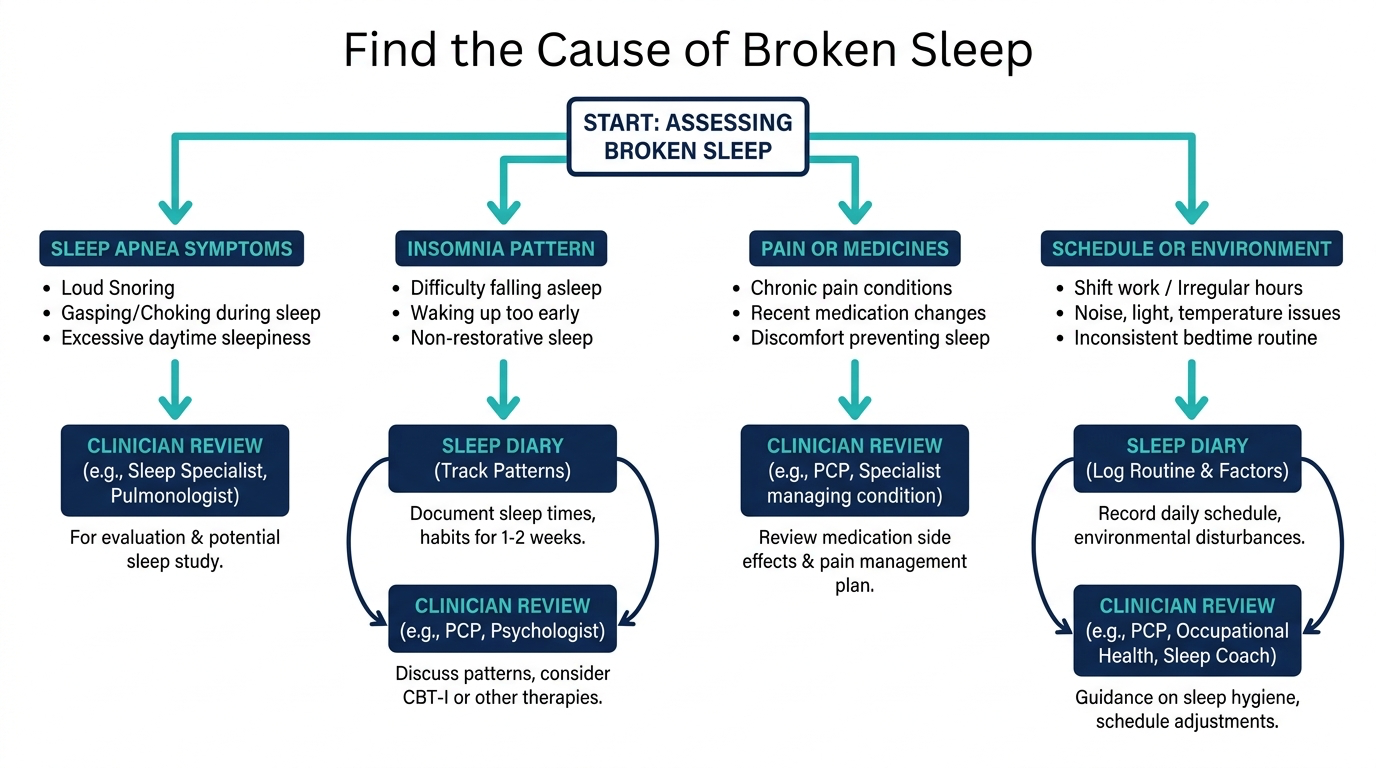
For persistent insomnia, cognitive behavioral therapy for insomnia is a first-line treatment in the American College of Physicians guideline. This is a structured therapy, not generic advice to relax or keep a dark room. Sleep restriction within CBT-I should be supervised when a person has important medical or safety constraints. If pain, mood symptoms, nocturia, restless legs, or a recent medication change appears central, address that driver with a clinician rather than treating all awakenings as the same disorder.
Regular wake times, daylight exposure, reasonable caffeine timing, and a sleep environment that limits avoidable disturbance can improve the conditions for sleep. These measures are useful but do not substitute for an apnea evaluation or formal insomnia treatment when symptoms persist. Sleeping tablets may alter symptoms and carry risks, particularly in older adults; a better night on a tracker is not proof of better long-term health.
What a useful improvement would look like
The strongest near-term outcomes are fewer disruptive awakenings, better daytime function, and treatment of a diagnosed cause. For a person with apnea, treatment effectiveness is judged by clinical follow-up and relevant sleep measures. For insomnia, symptom and function changes matter more than one device’s stage estimates. Research has not yet shown that an arbitrary reduction in fragmentation scores extends human life or reverses biological age. The title describes a credible area of aging biology, not an established longevity prescription.
Sources
National Institute on Aging, Sleep and Older Adults.
Lim and colleagues, sleep fragmentation and incident Alzheimer disease, 2013.
Kaneshwaran and colleagues, sleep fragmentation and microglial aging, 2019.
Trammell and colleagues, experimental fragmentation in mice, 2014.
American College of Physicians, chronic insomnia treatment guideline.
This article is educational and does not diagnose a sleep disorder or prescribe treatment. Persistent symptoms and safety concerns require individual clinical assessment.