Colon Cancer Screening: Choosing a Test You Will Complete
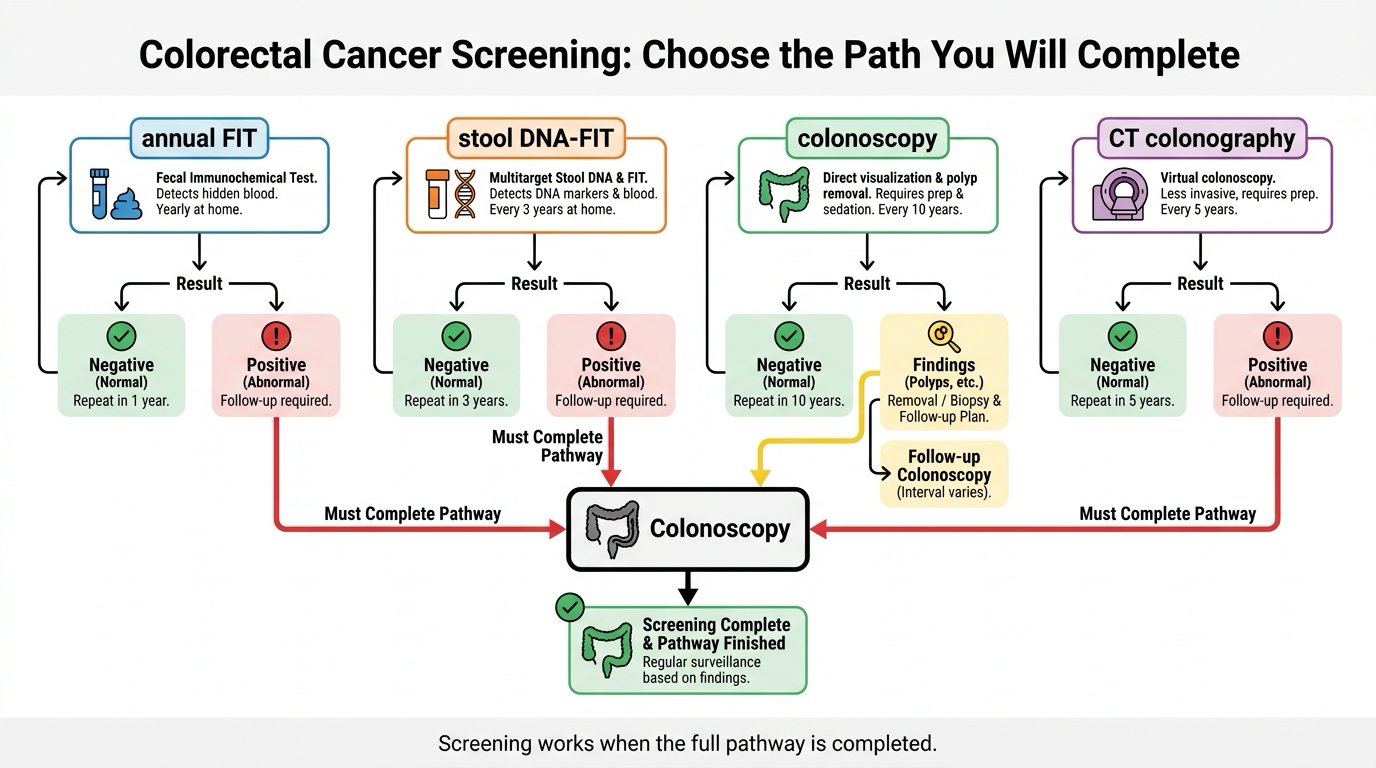
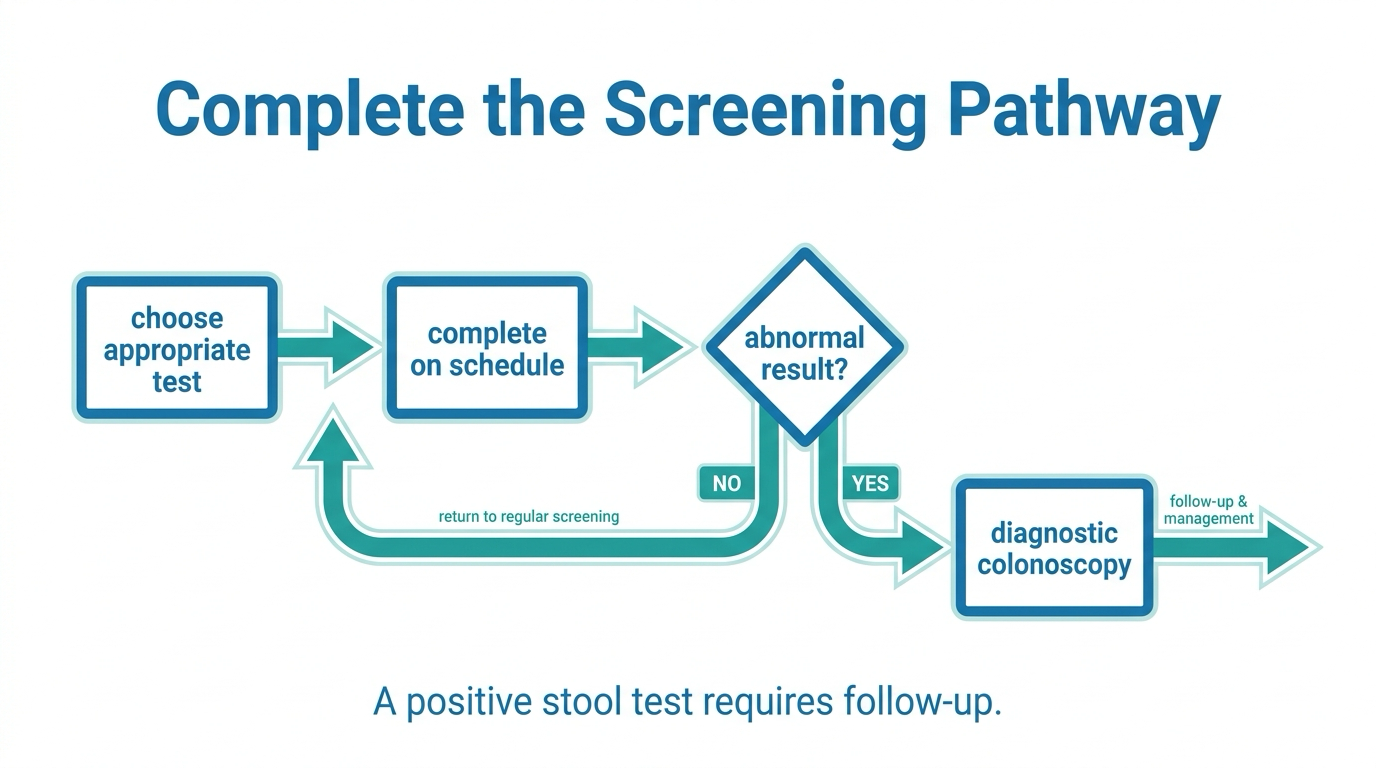
For most average-risk adults, the screening decision is not a contest to find one universally best test. It is a commitment to complete an appropriate test on schedule and to complete colonoscopy follow-up if a non-colonoscopy test is abnormal.
The U.S. Preventive Services Task Force recommends screening average-risk, asymptomatic adults from age 45 through 75. It recommends an individualized decision from 76 through 85, based on health, prior screening, and preferences. People with symptoms, prior polyps or cancer, inflammatory bowel disease, or a high-risk family history need individualized clinical advice rather than this average-risk framework.
The main tradeoff is the pathway
FIT is a stool test done at home every year. Stool DNA-FIT is done every one to three years. Colonoscopy usually has a ten-year interval after a negative screening result, but requires bowel preparation, a clinical appointment, and usually sedation and transportation. CT colonography and flexible sigmoidoscopy offer other intervals and logistics; an abnormal result still leads to colonoscopy.
Match the test to the constraint
| Practical constraint | Question to resolve |
|---|---|
| Home collection | Can you complete and return a stool test every year or at its recommended interval? |
| Procedure logistics | Can you arrange bowel preparation, time away, and a ride home if sedation is used? |
| Follow-up | If a non-colonoscopy test is abnormal, can you promptly complete colonoscopy? |
| Prior screening | Does your prior result or risk history change the standard interval or test choice? |
There is no credible shortcut in which a stool test replaces follow-up after an abnormal result. The Task Force also does not include blood, urine, or capsule tests in its recommended strategies because evidence is limited relative to established options.
Make the appointment useful
Ask which options fit your risk category, whether your prior screening changes the interval, what costs and preparation apply, and who will coordinate follow-up if a test is abnormal. The clinically appropriate option is personal; this article cannot determine it for an individual.
Sources
This article is educational and does not provide medical advice, diagnosis, or an individual screening recommendation.