Hearing Loss, Cognitive Load, and the Hidden Longevity Penalty
The first sign of hearing loss is often a conversation that requires work. A person can still hear a voice but spend increasing effort separating speech from restaurant noise, reconstructing missed words, and keeping up with the next sentence. That daily cost matters before a hearing test produces a severe label. Research connects hearing loss with cognitive decline; it has not proved that restoring sound extends life or prevents dementia in everyone.
The National Institute on Deafness and Other Communication Disorders reports that about one in three U.S. adults aged 65 to 74 has hearing loss, with difficulty more common after 75. Its practical consequences extend beyond entertainment: understanding clinical instructions, hearing warnings, and sustaining conversations become harder. Hearing is therefore part of functional reserve, even if the word “longevity” never appears on an audiogram.
Why a noisy room takes more work
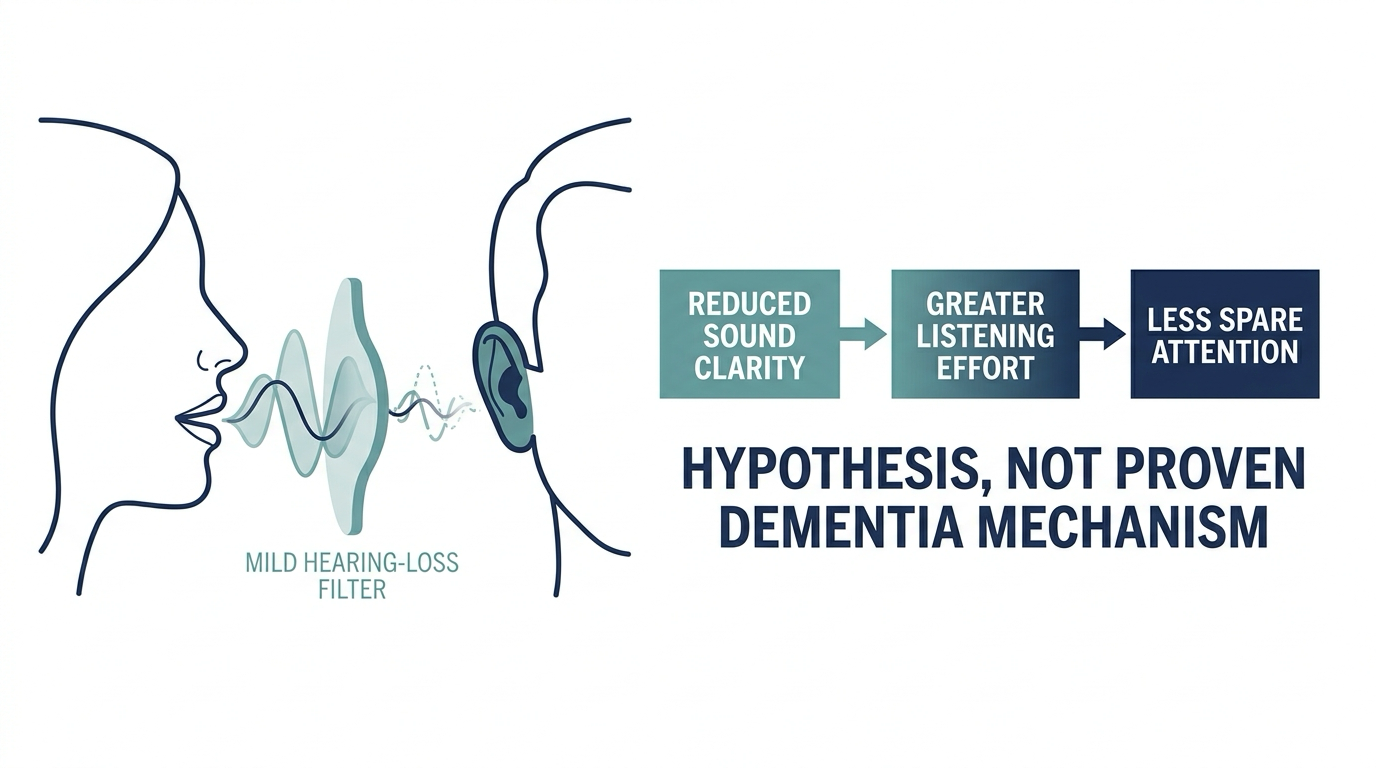
Age-related hearing loss commonly develops gradually in both ears. Speech in noise can become difficult while quiet one-to-one conversation still seems normal. The listener may devote more attention to decoding sound and have less available to remember content, respond, or follow a second speaker. This is the cognitive-load hypothesis. It describes a plausible allocation of mental effort, not a measured depletion of a finite brain battery.
Other paths could connect hearing and cognition. Reduced auditory input may change neural processing over time; difficult conversation may reduce social participation; vascular or other age-related disease may affect both the ear and the brain. Early cognitive changes can also alter auditory processing, and poor hearing can distort performance on spoken cognitive tests. These competing explanations matter because an association alone cannot determine which direction caused it.
What the intervention trial found
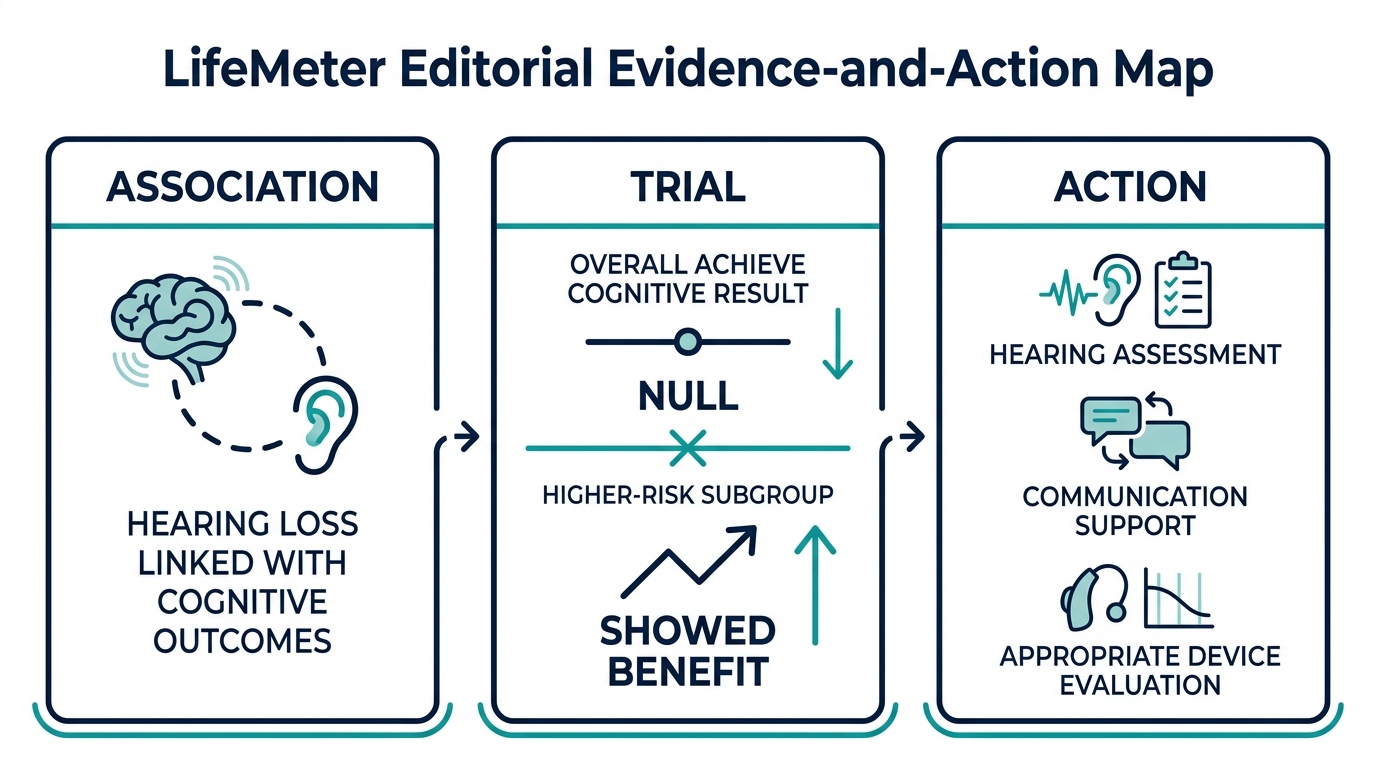
The NIH-funded ACHIEVE trial randomized 977 adults aged 70 to 84 with untreated hearing loss to a hearing intervention or a health-education control. The intervention included audiological counseling and hearing aids, with follow-up over three years. In its prespecified primary analysis of all participants, cognitive change did not differ significantly between groups. That overall result must remain at the center of any claim that hearing treatment prevents cognitive decline.
The trial enrolled two different populations: participants from a long-running cardiovascular cohort who had greater baseline dementia risk, and newly recruited community volunteers who were generally healthier. In the higher-risk cohort, the hearing-intervention group had nearly 50% less cognitive decline than controls over three years. This subgroup result is meaningful but does not convert the overall null result into a universal effect. The populations differed before treatment, and the trial measured cognitive trajectories, not dementia prevention or lifespan.
Participants receiving the intervention also reported better communication. That is a direct outcome with immediate practical value. A hearing aid can help a person follow a meeting or speak with family even if future studies find a smaller or less general cognitive effect than the high-risk subgroup suggested. The right endpoint for a device decision is not a speculative number of extra years; it includes whether daily hearing and participation improve.
The longevity claim has several missing links
There is a difference between preserving communication, changing a cognitive test score, preventing dementia, and extending life. Evidence for the first is stronger than evidence for the last. Observational cohorts associate hearing loss with later dementia, but shared disease, social conditions, education, and reverse causation complicate the estimate. The ACHIEVE trial supports a possible cognitive effect in people at higher risk while leaving an overall effect unconfirmed at three years. It does not establish a mortality benefit.
The practical “hidden penalty” is therefore broader and more certain than a claim about biological aging. Repeatedly missing medical instructions, withdrawing from conversation, and expending attention to hear ordinary speech can erode independence and participation. Those are meaningful health and function outcomes in their own right. They also make hearing a reasonable target for assessment before a person has to prove a dementia diagnosis or a dramatic audiometric threshold.
Make the next step fit the problem
Notice specific failures rather than a vague sense that people mumble: repeated requests for repetition, difficulty in restaurants, raising television volume, avoiding group conversation, or missing alarms. An audiologist can measure the pattern and degree of loss and help distinguish hearing sensitivity from speech-understanding problems. A primary-care clinician or ear, nose, and throat specialist can assess medical causes when symptoms call for it. Sudden or one-sided loss and associated concerning symptoms should not be treated as ordinary gradual aging.
For adults who perceive mild to moderate loss, FDA-regulated over-the-counter hearing aids provide a route that does not require a prescription. They are not designed for severe or profound loss, and an unsuccessful device trial can reflect poor fit, a different kind of hearing problem, or an underlying condition. Professional fitting, assistive listening devices, captions, quieter seating, and communication changes may all have roles. The measure of success is whether the person can understand and participate in the situations that matter, followed by adjustment when the first setup fails.
A hearing assessment belongs alongside other functional checks because it identifies a treatable constraint on everyday life. It does not require a promise of dementia prevention. If future trials show that treatment reliably changes dementia or survival outcomes, the longevity claim can become stronger. Today, the evidence supports a precise course: detect the hearing problem, address it with suitable care, and judge the result by hearing, communication, and function.
Sources
NIDCD, Age-Related Hearing Loss.
Lin and colleagues, ACHIEVE randomized trial, The Lancet, 2023.
This article is educational and does not diagnose hearing or cognitive conditions. The causal pathways and long-term outcomes remain under study.