Amino Acid Restriction: Methionine, Leucine, and Lifespan
People often talk about protein as if it were one variable. Aging biology does not. Methionine, leucine, and the branched-chain amino acids sit inside different sensing circuits, different growth programs, and different tradeoffs. That is why amino acid restriction keeps generating real lifespan signal in model organisms while still failing to produce a clean human anti-aging protocol.
The strongest preclinical case is not that all lower-protein diets slow aging. It is that specific amino acid composition can reshape nutrient sensing, redox handling, stress response, and growth signaling in ways that affect lifespan. Methionine restriction has shown the most reproducible animal signal. Leucine is more complicated. Lower leucine input can reduce mTORC1 signaling, but leucine is also one of the main triggers for muscle protein synthesis. The practical question is not whether these amino acids matter. It is which tradeoff dominates in which organism, at which age, and under which dietary context.
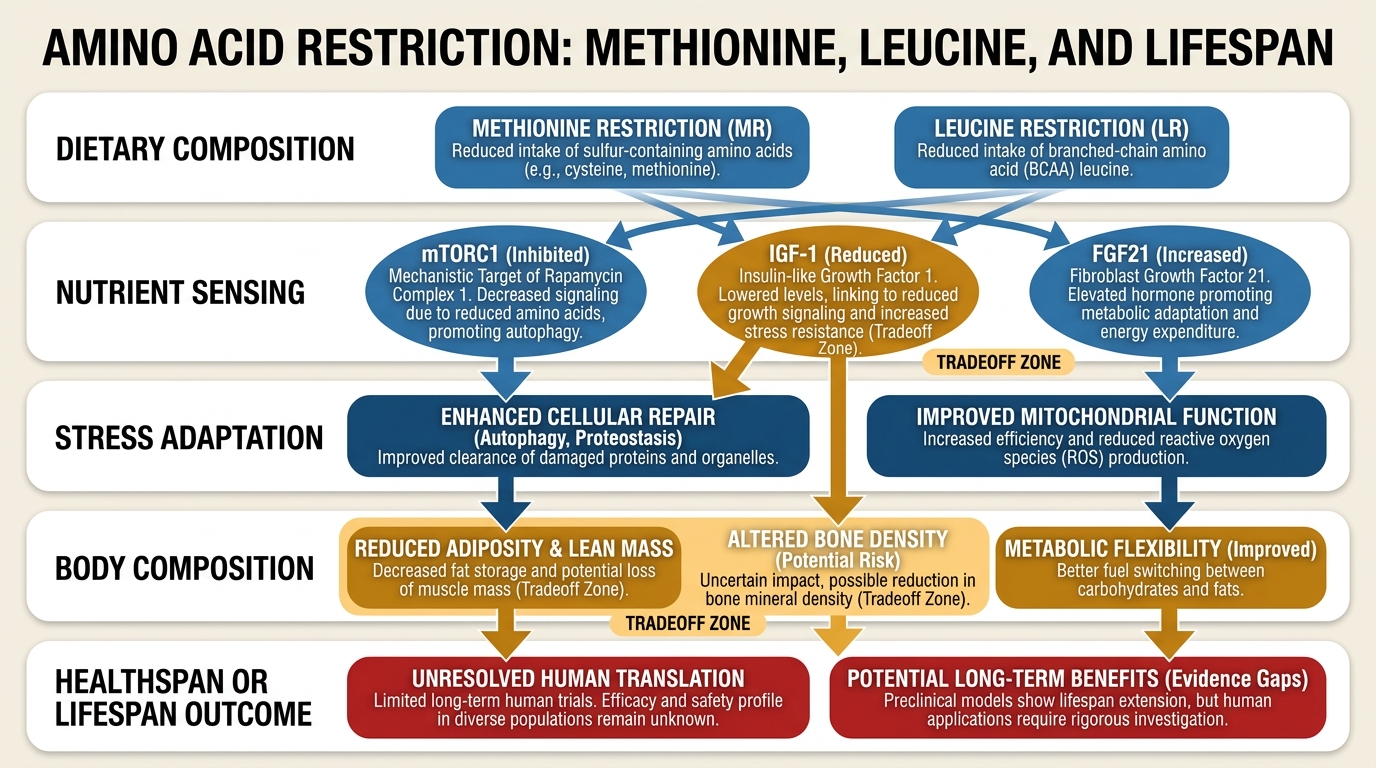
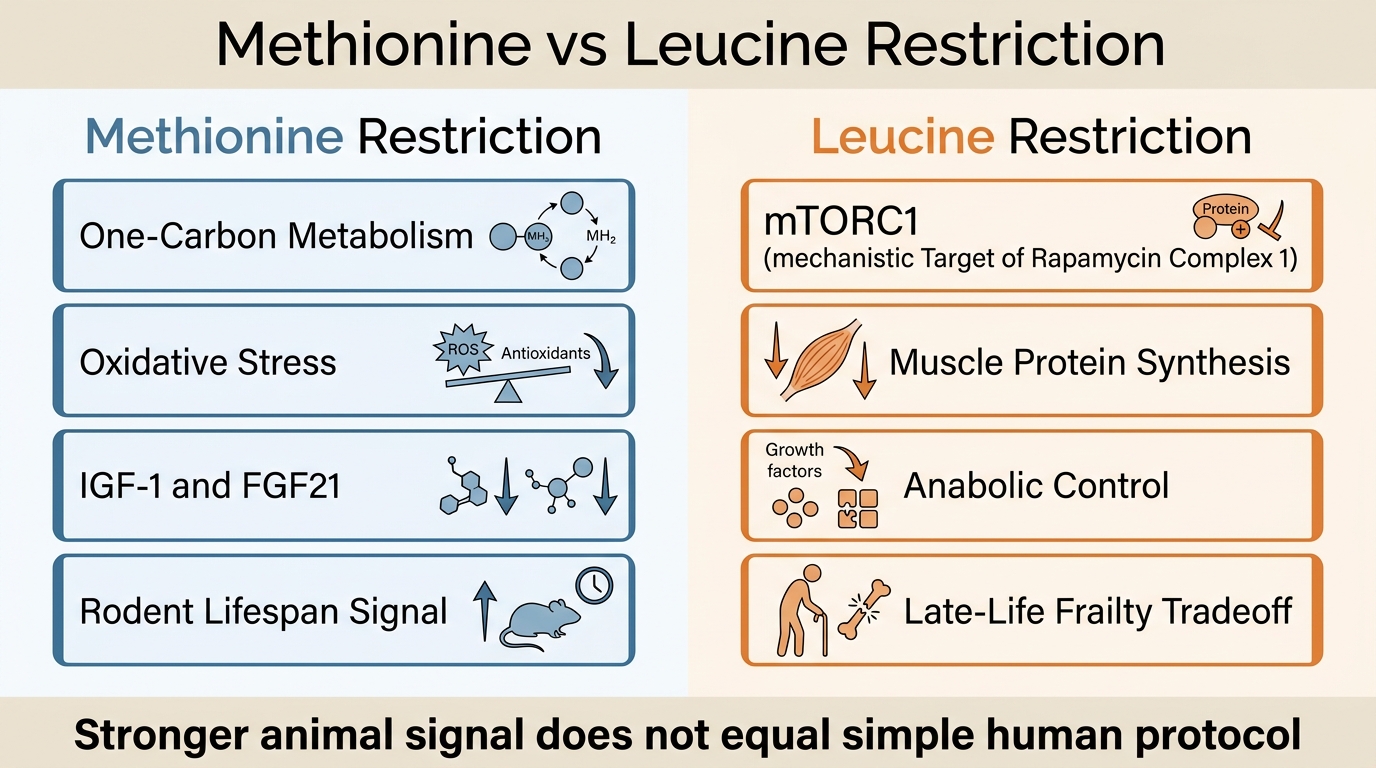
Core thesis: methionine and leucine restriction should not be treated as one intervention class. Methionine restriction has a meaningful animal-lifespan literature and plausible mechanistic links to lower IGF-1 signaling, higher FGF21, altered one-carbon metabolism, and lower oxidative stress. Leucine restriction is better understood as a growth-signaling and anabolic-control question with mixed longevity implications because the same pathway that may reduce overgrowth pressure can also undermine muscle maintenance, especially in later life.
Why Amino Acid Identity Matters More Than The Word Protein
Amino acids are not interchangeable fuel pellets. Methionine participates in methylation biology, sulfur amino acid metabolism, redox balance, and translational start control. Leucine acts as a prominent nutrient sufficiency signal for mTORC1 and skeletal-muscle anabolism. Glycine, serine, and cysteine sit in related but distinct networks. Once that is clear, the phrase protein restriction becomes too coarse to guide serious longevity reasoning.
This is why some of the most informative animal studies do not merely lower total calories or even total protein. They manipulate composition. A diet can be isocaloric and still change lifespan if the amino acid profile shifts nutrient-sensing architecture enough. That finding matters because it moves the field beyond a single calorie-first frame and toward a more explicit signaling model of aging.
The same logic also explains why translation is difficult. A composition that lowers proliferative pressure or improves metabolic flexibility in mice may impose a different cost in humans whose priorities include muscle retention, immune competence, fracture resistance, and long late-life survival.
What Methionine Restriction Seems To Establish In Animals
Methionine restriction has one of the cleaner historical signals in the dietary-aging literature. Across rodent models, lower methionine intake has been associated with lower adiposity despite preserved or even increased food intake, lower circulating IGF-1, higher FGF21, improved insulin sensitivity in some settings, and lifespan extension. The exact magnitude varies by strain, background diet, sex, and study design, but the direction of signal has been strong enough to keep the intervention relevant for decades.
The mechanistic appeal is not mysterious. Methionine availability touches growth signaling, oxidative defense, mitochondrial function, autophagy-related stress response, and methyl-donor economy. Lower methionine input appears to force a metabolic state that looks less growth-committed and more maintenance-oriented. That is conceptually adjacent to themes already discussed in caloric restriction mimetics and metformin, but it is not the same intervention logic.
What should be considered established is narrower than popular summaries suggest. Established: methionine restriction can extend lifespan in rodents and remodel several metabolic markers. Not established: that methionine restriction is the dominant causal lever, that the same magnitude of benefit survives normal human dietary behavior, or that a low-methionine pattern can be sustained without collateral cost across decades.
Why Leucine Is A Different Problem
Leucine sits at the center of a different argument. It is one of the most studied amino acid triggers for mTORC1 activity, and mTOR regulation is obviously relevant to aging. Yet leucine is also a major signal for muscle protein synthesis, which means restriction can collide directly with one of the most important late-life goals: preserving lean mass, strength, and functional resilience.
That tradeoff is the reason simplistic anti-leucine narratives fail. In a young fast-growing organism with excess nutrient abundance, lower leucine signaling may look protective because it reduces chronic growth push. In a middle-aged or older human fighting sarcopenia, frailty, or recovery deficits, the same move may degrade function faster than it helps systemic aging biology. The practical question becomes age-stratified and tissue-stratified, not ideological.
This is where the article belongs beside ketones and longevity and stem-cell exhaustion. Aging interventions cannot be graded only on whether they slow one pathway. They have to be graded on whether they preserve the tissues that determine real-world healthspan.
Human Translation Is Mostly About Markers, Not Lifespan Proof
Human evidence is much thinner than the animal literature. Short feeding studies and carefully controlled dietary interventions can move amino acid profiles, hepatic fat, insulin sensitivity, and some growth-related hormones. Plant-forward diets often lower methionine burden relative to animal-heavy diets, which creates another route for observational signal. But none of that constitutes proof that amino acid restriction extends human lifespan.
There are at least three reasons for caution. First, human adherence is noisy and dietary substitution effects are large. Lowering methionine usually changes food pattern, caloric density, fiber, micronutrients, and total protein source all at once. Second, the relevant endpoints take too long. Lifespan or even durable healthspan trials are not realistically available yet. Third, the intervention may not be uniformly beneficial across age bands. A thirty-five-year-old with excess energy intake and a sixty-eight-year-old trying to hold onto leg strength are not the same case.
That means most human claims remain inferential. Lower IGF-1 or altered sulfur-amino-acid flux can be directionally interesting without justifying a general recommendation.
Where The Main Tradeoffs Sit
| Question | What looks established | What remains unresolved |
|---|---|---|
| Methionine restriction in rodents | Lifespan and metabolic effects are real enough to count as a durable preclinical signal | How much of the benefit depends on species-specific metabolism, baseline diet, or growth pattern |
| Leucine reduction and mTOR control | Leucine is an important anabolic and nutrient-sensing signal | Whether chronic restriction improves whole-organism aging more than it harms muscle and function |
| Human dietary translation | Short-term markers can move with protein-source and amino-acid-profile changes | Long-run healthspan effect, adherence quality, and age-specific safety |
| Practical longevity prescription | Total diet pattern matters more than one supplement slogan | Which human phenotype should actually pursue targeted amino acid lowering, and for how long |
Why The Muscle Problem Cannot Be Treated As A Footnote
Aging is not only about suppressing pathways associated with growth. It is also about preserving function under declining reserve. That is why late-life protein and amino acid strategy is not solved by importing early-life or rodent logic wholesale. A person who loses muscle, balance, and recovery capacity may worsen real longevity prospects even if some growth-related biomarkers improve.
This is the central tension around leucine. One can make a mechanistic case for reducing mTOR stimulation in some contexts. One can make an equally serious functional case for protecting muscle protein synthesis, especially under training, illness recovery, or older age. Serious translation therefore has to ask not only whether a pathway is lower, but whether the person stays stronger, more independent, and more resilient.
That same discipline applies to methionine. A low-methionine pattern that is sustainable inside a balanced whole-food diet may differ sharply from a poorly planned low-protein intake that simply erodes tissue quality.
What A Reasonable Inference Looks Like
The reasonable inference is that amino acid composition deserves a permanent place in longevity research. The stronger claim, that most adults should actively restrict methionine or leucine in pursuit of longer life, is not yet earned. Methionine restriction looks like a serious biological signal. Leucine restriction looks like a context-dependent signaling tool with an unusually obvious downside if applied crudely. Human use should therefore remain conditional, phenotype-aware, and more conservative than the rodent headlines imply.
That reading also fits the broader pattern across longevity science. Many interventions show cleaner effect when measured against one pathway than when measured against the whole organism. Multi-omics integration may help separate which tissues are benefiting and which are being taxed. The final verdict still depends on function, not only on biomarker movement.
Practical Read For Readers
- Do not treat plant-forward or lower-methionine eating as identical to proven lifespan extension.
- Do not treat leucine as a simple villain when muscle maintenance is itself a longevity variable.
- Ask whether the dietary change is improving metabolic flexibility without degrading strength, recovery, or total protein adequacy.
- Expect age, training status, frailty risk, and disease context to change the answer.
- Prefer whole-pattern analysis over isolated supplement logic or social-media fasting folklore.
Bottom Line
Amino acid restriction is a credible research lane because methionine and leucine sit inside real longevity-relevant circuitry. It is not a solved consumer protocol. Methionine restriction has the cleaner animal lifespan case. Leucine restriction has the sharper functional tradeoff because the same amino acid that helps drive growth signaling also helps preserve muscle. For now, the intellectually honest position is strong mechanistic interest, real preclinical signal, and restrained human certainty.
Primary Source Anchors
Orentreich, N. et al. Low methionine ingestion by rats extends life span. Journal of Nutrition (1993).
Foundational rodent methionine-restriction literature on IGF-1, FGF21, insulin sensitivity, and lifespan extension across later follow-on mouse studies.
Solon-Biet, S. M. et al. protein-composition and longevity studies in mice linking amino acid balance to metabolic and lifespan outcomes.
Leucine, mTORC1, and skeletal-muscle anabolism literature in exercise physiology and geroscience, including work on anabolic signaling tradeoffs in older adults.
Supporting context from existing LifeMeter analyses on caloric restriction mimetics, ketones, and metformin.